
Can I place a dishwasher next to an oven?
 When planning the space in a small kitchen, homeowners strive to make every centimeter useful. This can be incredibly challenging, but many succeed. In their rush to squeeze as many useful appliances into a small kitchen, people forget that some appliances don't fit comfortably next to each other. This is precisely why we're asking the question we want to answer today: can a dishwasher be placed next to an oven, and how might this affect the two appliances? Let's find out.
What does the manufacturer say?
What does the dishwasher manufacturer tell us? Can dishwashers be placed close to ovens? There are a number of installation guidelines for dishwashers, and failure to follow these guidelines may void the warranty.
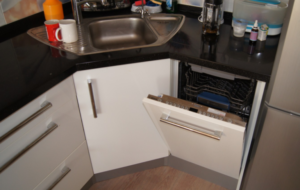
- It is not acceptable to place the dishwasher under the sink or close to the sink.
- Do not place the dishwasher under a hob.
This refers to any hob, even one with an insulating base underneath.
- The dishwasher cannot be installed in the outer drawer of a furniture set.
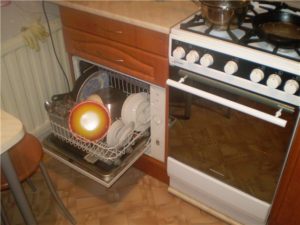
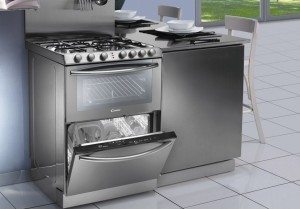
- It is not permissible to place the dishwasher in close proximity to the oven.
The last rule answers our question very clearly. It means that the oven should not be placed above, below, or adjacent to the dishwasher. The required technological gap that will separate these household appliances must be at least 40 cm. Not all manufacturers specify that the distance between the dishwasher and oven should be exactly 40 cm, but the pedantic Germans, for example, specified exactly this distance. So if you were careless enough to installBosch dishwasher If you're near the stove, say goodbye to your warranty. Service center technicians won't let you off the hook.
Conditions for the proximity of household appliances
Rules are rules, and you can't break them. But it's important to remember that these rules can only be followed if you have a room of reasonable size. If your kitchen is the size of a "Papa Carlo's closet," you can forget about following these rules, as those 40 cm are simply not available. What to do? There are two options: follow the rules and forgo the dishwasher, or break them and install both the oven and the dishwasher.
Taking this risk could potentially result in a loss of warranty. A heated oven will exert prolonged heat on the dishwasher's body, causing the electronics to overheat and drying out the rubber seals, which will eventually crack and fail. Statistically, the risk of dishwasher failure increases by 1.5 times in this situation. However, taking a few precautions can minimize these risks.
- If it's possible to leave at least half a centimeter of space between the oven and dishwasher, do so. Slide a small piece of foil-covered polyethylene foam into the gap, and you'll reliably insulate the two appliances.
- If you have to place a stove and dishwasher close together in a single cabinet, do not turn on both appliances at the same time. A hot oven can short-circuit the dishwasher's electronic circuits if it's running.
- If you still have the option of choosing a dishwasher or oven, choose a well-insulated model. The main goal is to reduce the heat buildup on the walls of both appliances when placed side by side.
It would be better to plan the approximate placement of household appliances in the kitchen before purchasing such appliances.
How come this technology hasn't been installed yet?
The number of dishwasher placement options will directly depend on the kitchen size and the amount of appliances that need to be crammed in. It's common these days to place the dishwasher next to the washing machine, justifying this by citing the ease of connecting two similar appliances. The idea is that the washing machine, like the dishwasher, needs to be connected to the water supply and sewer system. In reality, this is a huge mistake.
These two appliances, placed close together, have a detrimental effect on each other. During the spin cycle, the washing machine vibrates heavily, swaying from side to side and hitting objects to the right and left. It's not hard to guess that the vibration is transmitted to the adjacent dishwasher, gradually damaging it from the inside. If you run the dishwasher and washing machine simultaneously, the vibration from the washing machine will damage the dishes in the baskets in the wash chamber. If the dishes are fragile, this will be the end of them.
It is relatively safe to place a refrigerator next to a dishwasher, even if the refrigerator has a self-defrost function. Its walls don't get very hot, so they can't harm the dishwasher. A microwave oven is a different matter. Any appliance containing electrical components, let alone electronics, should be kept away from it. Ideally, a microwave should be kept at least half a meter away from any other appliance, but this isn't always possible.
To summarize, it's not advisable to place a dishwasher under, above, or next to an oven. Do so at your own risk, unless there are no other options. However, be sure to consider the recommendations we've outlined in this publication. Also, before purchasing and installing a dishwasher or oven, determine the approximate layout and sound insulation for both. Failure to do so will only lead to further problems. Good luck!
Interesting:


1 reader comment
Add a comment
Headings
Washing machine repair




For buyers




For users


Dishwasher




What does the "close to the sink" rule mean?