
White deposits on dishes and in the dishwasher
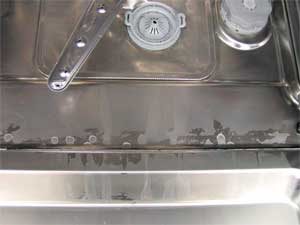 A dishwasher should clean dishes flawlessly, after all, we spend a lot of money on various tablets, salts, rinse aids, and powders. But often, the result isn't what we expected. Plates and pots are covered in a white film and streaks, and even the walls of the dishwasher are covered in this film. Let's take a look at the causes of this unpleasant phenomenon.
Reason one: water hardness
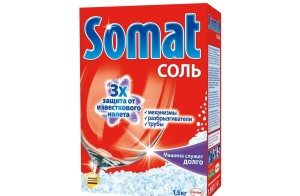
The main reason why white deposits appear on the dishwasher walls or the dishes themselves is hard water. Hard water contains high levels of calcium, iron, and other impurities, causing the white deposits to appear as they dry. For this purpose, dishwashers are equipped with an ion exchanger with a resin-filled reservoir. The ion exchanger is responsible for softening the water, but to restore its ability to do so, it is necessary to regularly add special salt to the tank.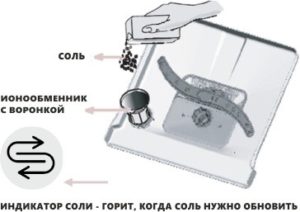
If you don't add salt, you might not notice anything after a few cycles, thinking the machine washes just fine without it. But it's not that simple! The ion exchanger will soften the water well for a while, but then it will deteriorate, and if you don't use salt for a long time, it will break down completely.
Salt isn't everything. You need to adjust the amount of salt in your dishwasher, which depends on the water hardness in your region. Water hardness adjustments are detailed in the instructions for each dishwasher, so be sure to read them before using it.
Please note! Some expensive dishwashers have an automatic water hardness sensor; the machine will automatically detect the water hardness and select the appropriate program.
Reason two: the quality and dosage of detergents
A very common cause of white residue on dishes after washing is improperly dosed detergent, especially in areas with soft water. White residue on dishes can be caused by:
- poorly washed off powder;
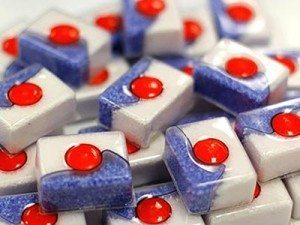
- poorly dissolved tablet;
- insufficient amount of rinse aid or no rinse aid at all.
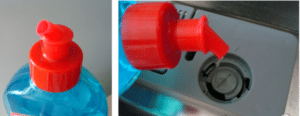 Dishwasher powder does not rinse well if you add too much of it, or the powder itself is of low quality. When using powder, it is essential to use rinse aid. It's important to set the rinse aid dosage correctly; users agree that trial and error are the most accurate way to determine this. Both too much and too little rinse aid are harmful. Too little will result in a white residue, while too much will result in excessive shine and a rainbow-colored film.
It's not just the amount of rinse aid that's added to the wash cycle that's important, but also where it's added. Some people even add rinse aid along with the detergent. As a result, the rinse aid is washed out during the wash cycle, whereas it should be added after the first rinse, before the final rinse.
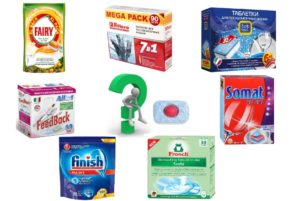
Low-quality tablets rinse poorly, so it's worth replacing the detergent with a new one from a different brand. Some people report that using separate detergents produces better results, arguing that combination tablets have a uniform dosage. In reality, however, everyone has different water hardness, people load their dishwashers differently, and dishwashers are also different, holding different amounts of dishes and using different amounts of water. Detergents can be dosed to find the optimal dose for your dishwasher.
Important! Do not use hand dishwashing detergents or untested homemade products in your dishwasher. This could result in not only white residue and streaks on your dishes after washing and drying, but also damage to the dishwasher.
Some dishwasher users report that a white residue on dishes occurs when salt gets into the dishwasher. For example, salt may have accidentally spilled while pouring into the ion exchanger, the ion exchanger lid may not have been properly closed, or salt may have been poured into the detergent compartment along with the detergent powder.
Reason three: malfunctions, violation of operating rules
The appearance of film and streaks on dishes after washing in the dishwasher may be due to technical malfunctions. Such malfunctions include:
- the lid of the powder and tablet compartment gets stuck, resulting in the powder not being washed out well or the tablet remaining undissolved;
- clogged dishwasher filters;
- clogged sprinkler holes and reduced water supply pressure.
You can fix these problems yourself, without calling a professional. First, you need to thoroughly clean the dishwasher. First, thoroughly rinse the mesh filters and then run an empty wash. with a special detergent, which will wash away plaque from the walls of the machine, clean all the holes from limescale, and rid the machine of unpleasant odors.
Important! A full cleaning of the machine should be performed at least twice a year, regardless of how often it is used.
Regarding the compartment cover, some Chinese-assembled machines have poorly fitting covers that stick when opened. To resolve this, you can replace the compartment or file the cover down to the correct size.
The compartment lid may not open properly due to improperly placed dishes, which can interfere with opening. Even if the lid opens, improper placement and overloading the dishwasher may result in poor cleaning, and don't be surprised if a white residue remains on the dishes after the wash cycle.
If you regularly add salt, use good, proven detergents, dose them correctly, and follow the dishwasher's operating instructions, and still have a white residue, a faulty ion exchanger may be the cause. This is rare. In models with a water hardness sensor, this problem can occur if the sensor is faulty. Diagnosing this type of problem is difficult and is best left to a professional.
Therefore, there are many possible causes of a white residue remaining in the machine after washing. Most of these causes can only be determined experimentally by replacing the detergent, adjusting the dosage, or performing a full cleaning of the machine. If the cause cannot be determined, it is necessary to contact a service center.
Interesting:

Readers' comments
Headings
Washing machine repair




For buyers




For users


Dishwasher




Add a comment