
How to tighten the belt in a Samsung washing machine?
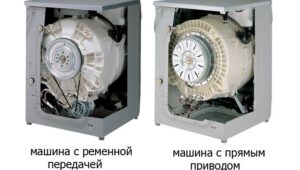
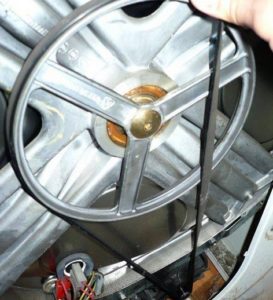 All modern Samsung washing machines are equipped with direct-drive inverter motors, which are designed without a belt. However, machines manufactured 7-10 years ago have brushed motors with a belt drive. Therefore, if your washing machine is older, the likelihood of encountering this problem increases. Let's look at how to tighten the belt on a Samsung washing machine and what symptoms indicate the problem is with the belt.
How do you know if the problem is in the belt?
It's impossible to immediately tell if the drive belt has slipped: the rubber band is hidden behind the rear panel, making it difficult to confirm without a screwdriver. However, certain telltale signs suggest that the washing machine's stalling problem stems from a problem with the drive. The first and most incontrovertible sign will be a signal from the self-diagnostic system.
Washing machines can automatically detect faults and report them to the user in encrypted form thanks to a built-in self-diagnostic system. If the washing machine is equipped with a display, the corresponding error code will appear on it. All you need to do is find a code table suitable for your specific Samsung model and search through the combinations for the sequence that pops up. Such lists are usually publicly available online. You can also find the answers in the user manual.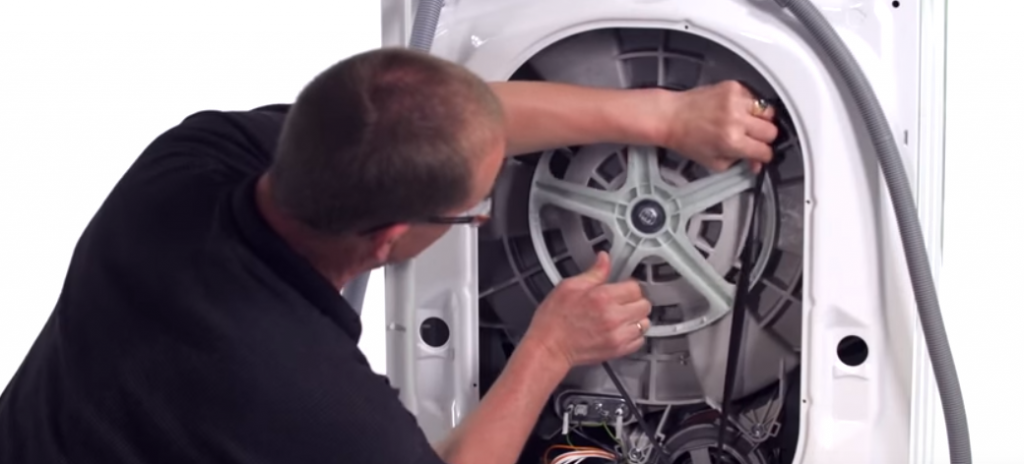
But the self-diagnostic system doesn't always detect a slipped belt. Sometimes the failure goes unnoticed, and the problem must be inferred from indirect symptoms. For example, drive problems can be suspected in the following situations:
- the washing program is turned on, water is collected, the motor is running, but the drum does not rotate;
- The car's engine hums rhythmically, then stops and becomes silent. This change in state occurs at regular intervals;
- the cycle begins, the engine runs continuously, but the electronics “freeze” and the machine does not respond to user commands;
- The washing machine drum rotates manually with ease, but the motor does not make noise.
You cannot operate a washing machine with a broken drive belt – the motor will run in vain and overheat.
If you notice any of these symptoms, stop the cycle and check the drive belt. Get a screwdriver ready, disconnect the washing machine from the power supply, and begin a mini-diagnosis. To do this correctly, follow the instructions below.
Repair algorithm
If the belt has slipped off for the first time, simply reinstall it. Despite its apparent simplicity, this procedure can often be challenging. Re-tensioning the rubber requires skill, strength, and considerable patience. However, even a novice can handle it, as long as they remain persistent and follow the instructions carefully.
If the belt comes off regularly, a comprehensive diagnosis of the washing machine is necessary – there may be a more serious problem. The rubber belt is replaced according to the following procedure.
- Make sure the washing machine is disconnected from the sewer and water supply. Also, disconnect the inlet and drain hoses from the machine body.
- We provide free access to the machine by moving it away from the wall or cabinet, and turn the unit with the back wall facing us.
- Unscrew the screws holding the back panel and remove it. On some Samsung machines, the top cover prevents the back panel from being removed. In this case, remove the top cover first.
- Locate the drive belt. It should be located just behind the rear panel between the drum "wheel" and the motor pulley. If it's not there, it's slipped and is located somewhere on the bottom of the housing.
- Remove the belt and assess its condition. First, find the markings on the rubber, where the first four digits indicate the original diameter in millimeters. Next, measure the circumference and compare the calculated value to the factory length. If the calculated difference is equal to or greater than 20 mm, discard the rubber band—it has stretched too much due to long-term use and is no longer suitable for use.
If the belt has stretched by 2 or more centimeters from its original length, then the rubber must be replaced with a new one of a more suitable diameter.
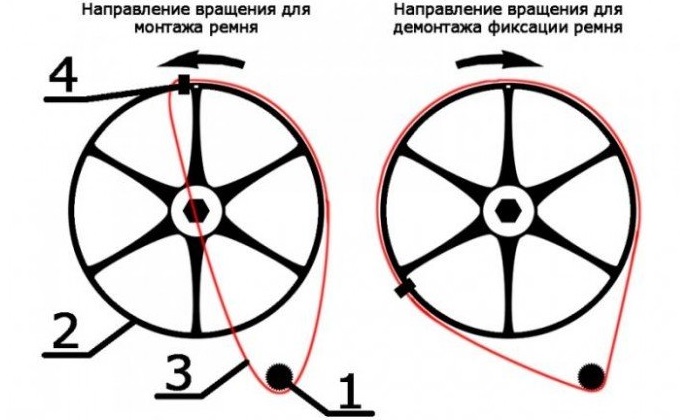
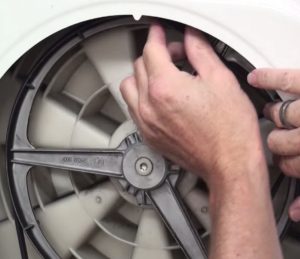
- We tighten the belt onto the engine pulley, and then, gently rotating the drum "wheel" counterclockwise, try to tighten the rubber band. For quick results, it's best to have an assistant, as it's easier to tighten the belt with two hands than with one. But be prepared to spend a fair amount of time: on some Samsung models, the rubber band is too tight, and the manufacturer doesn't provide any adjustments.
- Make sure the belt is firmly seated in all grooves by rotating the pulley several times. If the "wheel" rotates very tightly, the rubber is properly tensioned.
After visually inspecting the workmanship, we begin reassembly. Replace the back panel and secure it with the removed bolts. Then move the washing machine to the wall or cabinet and connect it to the utilities. Be sure to run a test wash to ensure the machine is functioning properly.
Recurrence of the fault
If the rubber band periodically comes off the pulley, this may indicate certain problems in the system. When the belt falls off more than 2 times within 6 months, you should be wary and have your “home assistant” diagnosed. The main reasons for the repeated falling off of the element from the functional wheel of the drum and the engine can be considered:
- Drive belt wear. It often falls off due to natural stretching. If there are signs of wear on the surface, the gussets are selectively ground down, or the length has noticeably increased compared to the factory length, the belt has reached the end of its service life and needs to be replaced.
- Pulley play. In this situation, the belt is not securely attached to the wheel and will periodically slip off when the drum rotates. Fixing this problem is quite simple—just tighten the mounting bolt or replace the pulley;
- Loose motor mounting. The Samsung washing machine's motor is securely mounted, but due to constant vibration during operation, the bolts can loosen, causing the motor to become loose. This can lead to belt drive failure. To fix this, secure the motor in place, tightening all fasteners securely.
- Incorrectly shaped shaft or drive wheel. After a botched repair, during which the "unscrupulous mechanics" bent the pulley, problems with the drive belt may arise. There is a solution: carefully straightening the uneven surface is acceptable, but the best option is a complete pulley replacement.
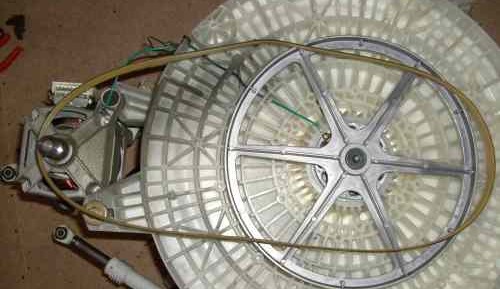
- Spider defect. In some cases, Samsung washing machine users may experience damage to the shaft and spider. This can occur either due to manufacturer fault (if there's a manufacturing defect) or due to vibrations generated by the washing machine during operation. The spider must be replaced; otherwise, a defective part can lead to drum imbalance, which can lead to a more serious malfunction of the washing machine.
- Broken bearings. It's rare for users to let their washing machine get to this point, but defective bearings can sometimes cause the system to become distorted, leading to belt slippage. The only way to fix this problem is to replace the drum bearings and seal.
Errors made during previous repairs of the element can also lead to periodic decline.
This refers to the drive belt not being installed completely—if it's not secured in the grooves, it will eventually come off again. It also happens that the rubber band is replaced with a slightly different one, not the same one. In this case, it can also fail. To prevent the belt from falling off, replace it with a new one that's compatible with your specific Samsung washing machine model.
So, having identified the cause and correctly eliminated it, you can forget about problems with the belt drive for a long time and continue using the washing machine.
Interesting:
Readers' comments
Headings
Washing machine repair




For buyers




For users


Dishwasher




Add a comment