
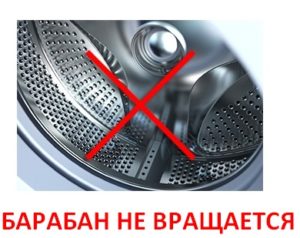
The Ariston washing machine does not spin the drum.
 A washing machine drum that isn't spinning is a malfunction that requires immediate repair. As with any appliance, malfunctions have their causes, and you can fix this problem yourself. Before attempting repairs and understanding what to do, it's important to determine when the problem occurred: at the start of the program or during the spin cycle. Let's find out.
It started and stopped
The laundry is loaded, the program is set, but the cycle doesn't start, and the drum doesn't spin. Or it does the favor of performing a couple of lazy spins, but ultimately, it all ends very quickly with a simple stoppage of the problematic component. If the washing machine has a display, it displays an error code, and nothing can be done about it. This happens for a number of reasons:
- the laundry is poorly distributed in the drum, causing an imbalance;
- the drive belt fails;
- problems arise with the heating element;
- problems with the engine appear (brush wear);
- a malfunction of the tachometer sensor (a special element that regulates the rotation of the motor) occurs;
- a breakdown of the electronic module “emerges”;
- problems with the power supply wiring appear;
- There is a foreign object in the tank.
It seems that with such a long list of possible causes, figuring out exactly what's broken is incredibly difficult, but there's no time to panic. Nothing bad will happen to your equipment if you calm down and approach the problem sensibly.
It spins during washing, but not during spinning.
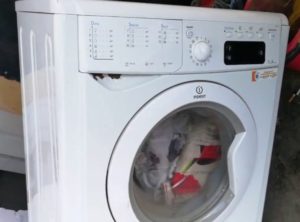 The first stage was completed, the laundry was placed in the drum and even washed, but when it was time to spin, the Ariston machine did not spin the drum. Perhaps there is no breakdown, but the mode in which the spin cycle should be carried out was simply not selected. Check that you haven't set the "no spin" or delicate wash cycle, which uses minimal or no spinning. There are other considerations to keep in mind as well.
- There is too much small debris in the drain, preventing the water from exiting, which is why the spin cycle cannot technically begin.
- Unbalance. The load has exceeded the maximum load capacity, causing items to pile up on one side and preventing further operation.
- The pressure switch (the device that informs the washing machine's "brain" about the water level) is broken, so without the required command the spin cycle does not start.
- Something has happened to the control board. A burnt-out wire or a broken triac could cause problems.
Such issues are generally common across all washing machine models, but it's important for us to understand the problem with the Hotpoint Ariston. A prompt response and troubleshooting will quickly get your washing machine back up and running. Moreover, many problems can be resolved at home.
The equipment stops after filling with water.
Let's examine the symptoms of a breakdown as closely as possible. When the washing machine stops, first check to see if it has filled with water. If so, drain the liquid through the waste filter and try to rotate the drum manually. If the drum turns with difficulty or does not turn even by hand, it means that something is preventing it from rotating and it is simply jammed. In this situation, we must keep in mind that it is possible:
- the belt has come off the drum or broken and then ends up on the pulley, which blocks the movement of the drum.
- some thing, which was probably previously in the pocket, ended up between the mechanisms.
- The bearing is damaged and no longer functions properly. This can occur due to heavy loads on the washing machine, excessive loads, or improper lubrication of the seal (factory defect).
Bearing failure can usually be immediately identified by the clanking and grinding sounds that occur when the Ariston washer is running. At the first sign of such noise, repairs should be considered.
The car hums after starting
At the very beginning of a wash cycle, the washing machine makes a characteristic humming sound, as if it's filling with water, but the drum doesn't spin. This sound is caused by a motor that's receiving power, but for some reason, it's not performing its intended function. What should we pay special attention to?
- Worn brushes. An unpleasant burning smell emanating from the machine is often an indirect indicator of this problem. Wear of this element is a common problem with brushed motors.
- Damage to the motor fins. This is a rarer problem, but it does happen. A thorough inspection will be necessary.
- Bearing failure and seizure. Squeaking and other unpleasant sounds are a precursor to the main problem, as after bearing failure, the drum stops dead in its tracks.
We're trying to repair it.
So, let's begin by talking about repairs. We'll do this by first identifying the causes of the breakdowns and then identifying possible solutions. If an imbalance occurs, the most important thing is to stop the wash cycle.
The collected water must be drained. This is done for safety reasons. Now you need to open the machine and redistribute the laundry.The items should lie evenly in the drum. If debris has accumulated in the drain hose, the action plan is as follows:
- open the hatch on the panel below in front.
- remove the filter and get rid of any excess on the filter itself.
- return this element to its place.
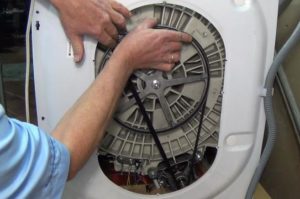 To check the drive belt, examine the contents of the machine located behind the rear panel. Arm yourself with a screwdriver, spare parts if necessary, and proceed.
- First, disconnect the power from the machine.
- Disconnect the hose, first turning off the water supply to the washing machine.
- Remove the screws on the back cover using a screwdriver.
- Inspect the damage with the panel removed. Replace any frayed or missing belt; if it's excessively worn, it needs to be replaced.
- First, place the belt on the small pulley, and then on the large one, turning it in one direction with one hand.
- Put the wall back in place.
Even if the heating element is faulty, the situation isn't hopeless. Furthermore, both problems (including the motor) can be resolved simultaneously. First, remove the back cover. The heating element is located under the tank.
To check the contacts, their resistance is measured using a multimeter.
After confirming the fault, disconnect the wires from the heating element. Unscrew the central nut, but not all the way, and then press the bolt inward slightly. Using the edges, pull the element out of the washing machine. The resulting opening allows you to inspect the inside of the tank for foreign objects and remove them if necessary.
The heating element for replacement is installed in the same way if you proceed in reverse order. Before screwing the panel back into place, inspect the motor, also located at the rear, for any problems. As long as the panel isn't screwed on, they can be repaired in place. The next step is to remove the motor to inspect the brushes and other components.
- Disconnect the wires connecting the motor to the system.
- Remove the fastening bolts.
- Remove the motor and brushes and inspect their condition. If the brushes are worn, they must be replaced, as must the fins and windings.
- Assess the condition of the tachogenerator located near the engine. It should also be replaced if any faults are detected.
Repairing a washing machine yourself is a complex task, but it's possible to at least assess the extent of the damage. Even if you can't fix it yourself, you can accurately describe the problem to a technician or service center. They'll definitely help.
Interesting:
Readers' comments
Headings
Washing machine repair




For buyers




For users


Dishwasher




Add a comment