
The drum in the Atlant washing machine does not spin.
 It's easy to tell if your washing machine's drum isn't spinning: the cycle has started, the machine has filled with water, but the unit still isn't spinning. If this happens, you'll need to cancel the cycle and have your Atlant diagnosed. There's no need to call a service technician—you can troubleshoot the problem yourself. Step-by-step recommendations and instructions will help you understand your washing machine.
What caused the problem?
Let's be clear: drum stalling in Atlant washing machines can be caused by a variety of issues, from a slipped drive belt to a broken motor and circuit board problems. To simplify the search for the culprit, it's necessary to analyze the machine's behavior and more precisely identify the problem. This article will examine a situation in which the machine accepted a user command, started a cycle, filled with water, and only then stopped.While the pump is working properly, the unit itself is making a crackling noise. In other words, in our case, the motor isn't rotating at all, or it's accelerating but isn't transmitting power.
The crackling noise narrows the range of causes to the following faults:
- the drive belt has broken or come off the pulley;
- the electric brushes are worn out;
- the lamellas have peeled off;
- the tachometer sensor is damaged;
- the electric motor broke down;
- There is a foreign object stuck between the tank and the drum.
In Atlant washing machines, the drum does not rotate due to the motor, Hall sensor, drive belt, or a foreign object that has gotten into the tank.
When diagnosing, it's important to determine whether the drum is rotating and whether other system components are functioning properly. Otherwise, the range of possible malfunctions will increase exponentially.
Let's pay attention to the engine
When a washing machine's drum doesn't spin, the first place to suspect is the motor. It's logical: the shaft isn't receiving power from the motor and remains stationary. However, the motor can fail for many reasons.
Before making a diagnosis, it's important to understand why and when the motor isn't running. If the engine starts and rotates, but stops under additional load, such as when the belt gets caught, the brushes are to blame. They can't be fixed; they need to be replaced.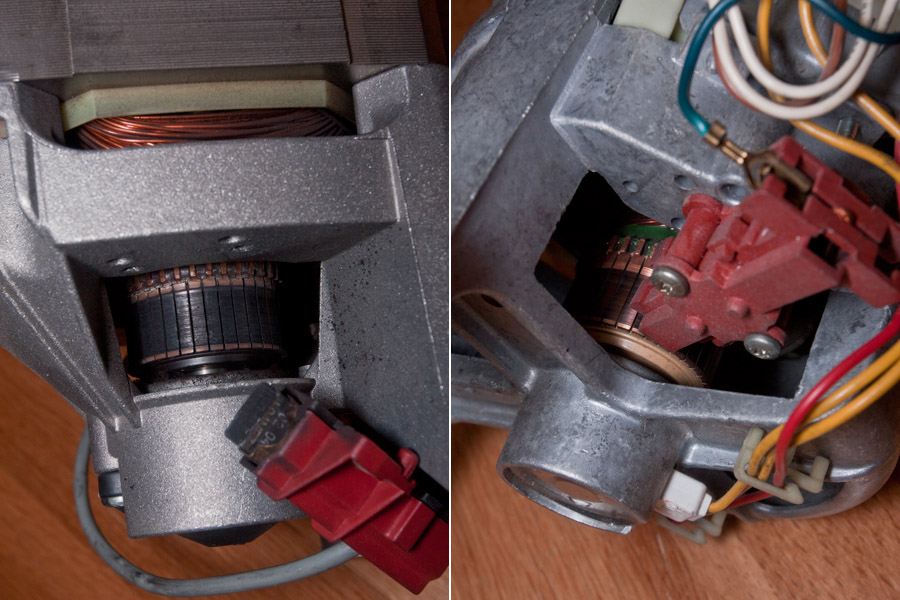
Replacing the electric brushes is carried out as follows:
- unscrew the bolts from the back wall and remove it;
- remove the drive belt from the pulley;
- we disconnect the wiring connected to the engine;
- loosen the bolts holding the motor;
- rocking the body, we take out the engine;
- we find “cases” on the sides of the body – brushes;
- unscrew the fasteners that secure the brushes;
- release the brushes;
- We assess the condition of the carbon tips - if they are worn out, they need to be replaced.
You cannot replace just one electric brush – they are installed only in pairs!
Brushes should only be replaced in pairs, even if one is completely intact. You should purchase identical tips and install them in their proper locations.
If both brushes haven't reached their "limit," further diagnostics are needed. The second check is the tachometer sensor, which monitors the engine's acceleration. If the sensor fails, the motor will not start for safety reasons. The device's functionality is checked using a multimeter set to measure resistance.
Also, detached fins prevent the engine from reaching full power. To confirm this, you'll have to disassemble the engine housing and inspect the commutator fins. If they're faulty, the engine will need to be resurfaced.
Another common problem with the Atlant washing machine is a broken motor winding. Therefore, switch the multimeter to the ohm range and apply the probes to each pair of slats. If all readings are within the 0.1-0.4 ohm range, the wiring is fine.
Belt problems
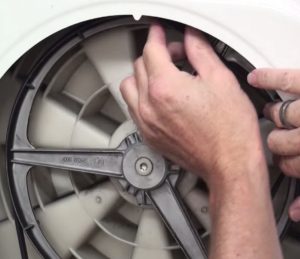
A slipped drive belt often causes the drum to stop. It's simple: the motor accelerates, but without a "middleman," the speed isn't transmitted to the drum shaft, so the machine starts the wash cycle but doesn't wash anything. It is easy to check whether the rubber seal has broken, as it is enough to open the hatch door and unscrew the tank manually. If nothing interferes with the movement, then there is a problem with the drive.
The belt comes off in three cases: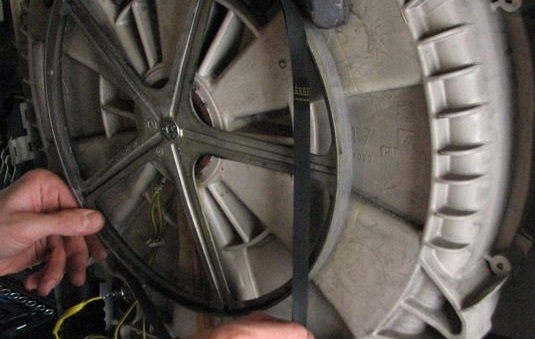
- accidentally, due to strong vibration of the machine during spinning;
- when stretched (when the belt stretches by 2 cm or more from its original diameter);
- if it breaks.
If the drive belt has stretched during use and the difference between the current and initial diameter exceeds 2 cm, then the rubber band must be replaced!
If the belt breaks once, simply replace the old one. However, if the rubber band has broken or has broken twice in six months, it needs to be replaced. A new "ring" is purchased based on the serial number printed on the rubber surface; in extreme cases, the model of your Atlant washing machine is used as a guide.
Now let's talk about how to ensure the belt fits perfectly on the pulley. Hold the rubber band with one hand and spin the wheel with the other. Tensioning it will require considerable effort, skill, and patience, as the ring is very difficult to stretch. Ideally, have an assistant help you tighten the belt together.
Something got into the tank
If you can’t turn the drum manually, it means that a foreign object has gotten into the tank and is blocking it. To continue washing, you will have to remove the foreign object from the machine. The "repair" process looks like this: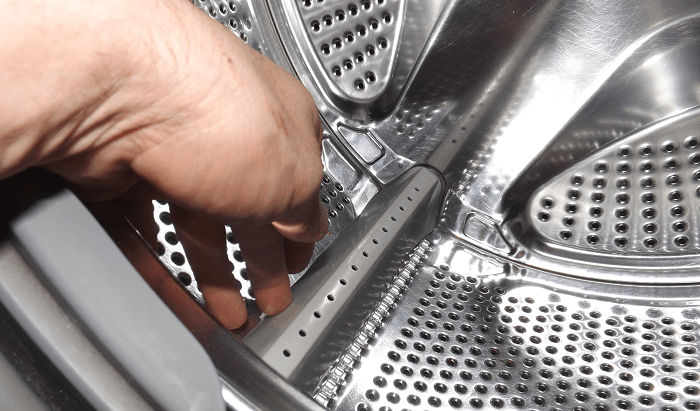
- remove the back wall;
- we remove the heating element from its seat;
- We shine a light through the freed hole;
- We pull the object out of the wire using our hand or a hook.
Before washing, check the pockets of the items you load into the drum!
It's even worse if the item is stuck tightly or can't be removed through the heating element. Then you'll have to disassemble the washing machine down to the drum, which is much more difficult and time-consuming.
Interesting:


Readers' comments
Headings
Washing machine repair




For buyers




For users


Dishwasher




Add a comment