
The Electrolux washing machine drum does not spin.
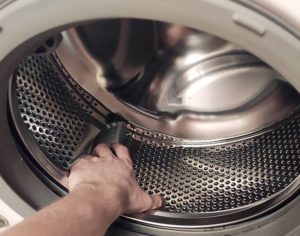 Every home appliance manufacturer has its own typical malfunctions. For example, the drum of an Electrolux washing machine often stops spinning—it suddenly slows down or jams. In the latter case, you can't even turn the drum by hand—the drum becomes stuck, preventing the wash cycle from continuing. This requires diagnostics and repair. It's essential to identify the problem and begin repairs.
Where did the breakdown come from?
It is impossible to immediately say why the drum suddenly stopped. There are many possible causes for a malfunction, and the final list of breakdowns depends on the brand and model of Electrolux, as well as the components used, right down to the country of assembly. But, as a rule, the user encounters the following malfunctions that slow down the machine:
- an object is stuck between the tank and the drum, jamming the mechanism;
- there are problems with the drive, belt or pulley;
- the electric motor coil is out of order;
- the carbon brushes are worn out;
- the fins on the motor have peeled off;
- the semiconductor elements on the control board are damaged, or the module itself is broken.
This isn't a complete list. It's important to understand that even a simple Electrolux washing machine is equipped with numerous interconnected components, sensors, and microcircuits. Even the slightest malfunction in one component can cause the washing machine to stop working completely. Diagnosis is further complicated by the fact that the symptoms of some malfunctions can be identical to those of other faults. As a DIYer, pinpointing the exact problem can be difficult. It's best to avoid jumping to conclusions and contact a service center instead. However, you can handle a slow-running drum on your Electrolux washing machine yourself. The key is to get it diagnosed promptly.
The drum of the Electrolux washing machine does not rotate due to jamming, problems with the drive, or a broken motor or control board.
It's important to note that the list of causes will increase if the drum rotates, albeit unsteadily. In this case, the range of possible malfunctions expands. This article examines the situation where the cylinder stops completely.
The drive mechanism elements are broken
If your washing machine's drum isn't spinning, the first thing to check is the drive belt. It's likely broken or slipped, preventing the motor from transmitting power to the drum shaft. The situation isn't serious: simply remove the back panel and replace the belt.
Repairs become more complicated if the belt slips regularly, more than three times every six months. In this case, you need to replace the severely stretched rubber band or check the drum pulley for integrity. Here's how to do it:
- we disconnect the machine from communications;
- we move the equipment away from the wall, opening access to the “back”;
- unscrew the back panel or service hatch (depending on the Electrolux brand);
- We inspect the large and small pulleys and check the belt.
If the rubber band is in place, then the problem is not in the drive. A slipped belt indicates problems with the wheel – it is necessary to inspect it for damage and deformation. If there are no visible defects, you can replace the rubber and run the washing machine again. If there are chips or cracks, replace the part with a new one.
If the drive belt breaks once, it is enough to put it back in place; if it happens regularly, it is necessary to check the integrity of the pulley and rubber.
The next step is to inspect the small pulley located on the motor shaft. A deformed wheel requires immediate replacement.
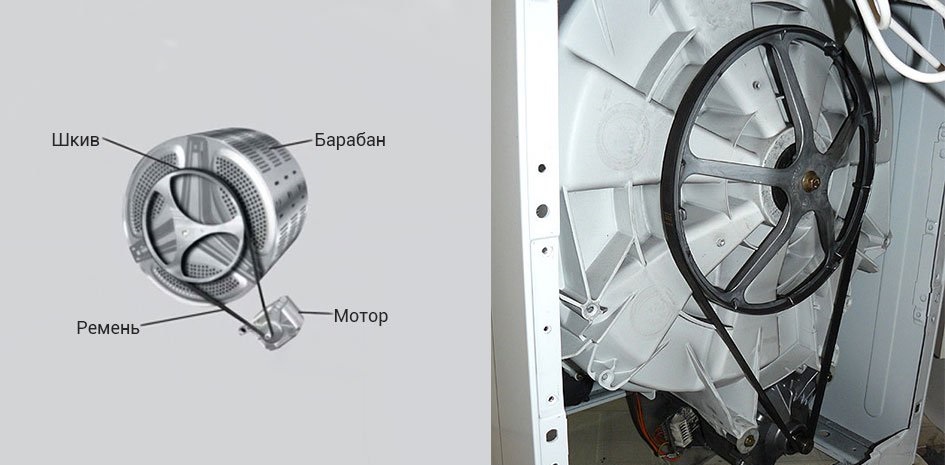
To replace a large pulley yourself, you must follow these instructions:
- fix the wheel in a stationary position by inserting a screw or a wooden block;
- treat the central bolt with WD-40 and wait 30-40 minutes;
- Use a ratchet of a suitable size to loosen the bolt (do not apply excessive force, as this could strip the threads and damage the screw);
- remove the wheel;
- Place a new pulley on the rod and secure it with a bolt.
After that, all that's left to do is tighten the drive belt. First, the rubber band is placed on the small pulley, then on the large pulley. Ideally, it's recommended to replace the rim itself as well to prevent the belt from slipping again.
A foreign object is to blame
 Foreign objects getting inside the washing machine can cause more than just drum jams. Paper clips, keys, coins, buttons, and hairpins can damage the walls of the metal cylinder or plastic tub, clog the drain, or jam the pump impeller. Therefore, it's recommended to check the pockets of laundry before loading it—there shouldn't be any forgotten items in them!
More often, objects accidentally dropped into the drum cause the drum to jam. In this case, the machine suddenly stops with a clanking noise, signaling an error. Trying to unscrew the drum by hand or restarting the wash cycle is not recommended—it could make the situation worse!
It is prohibited to operate a washing machine with a jammed drum - you can make the situation worse and puncture the cylinder or tank!
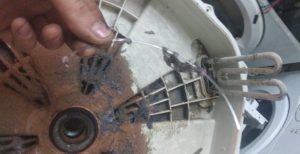
There's only one solution: remove the foreign object from the tank. This can be done through the special recess where the heating element is located. If the heater on the Electrolux is located at the back, it's best to do this through it. The instructions are as follows:
- disconnect the washing machine from the power supply;
- drain the water using the emergency drain (if the machine stops in the middle of the cycle);
- remove the back panel from the case;
- find the heating element located under the tank;
- disconnect the wires connected to the heater;
- loosen the retaining nut and, by rocking it, pull the heating element out;
- Insert a wire hook or your hand into the freed hole and remove the stuck object.
If the Electrolux's heating element is located at the front, it's best to access it through the drain pipe. Otherwise, you'll have to remove the front panel, which is much more difficult and time-consuming. Once you've found the drain pipe, lay the washing machine on its left side, look through the bottom, clear the drain hole by removing the drain plug, and then fish out the stuck object by hand.
Motor faulty
The drum won't rotate if there's a problem with the electric motor. It's simple: the motor doesn't reach the set speed, the drive stops, and the drum shaft won't spin. Inverter motors on Electrolux stop extremely rarely, while collector motors, on the contrary, slow down quite often.
As a rule, collector motors break down due to:
- worn out electric brushes;
- closed winding;
- peeled off lamellas.
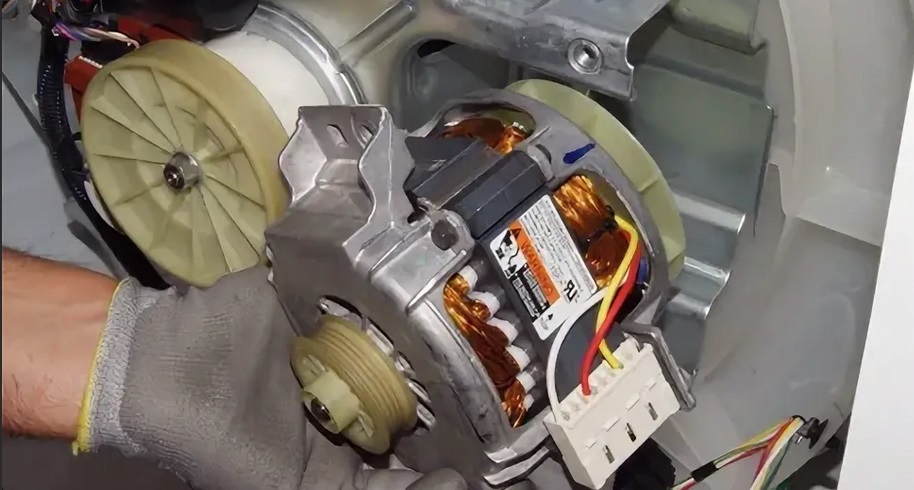
Diagnosing and repairing a motor is no easy task. It's necessary to remove the motor from the washing machine housing and test it with a multimeter. Identifying the cause of the malfunction is no easier. While replacing the brushes is possible at home, sharpening the fins and restoring the integrity of the winding should only be done by professionals using specialized equipment.
Electronic filling
The most serious malfunction that can cause the drum to stop is a malfunction in the control board. Self-diagnosis and repair of this problem is strongly discouraged. Only a professional should dismantle, inspect, and test the electronic module. Firstly, experience and specialized equipment are required. Secondly, each semiconductor, contact, and microcircuit must be checked individually. Thirdly, the cost of error is too high—a careless move could worsen the situation, leading to a fatal outcome. The cost of a new unit is often equal to the price of a new Electrolux.
Diagnostics and repair of the control board should only be performed by professionals!
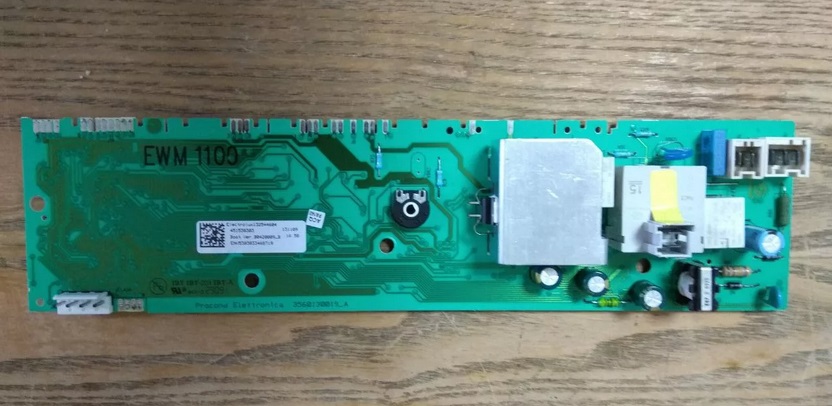 If the control board fails, the washing machine inevitably stops working. This doesn't necessarily mean the triac responsible for the motor and tachogenerator, or the corresponding track, is faulty—it's likely a completely different microcircuit. The fact is, even a single burned-out semiconductor interrupts the well-designed electronic control circuit. In this case, the module cannot receive information about the unit's readiness, transmit the command further, or control the process. For safety reasons, the system is immediately shut down.
If the drive, drum, or motor inspection doesn't reveal a fault, it's best to stop the diagnostics and contact a service center. Messing with the electronics yourself is too risky—calling a technician is safer and cheaper.
Interesting:


Readers' comments
Headings
Washing machine repair




For buyers




For users


Dishwasher




Add a comment