
The door of the Indesit washing machine does not close.
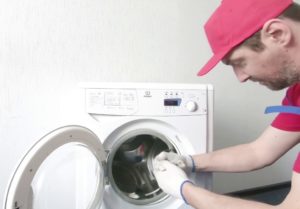 Users often encounter problems with the door closing on their Indesit washing machine. In this case, don't panic: these issues are usually resolved quickly and easily, and this article will explain how. It's worth noting that there are typically two types of this problem: the washing machine door won't close and the door won't lock. For your convenience, we'll discuss these cases separately, as they are often unrelated.
The door itself is broken
In this case, the Indesit machine's door lock doesn't actually close. In this situation, when the door is closed, the hatch won't stay closed (the characteristic click that indicates the door is closed won't be heard) or will simply open. Another possible scenario is that when you close the hatch, it will seem to you that something is preventing it from slamming shut, as if an obstacle has appeared that the hatch is bumping into. The reasons for this door behavior are varied.
- Your door is warped. Washing machine doors tend to warp over time with heavy use; this is completely normal. Therefore, check that everything is in place and that the hook fits into the designated hole. If you find a problem, the door can be adjusted using the mounting bolts.
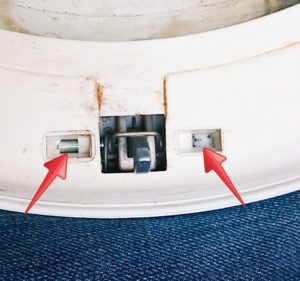
- The latch bolt—the device that holds the door closed—has broken. It, in turn, is held in place by a special metal rod, which could easily have fallen out. To fix the problem described above, all you need to do is disassemble the door and return the rod to its original position.
- Another part of the door itself could have broken—a hook, for example. In this case, the only solution is to replace your appliance's door handle.
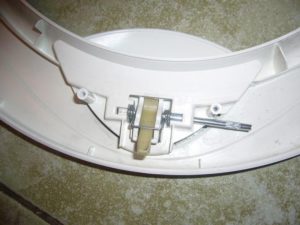 If the lock doesn't stay closed or the door simply opens when released, the problem is most likely with the plastic guide. This part is built into some washing machine models and is prone to wear. Your door may be slightly warped, which won't affect the washing machine's operation, but sooner or later you'll encounter a problem with the plastic guide. What will happen? The hook will no longer stay in the groove, and the door simply won't close until it clicks shut. What should you do in this case?
- Unscrew the fasteners connecting the door to the hinge using a star screwdriver;
- unscrew the screws located on the inside of the door in a circle, having first removed it from the hinge;
- use something sharp to pry the door halves apart and take it apart;
- inspect the opening mechanism, find the problem.
Unfortunately, individual mechanisms are rarely available for purchase, so the entire door will likely need to be replaced. However, if the damage is not serious (a spring has fallen out or a pin has popped out), you can repair the mechanism yourself.
Be careful when performing such operations to avoid damaging any other parts of your washing machine. In rare cases, such manipulations can lead to even more serious consequences if basic precautions are not taken. Exercise extreme caution!
When the hatch closes but does not lock
To understand the problem, imagine this: you close the door, it latches shut, but the washing machine indicates the door is open and refuses to start washing. What's the problem? Most likely, the door locking device (HLD) is broken or the control module has failed.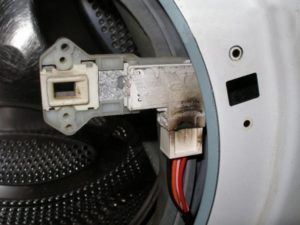
So, the door locking device is faulty, meaning the door won't lock and the wash cycle won't start. The door locking device works like this: when power is applied, it locks the door. Therefore, if the door locking device is faulty, there's no washing!
Besides a breakdown, there's also the possibility that the door lock is simply clogged. It could get clogged by anything, especially if there are small children in the house. This problem can be solved almost instantly: simply check the lock and clean it if necessary.
A malfunctioning electronic module, however, is a more serious cause for concern. The module is designed to send the appropriate signal to the sunroof locking device, but if it malfunctions, it doesn't. This is why your door won't lock. The module could burn out from a power surge, or its software could suddenly malfunction. In either case, you'll need to call a repair technician. They'll either replace the module or reinstall the software, depending on the type of malfunction.
Testing UBL
To check the lock's operation, there's a special tester (a long-range multimeter is the most suitable option). However, to use this device, the hatch door must be removed.
- Loosen the clamp that holds the front wall cuff in place. Depending on the clamp (they vary), use either round-nose pliers, a screwdriver, or flat-nose pliers.
- To find the UBL, you need to remove the cuff from the front wall.
- Remove the two screws (which hold the lock in place) from the outside where the lock hook contacts the locking device.
- Disconnect the wires and remove the UBL (it is no longer secured) through the hole between the cuff and the car body.
To proceed further, you need to study the hatch lock's wiring diagram. This device is typically found in almost every car, but each manufacturer installs it differently (the contacts differ), and we need to know the purpose of each contact in advance, otherwise, nothing will work. Find such a diagram online and determine the location of the live, neutral, and common contacts. Only then can you test the lock with a tester.
- The device toggle switch must be set to resistance test mode.
- Install the probe onto the neutral and phase contacts of the lock.
- After this, the device should show a three-digit number.
- Next, the probes should be installed on the common and neutral contacts.
- If you see 0 or 1 on the device, this indicates a malfunction of the device.
As you can see from our description, some defects in your washing machine can be fixed with little effort and almost instantly, while others will require a significant investment of time and effort. However, in any case, these problems can be resolved either independently or with the help of a specialist.
Interesting:

Readers' comments
Headings
Washing machine repair




For buyers




For users


Dishwasher




Add a comment