
AEG washing machine malfunctions and repairs
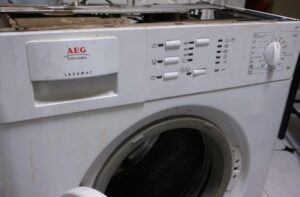
 AEG washing machines are known worldwide as high-quality German-made machines. Even though they are now manufactured under the supervision of Electrolux, their quality remains unchanged. However, even these machines can break down, and individual components can simply wear out over time. In these cases, AEG washing machine repair is required, and in most cases, you can do it yourself. How can you find the cause of the malfunction, how can you fix it, and is it worth it? We'll answer these questions.
Symptoms of malfunctions and their causes
Breakdowns in AEG washing machines are extremely rare, and even these rare breakdowns are most often the result of improper installation or improper operation. Furthermore, one should not rule out the possibility of manufacturing defects or force majeure situations, such as a power surge that burns out the control board or heating element.
Important! By being vigilant and always unplugging your washing machine, you can reduce the risk of exposure to power surges.
The most common symptoms that appear in AEG automatic washing machines are the following:
- the water during washing does not heat up to the set temperature, washing does not start or takes place in cold water;
- when switched off, a grinding and knocking sound can be heard in the drum when it is rotated by hand;
- water does not collect in the drum;
- The water does not drain from the machine, the washing process stops.
In such breakdowns, the most common cause is a malfunction:
- heating element;
- temperature sensor;
- control module;
- drain pump.
How to diagnose a breakdown
Once you've realized that your washing machine has stopped working properly, you can try to diagnose the problem yourself. First, If the AEG machine has a display, an error code indicating a specific malfunction should appear on it.The decoding of these codes is in the car's manual. We'll offer some of them.
- E11 (C1) – an error indicating that there is no water filling the tank. In this case, the most likely cause is a faulty inlet valve;
- E21 (C3 or C4) – waste water does not drain for a long time, the probable cause is a pump breakdown, possibly the electronic controller is faulty;
- E61 (C7) – water does not heat up to the required temperature for a long time, in this case the heating element is faulty; Please note: This error only appears in diagnostic mode.
- E71 (C8) – the resistance of the temperature sensor does not correspond to the specified limits, this indicates a breakdown of the sensor itself or the heating element, which happens less often;
- E74 – the temperature sensor position is out of alignment;
- EC1 – blockage of the inlet valve, in this case both the valve itself and the washing machine control board may be faulty;
- CF (T90) – control board failure.
There are quite a few error codes stored in the microprocessor by the manufacturer. We've listed only the most common ones. In some cases, such codes may not appear, in which case you'll need to run diagnostic mode. To do this, follow these steps:
- Turn the programmer to the off position (AUS), thereby canceling the selected program, and turn off the machine.
- Hold down the Start (Pause) key and the Exit key simultaneously.
- Turn on the machine and turn the programmer clockwise one notch.
- Hold down the Start (Pause) key and the Exit key simultaneously until the diagnostic mode appears, or more precisely, an error appears on the display.
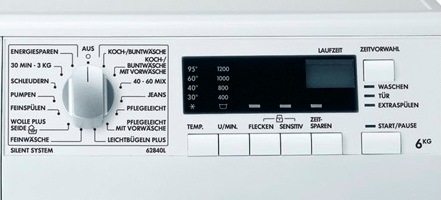
To exit test mode, you need to turn off the machine, then turn it on and turn it off again.
Troubleshooting
What should you do if you encounter one of the above problems? There are two options: try to fix it yourself or call a professional. If the heating element fails, it is quite possible to solve the problem yourself. The plan of action in this case is as follows:
- We purchase an original heating element for an AEG washing machine in accordance with the machine model.
- Inspect the rear case cover. If there's a small access hatch, the heating element is most likely located behind the front case cover. If there's no access hatch, the heating element is located behind the rear panel.
When in doubt, start disassembling from the back of the case, as it comes off much easier. - Having opened access to the heating element, we check its resistance using a multimeter, which for a serviceable unit should be 30 Ohms.
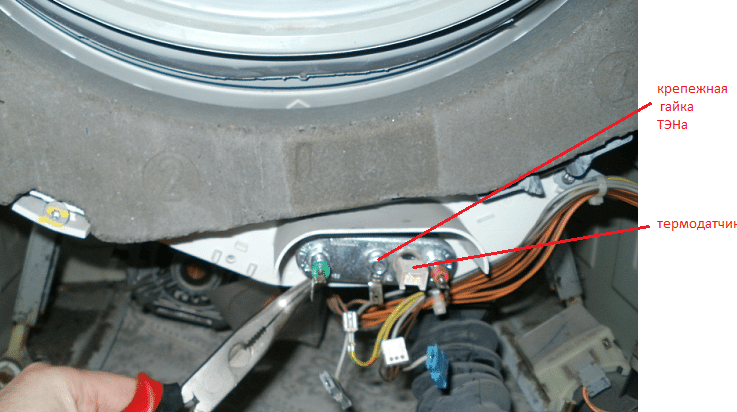
- If the heating element is faulty, unscrew the bolt in the center and disconnect the sensors and contacts from the heating element.
- Using careful movements left, right and towards ourselves, we remove the heating element from the holder.
- We insert the new heating element into the holder and screw on the retaining bolt.
- We connect sensors and contacts.
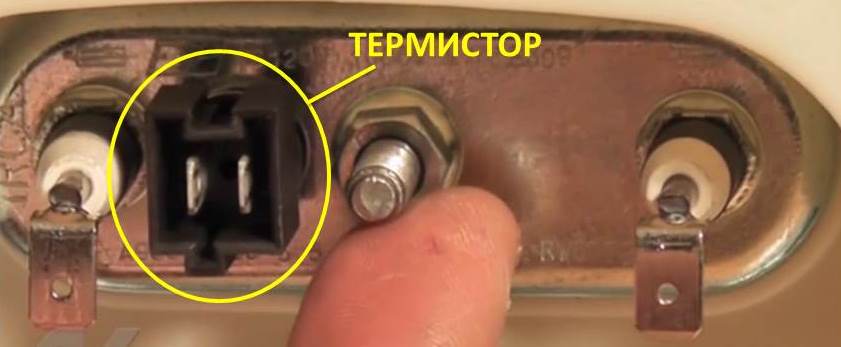
The temperature sensor is also easy to change. In modern washing machines, a thermistor is installed as a temperature sensor, which is attached to the heating element. Therefore, when checking the heating element for functionality, you can immediately check the thermistor too.
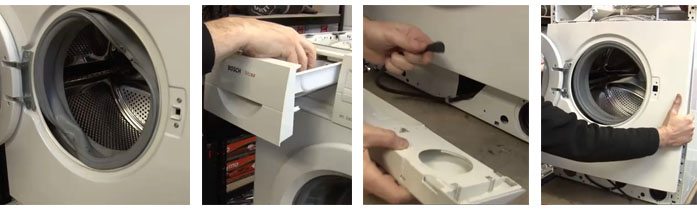
If the drain pump is broken, you can also repair it yourself. However, this is somewhat more complicated than replacing the heating element, as it's accessible through the front wall of the machine. The pump replacement instructions can be summarized as follows:
- Remove the top cover of the case.
- Remove the front panel, which houses the drain filter. While you're at it, drain any remaining water and remove the bolts holding the pump in place.
- We take out the powder tray and unscrew the bolts that hold the control panel.
- Carefully lift the panel upward so as not to damage the wires connecting the panel to the sensors and other units.
- Removes the clamp on the drum cuff, and then the cuff itself from the front wall.
- We unscrew all the bolts that hold the front cover of the case and remove it.
- We disconnect all wires from the pump and loosen the clamps.
- We remove the pump, disconnect the volute, and inspect the impeller for debris and damage. The pump winding can be checked with a multimeter.
- We replace the faulty pump with a new original one from AEG and reassemble the machine in reverse order.
The situation is much more complex when the control board fails. Its malfunction can manifest itself in various symptoms, which may also be related to the failure of other components. Therefore, The first difficulty when working with an electronic module is diagnosing its malfunctionThe second difficulty is determining whether the module needs to be replaced completely or can be repaired. It's best to entrust this type of work to a professional who can test the module using specialized equipment.
Please note! Replacing a faulty module can be quite expensive, around 40% of the cost of a new machine. Therefore, sometimes it may even be wiser to consider buying a new washing machine altogether.
In conclusion, it's worth noting that most common malfunctions across different brands are similar, and troubleshooting procedures for these problems are similar. Repairs to AEG washing machines that have been in operation for over 10 years may be necessary due to normal wear and tear on the machine's components. However, this doesn't mean you can always handle the repairs yourself; in some cases, you'll need to rely on professionals, even if you really don't want to overpay.
Interesting:

Readers' comments
Headings
Washing machine repair




For buyers




For users


Dishwasher




Add a comment