
Why can't you wash aluminum cookware in the dishwasher?
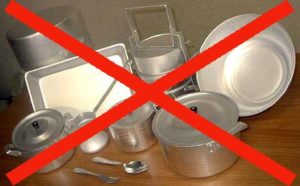 The dream has come true – the dishwasher is finally installed, and it's time to start washing. Many people are tempted to wash every dish in the house, and some do so without thinking. However, there's no need to rush, as some items are strictly prohibited from being put in the dishwasher. This applies primarily to all items made of aluminum. Let's find out why aluminum cookware is so dishwasher-safe.
Reasons why you shouldn't put aluminum in your dishwasher
Aluminum is a fairly reactive metal, reacting with many substances, even water, under certain conditions. These conditions are found inside a dishwasher. The surface of this metal has a dense oxide film that is easily dissolved by alkalis. Many dishwasher detergents contain alkalis, which help clean dishes without physical action.
So, under the influence of alkali in hot water, the oxide film is removed from the surface of aluminum cookware. As a result, aluminum is able to react with water, which leads to the destruction of this metal and the appearance of a dark coating on its surface.If you expose your dishes to this temperature for a long time, they won't just darken but will also begin to deteriorate. Some report that washing them at 35 degrees Celsius (95 degrees Fahrenheit) didn't cause any problems, but we warn you again: after several such washes, your dishes will still darken. And perhaps permanently.
Important! Scientists have proven that aluminum cookware should not be used. Large quantities of the metal enter the human body, negatively affecting the functioning of all organs without exception.
Hand dishwashing detergents are less aggressive, so we don't notice any changes to aluminum cookware. However, with prolonged use, darkening does occur. So, let's conclude that aluminum cookware should not be placed in the dishwasher because:
- it loses its appearance, acquiring a dark coating;
- This is not safe for health.
What to do with darkened dishes?
It's clear why aluminum shouldn't be washed in the dishwasher. But few remember their chemistry classes, not everyone reads dishwasher instructions, and not all instructions include a warning that aluminum cookware shouldn't be washed. Some even accidentally put such items in the dishwasher. On specialized forums, users write about how their dishes were ruined: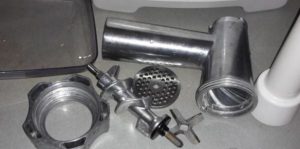
- pots;
- frying pans;
- garlic presses;
- spoons;
- meat grinder parts.
So the question arises: is it possible to restore aluminum cookware to its former shine and appeal? It's not that simple and will depend on how much the item has changed color. The protective layer of the metal doesn't break down immediately; the hotter the water and the more alkaline the detergent, the faster the cookware will darken and become covered with a gray film. Of course, the damaged cookware should be thrown away, but sometimes that's not an option, especially if it's parts from a new meat grinder. So how can the film be removed?
Only manual cleaning with special products will help. But boiling with soda and powder will only make the situation worse, so do not do this under any circumstances.Nitric, sulfuric, and other acids can help combat plaque, but we won't describe this method, as it's not safe and can cause irreversible damage. Vinegar and citric acids are unlikely to have the desired effect, as they are weak. Here's what you can try:
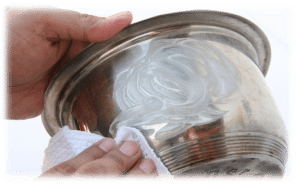 Cleaning and polishing with GOI paste for a final polish. Apply the paste to a piece of felt cloth and rub the darkened item;
- polishing with a special paste from France, Dialux;
- Treat darkened items with HORS rust converter for cars (use only in extreme cases), and then rub with one of the above-mentioned products.
Remember! Aluminum cookware should only be washed by hand, and if possible, with specialized detergents, of which there are many available, or with regular kitchen soap.
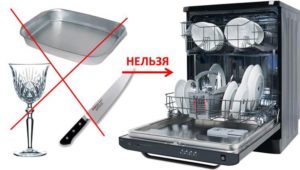
What other dishes should not be washed in the dishwasher?
Aluminum isn't the only item that can be damaged in the dishwasher. While some aluminum cookware can and should be replaced, others aren't so easy to part with. So, consider which other items shouldn't be washed in the dishwasher: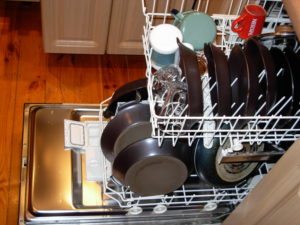
- wooden dishes or dishes with wooden parts - if left in water for a long time, such dishes will swell and crack;
- silver and nickel silver tableware - just like aluminum tableware, it can darken and lose its attractive appearance, which is not so easy to restore;
- pans with a Teflon coating, if there is no permission sign - during the washing process, unprotected Teflon becomes matte, which leads to food burning;
- knives - when exposed to hot water, knives become very dull;
- Bone and expensive porcelain - may darken and lose their shine.
The most important thing when washing dishes is to maintain the temperature regime and rules for arranging dishes. Even ordinary dishes can be ruined if washed in too hot water with concentrated detergent.
So, aluminum cookware is the number one no-no for a dishwasher. If you don't want to ruin the parts of your new meat grinder or your favorite aluminum frying pan, then don't experiment based on other users' advice, like, "You never know until you try." In this case, everything is pretty clear even without experimentation; learn from others' mistakes.
Interesting:


8 reader comments
Add a comment
Headings
Washing machine repair




For buyers




For users


Dishwasher




Thank you so much for the article. It answers all the questions I was wondering about in an accessible way!
Thank you, I agree with Yulia.
I read it too late, the spare part from the meat grinder and the aluminum spoon had already darkened.
It's strange, but on the contrary, all my aluminum spoons and forks have turned white.
It just turned out to be different aluminum salts, but they are also not very useful.
So, now you can’t use this dishware (if it has turned white)?
How do knives become dull from hot water? What's the physics behind the process?
It's a shame I had to read this article after washing the meat grinder parts in the dishwasher 🙁