
How to clean the detergent drawer in a washing machine
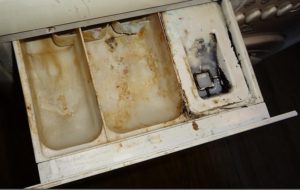 A washing machine is one of the most frequently used appliances in the home. Along with a refrigerator, stove, and microwave, it's an essential part of everyday life. But the problem is, while they're constantly using their "home helper," people often forget to take care of it, including cleaning the machine's tray of detergent residue and limescale. It seems simple enough, but it's precisely this simple task that often causes difficulties. Let's discuss it in detail!
Physical cleansing
The drawer of an automatic washing machine is a fairly dirty place, dirtier only than the drum, drain pipes, and drain hose. Unlike the drum and drain pipes, which are harder to reach, the drawer is much easier to clean because it's visible. In fact, many washing machine users don't even know how to remove the drawer and have never thought about cleaning it.
In some cases, the detergent drawer becomes so clogged with detergent that water stops flowing and washing away the powder. Owners call technicians to fix the washing machine, but when they arrive, they don't fix anything, only clean the drawer and charge a hefty price for the repairs.
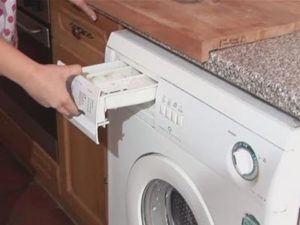 Indeed, an inexperienced user of an automatic washing machine may find that he or she cannot immediately remove the detergent drawer, although this can be done in one movement, the main thing is to understand the principle. Most brands of automatic washing machines have a simple straight tray with a locking tab. This tab partially covers the rinse aid compartment. Press your finger on this tab, then pull the tray toward you, and it will come out very easily.
The detergent drawer in an automatic washing machine can have an unusual design. There aren't many brands of machines with non-standard drawers, but they are fairly well-known. Removing the detergent drawers in these machines can be challenging the first time, but once you understand the principle, you'll get the hang of it. How to remove the detergent drawer in an Indesit or Ariston washing machineWe talk about this in detail in the article of the same name, but we will not dwell on this issue in detail.
Having taken out the tray, we begin cleaning it. Physical cleaning comes down to simple rubbing and scraping off pieces of dried powder and limescale from the inner surfaces of the tray. It is better to do this procedure like this.
- If the detergent container isn't too dirty, you can clean it without using any special cleaners, much less soaking it. Just rinse it with hot water first.
- Take a small, not too hard brush, clean all the dirt from the tray, and then rinse the container with water again.
- Now we take a rag, we need to clean off the remaining dirt, and then rinse the tray again.
- We put the tray back in place and continue using the washing machine.
When physically cleaning the detergent drawer, do not overdo it and do not use particularly hard brushes with coarse abrasive surfaces, as the conditioner compartment contains a dispenser whose plastic markings can easily be erased by such brushes.
Dry cleaning
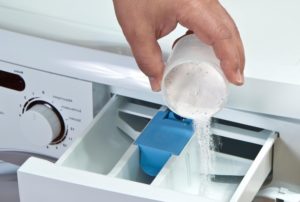 It may be that limescale and hardened powder cannot be removed using conventional physical methods, in which case dry cleaning with special products will come to the rescue. For dry cleaning to be successful, it's important to choose the right chemicals that will remove even the most stubborn dirt. We'll discuss this in the next section, but for now, let's move on to the actual process. A chemical cleaning alone won't be able to clean the tray; you'll need to clean the entire inside of the washing machine. But that's not a bad idea, after all, it's not just the tray that needs cleaning.
- Take a detergent dispenser or any other and measure out the required amount of cleaning chemicals. The dispenser is needed to ensure that the dose of chemicals is not exceeded and that these parts of the washing machine are not damaged.
- Open the powder tray, take the dispenser with the product and pour it into the tray, in the compartment for the main wash.
- We remove all dirty clothes from the washing machine drum and start the wash at a temperature of 90-950WITH.
- At the end of the program, we start a second rinse – the washing machine cleaning is complete.
The disadvantage of this method of cleaning the washing machine tray is that it cannot be used to clean a heavily soiled container, since dirt prevents water from penetrating into the compartments.
If water doesn't penetrate the tray, the detergent won't be washed out, which means dry cleaning won't work—a vicious cycle. If the tray is excessively contaminated with detergent residue and limescale, it's cleaned using a combination of chemical and physical cleaning methods. Here's how:
- We take out the tray and place it in a basin of hot water.
- Take the dispenser and measure out the required amount of cleaning agent.
- Empty the dispenser by pouring the product into a bowl with a tray.
- Shake the product until it dissolves in water.
- We leave the tray soaked in water with the product for a couple of hours.
- We take out the tray and clean it with a brush, and then with a rag.
- We rinse the tray with clean warm water and put it back in place.
Cleaning products
Finally, as promised, we'll list the cleaning products most commonly used by housewives to clean the detergent drawer of their washing machine. Let's start with commercial household cleaning products, which allow you to clean the entire washing machine, not just the drawer.
- Dr. TEN "Against Bacteria" is designed for dry cleaning the inside of your washing machine, including the tray. It will help if the powder tray is not very dirty.
- Frisch Activ. A comprehensive washing machine cleaner that removes mold, limescale, detergent residue, and soap scum. It will only clean the tray if it's not too dirty.
- Sandokkaebi. Made in South Korea. It perfectly cleans the washing machine's drawer, pipes, and hoses. It's relatively inexpensive.

Now let's look at some examples of products you can use to soak the tray. Since we're not pouring the product into the washing machine, we can use more aggressive chemicals. The following products are suitable for soaking:
- Domestos;
- Toilet duck;
- Silit;
- Comet (liquid), etc.
We haven't described the above-mentioned remedies, as they're already well-known. What remains is to discuss home remedies for cleaning the detergent drawer. In this case, vinegar essence and citric acid are unrivaled.
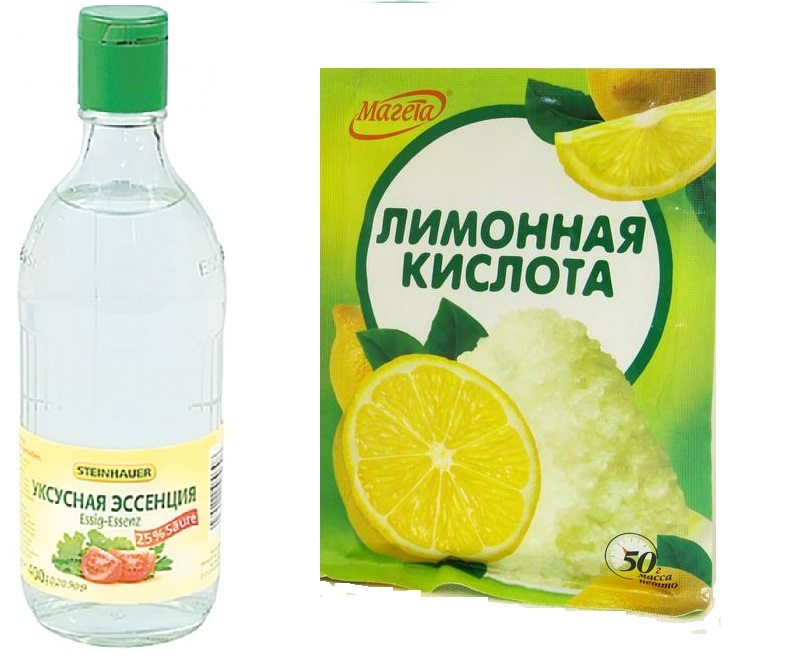
Vinegar essence is more suitable for soaking the powder container before physical cleaning, while citric acid can be useful for cleaning the inside of the washing machine as a whole.
In conclusion, cleaning the detergent dispenser in your automatic washing machine is quite simple. Just remember to do it at least every 10 washes, and your washing machine will definitely avoid some breakdowns. Good luck!
Interesting:


3 reader comments
Add a comment
Headings
Washing machine repair




For buyers




For users


Dishwasher




I'm wondering, can I put the tray in the dishwasher?
I washed it in the dishwasher, and it removed the black film, but the detergent didn't. I use Finish for the dishwasher.
We need to look deeper.
1. It is necessary to understand what kind of pollution this is in chemical terms.
2. Select the means and mechanics of action.
Let's start: 1. There are two types of contamination in the tray.
a) water film and deposits of the powder itself,
b) these are fatty deposits from underwear.
Based on the chemical properties of the reaction, grease dissolves alkali, while calcium and mineral deposits dissolve acids. Therefore, it's necessary to wash in two stages, as detergents are typically based on two bases: alkali and acid. Together, they neutralize each other. Therefore, first remove grease with alkaline detergents (check the ingredients when purchasing). The second stage involves removing mineral deposits with acidic detergents (check the ingredients when purchasing). If necessary, use immersion and leave the detergent for an extended period.