
Door error on Ariston washing machine
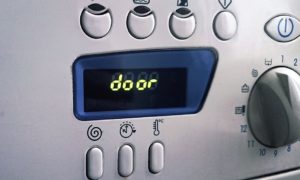 If an Ariston washing machine displays a "Door" error, owners familiar with English will immediately recognize the problem as a door issue. However, it's not that simple: this malfunction can also be indicated by the "F17" code or by the flashing of certain indicators. Our instructions will help you accurately diagnose the nature and extent of the problem, identify the signs, and repair the defect.
Nuances of code manifestation
First of all, it is necessary to recognize the “door” fault code. The easiest way is if the machine has a display and shows on the screen “door" or "F17». Along with this:
- after starting, the cycle and water intake do not start;
- the selected program is interrupted;
- The hatch door does not open at the end of the cycle.
The self-diagnostic system most often displays the “door” error on the display when the machine starts, less often at the end, and in extreme cases – in the middle of the cycle.
It's a different story if your Ariston washing machine doesn't have a display. In that case, you'll have to rely on the blinking indicators on the dashboard. The order and intensity of the indicators depend on the model.
- The oldest models have only two lights—power and door lock. Therefore, a problem with the sunroof can be identified by a series of 17 rapid flashes of the power button. The signal repeats at intervals of 4-5 seconds. Simultaneously, the selector rotates clockwise, and the unit makes an unusual clicking sound. This is often accompanied by the flickering of the door lock button.
- Ariston AV, AVL, AVTL, AVSL, and CDE models are equipped with numerous indicator lights. When a "door" error occurs, only two are illuminated: "Spin" and the bottom "Extra Rinse" or "Spin Speed Reduction" button. The "Key" indicator will also flash rapidly.
- Hotpoint-Ariston machines in the "Low-End" series (including ARSL, ARTL, ARXL, AVM, and ARUSL) indicate problems with the door closing differently. Here, pay attention to the LEDs labeled "Rinse" and "Key." Some are located in a vertical line near the cycle phase indicators. All other lights on the dashboard may also flash. However, the exact location of the signal buttons varies by model. For example, in Hotpoint Ariston machines of the ARTF, AVC, and ECOTF brands, the buttons are mounted vertically, while in ARTL, ARXL, BHWD, and BHWM, they are mounted horizontally.
- Hotpoint Ariston models without a display, such as the Aqualtis, such as the AQSL, AQS0L, and AQ9L, indicate the F17 fault by flashing two patterns. Most machines with six temperature indicators will flash the first and fifth ("No Heat" and "60°C"). If there are only five temperature settings, the LEDs next to the "No Heat" and "90°C" indicators will flash.
In most cases, it's easy to determine that the self-diagnostic system is displaying a "door" error. However, diagnosing the problem is only the first step. Next, you need to troubleshoot the issue and repair the unit. We'll explain how to do this in detail in the instructions below.
What broke?
Before considering how to remedy the situation, it's worth more precisely determining the nature and extent of the problem. Yes, the "F17" or "door" alarm code directly indicates an inability to close the door. This means the drum door isn't closing securely, or the control board isn't detecting the blockage.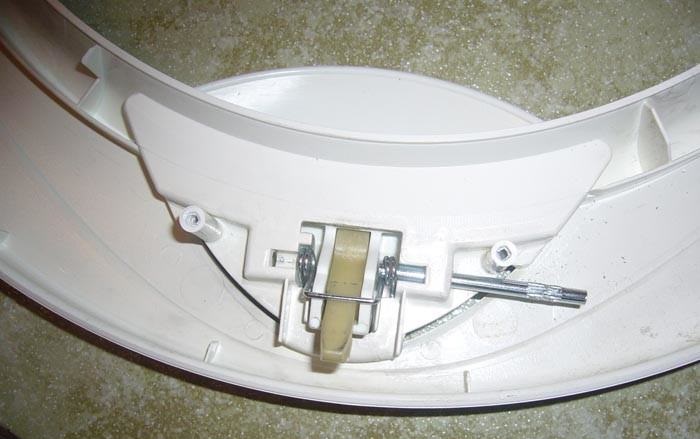
In other words, the hatch locking device or UBL has failed. This is an annoying problem and requires immediate attention. But it's not all bad: a real problem is rare, and more often than not, users are faced with their own carelessness or a program failure.. So, most likely, one of the common problems is taking place.
- The door isn't closed tightly. Often, in a rush, we don't press the door firmly enough against the frame or don't notice laundry stuck in the cuff. So, first, try opening and closing the door. If you hear a distinctive click, it's closed successfully.
- Power outages. Remember that if the voltage drops below 200 volts, the door lock will not function. This can happen when using an Ariston washing machine in a private home. To correct this, you need to add a voltage monitoring relay to the circuit.
- Dirty locking mechanism. If the machine isn't cleaned regularly, foreign objects or dirt may get into the opening for the door latch. A thorough inspection and cleaning will resolve the issue.
- Loose door hinge fasteners. This will prevent the latch from engaging the locking mechanism, preventing the door from closing properly. The necessary repair involves tightening the fasteners.
- System failure. The Ariston machine may simply malfunction: it may not register the blockage signal or display incorrectly. If this is the first time the error has occurred, it's best to restart the machine first. Simply unplug the machine, wait 5-10 minutes, and restart it. If the code disappears, the problem is solved.
- Loose contacts. The Ariston, like any washing machine, vibrates during washing. Excessive vibration often causes the wires to come loose, resulting in the "door" error message. To repair the machine, you'll need to carefully inspect the contacts.
Serious breakdowns are extremely rare. However, if none of the above issues are found, the problem lies elsewhere. To continue washing, you'll need to repair the machine yourself or call a professional.
Signs of breakdown and repair
Before you begin solving the problem, it's worth accurately diagnosing the problem. If the signs of a breakdown include a door that doesn't close, the lock disappearing mid-cycle, or the hatch not opening at the end of the program, then in 75% of cases the door lock is to blame. As already noted, it is responsible for maintaining a tight seal in the drum and the door. The device cannot be repaired; it must be completely replaced.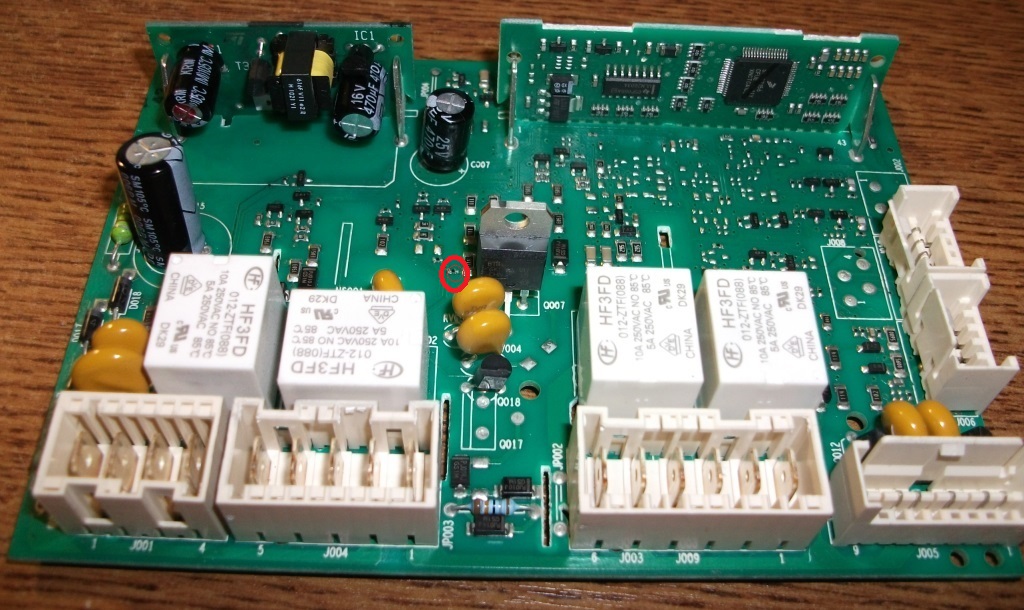
Another possible cause is a faulty control module. The control board coordinates the machine's operation, reading and transmitting commands from one component to another. When the electronic controller begins to slow down, the connection is disrupted and the system generates an error. This can be caused by burnt-out resistors, LEDs, triacs, or varistors.
Often, other problems are to blame for the “F17” or “door” display:
- oxidized or burnt contacts on radio components;
- failures in the control board firmware;
- faulty electronic controller processor.
If there are any problems with the board and radio components, it is necessary to repair, reflash, or replace the “brains” of the machine.
Worn brushes on the commutator motor may also be the cause. On many Hotpoint Ariston models, the board controls the door lock system by monitoring the circuit, which includes the motor. If the motor detects any faults, such as wear, carbon brushes, the system often interprets it as a problem with the hatch lock. Logically, repair requires replacement.
When an electric motor breaks down due to burnt fins or a broken winding, it must be replaced entirely.
If you can't close the hatch tightly because the door tongue doesn't fit into the opening in the housing or there's no click, try a different approach. First, pay attention to two things.
- Door hinges. The door is likely warped and won't fit into the factory grooves. Loose clips can be caused by mechanical impact, such as children riding on the open door. To continue washing, you'll need to replace one or both clips.
- The locking mechanism. The tongue can break either due to natural sagging or mechanical impact. As a result, the tongue does not fit into the groove. Disassembling the hatch and replacing the damaged parts will help solve the problem.
Often the guide of the locking mechanism “jumps out” of its seat, and it is enough to return it to its previous position.
The final cause of the "F17" or "door" error is damage to the wiring between the module and the locking device. Telltale signs include the lock failing to engage, disappearing during the wash cycle, or displaying an error message during the spin or drain cycle. Such problems can be caused by the conductor being abraded on a sharp edge of the drum or by rodents damaging the insulation. It's safer and more reliable to contact professional repairmen. If you decide to go it alone, avoid twisting or loose connections.
Interesting:
Readers' comments
Headings
Washing machine repair




For buyers




For users


Dishwasher




Add a comment