
Error E08 on a Candy washing machine
 It's impossible to imagine modern life without household appliances. But they often break down, forcing us to go beyond our comfort levels. Unfortunately, Candy washing machines are no exception. They are characterized by the E08 error, which occurs at the beginning of a wash cycle. At this point, the machine stops working, the door locks, and the laundry becomes trapped. What should you do in such a situation, what does this error mean, and how can you prevent costly repairs? We set out to address these questions in today's article.
Checking the tachometer and engine
Unfortunately, the included instructions do not include a detailed description of the E08 error. They only state that it occurs when the motor tachogenerator is open or shorted. It can also occur when the engine fails, and less commonly, when the control module is damaged. Based on the information provided, the following components should be checked for proper operation first:
- motor;
- tachometer;
- control module.
The inspection requires following a specific algorithm. The first step is removing the motor and tachogenerator, followed by the following steps:
- disconnecting the machine from the power supply;
- removing screws from the rear panel;
- dismantling the panel itself;
- removing the drivebelt while simultaneously pulling on yourself and turning the pulley.
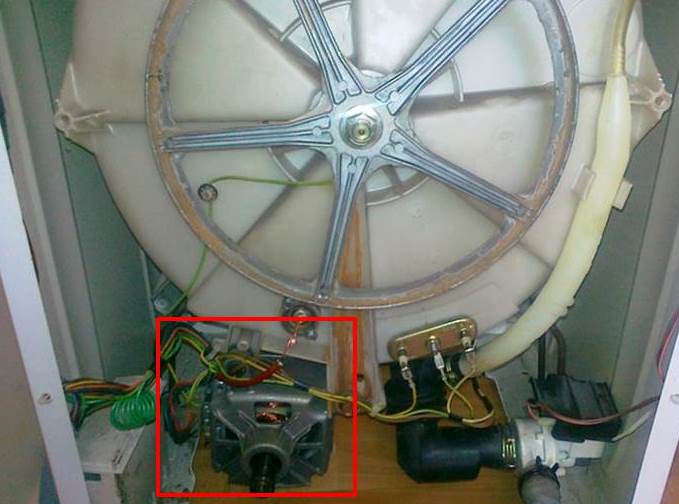
Next, remove the motor. It's recommended to label the wires coming from the motor to avoid any connection difficulties. Then, unscrew the bolts holding the motor in place and remove it from the housing. Now inspect the Hall sensor in the machine: strong vibrations could have caused the mounting or contacts to become loose. In this case, all you need to do is tighten the bolts and restore the connections.
If this wasn't the problem, you'll need to check the tachometer's resistance. There are two methods for this.
- Set the tester to resistance mode. Unclip the wire connectors and remove them from the sensor contacts. Then, attach the probes to the contacts to test the resistance. The normal range is considered to be from 60 to 70 Ohms.
- Switch the tester to voltage mode to determine whether current is being generated. To check, place the probes on the sensor contacts while cranking the engine. If the readings change (approximately 0.2 volts), the part is working properly.
It's imperative to check the wiring for integrity, as it's often the cause of tachogenerator failure. If the part is faulty, it will need to be repaired or completely replaced.
If the problem hasn't been identified yet, it's time to check the motor. First, check the brushes, and if they're worn, replace them.
You can purchase this part at specialized stores or use our custom-made service. To do this, simply search for the required part and find the right company.
So, using a multimeter, we check the wiring supplying the tachometer and motor for breakdown. If no breaks are found, we'll need to check the rotor and stator resistance. Next, we check for current leakage to the housing, followed by testing for interturn short circuits in the winding. A breakdown means the motor cannot be repaired due to the high cost of repair, and the best option is to install a new motor.
The control board needs to be checked
You can only conduct a superficial inspection of the module yourself for damage and burnout. Other inspections should only be performed by a specialist, who will immediately repair any faults detected with the E08 error. For a visual inspection, unplug the machine and follow these steps:
- removing the dispenser tray;
- unscrewing the front panel mounting bolts;
- release the plastic latches with a screwdriver and remove the panel from the case;
- The main unit is located behind the panel. Take a photo of it to document the wiring location;
- Sometimes you need to release the latches on the unit to get to the board.
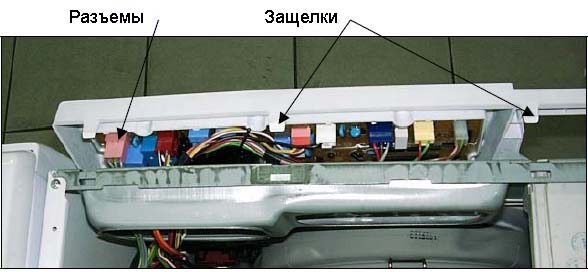
Afterwards, you'll need to thoroughly inspect the board. If there are any burnt spots, you should call a technician for repairs. Some parts can be repaired yourself. Prepare your soldering iron and purchase the replacement part.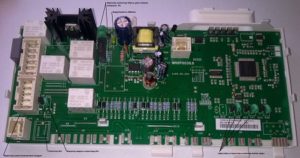
- A capacitor. It functions as a stabilizer, and to replace it, simply solder the purchased part to the positive electrode. To determine its location, you'll need to use a tester.
- Resistor. The tester also uses this component to check its functionality. For 1st order components, the optimal values are 8 Ohms and 2 A overload. For the second order, it's 3-5 A, and the resistance will depend on the module's frequency. Any deviation from the norm is a reason to replace the component with a soldering iron.
- Thyristor unit. To check it, the negative voltage is measured. The reading cannot exceed 20 V. Sometimes the unit's filter burns out, and repair involves cleaning the cathode.
- Trigger. To check its functionality, you'll need to measure the input voltage. The optimal value is 12 V, and for the trigger resistance, 20 ohms. To replace it, you'll need to use the same soldering iron.
If you've identified the burned-out component, desolder it and take it to a specialist store. The seller will find a similar part for you, and you can safely solder it in place of the old one. Just be careful not to damage the tracks leading to the component.
The integrity of the solder joint can be compromised by vibration during operation, causing the machine to display the E08 error code. Therefore, it is essential to ensure the machine remains stable during washing.
Experts know what to do if something breaks and how to properly troubleshoot it. Before attempting a DIY repair, consider whether you can handle it yourself. If you don't have soldering skills, contact a professional!
Interesting:


4 reader comments
Add a comment
Headings
Washing machine repair




For buyers




For users


Dishwasher




It's interesting to see how it works to pump out the excess through the filler neck. Generally, this is done through the dipstick hole. Using the filler neck is only for the most perverted.
Hello, if my Candy washing machine has a touchscreen, how can I replace the sensor?
It's strange, why does the description show an LG electronic module?
Why isn't the heating element on my Candy washing machine heating? The heating element is working. I applied power directly to it, it's heating, and the resistance is normal. I'm getting error code 08. I replaced the temperature sensor with a Samsung one. The machine works, doesn't display any errors, and washes, but doesn't heat the water.