
Error E21 in a Hansa washing machine
One of the advantages of most modern Hansa washing machines is a digital display that indicates the wash cycle status, selected mode, time, and other operational details. In the event of a malfunction, the display also alerts you with a coded message, and one of the possible SOS messages is error E21. To properly respond to the error code, you must first determine the nature of the malfunction. This article provides detailed instructions and guidance on the possible sources and scope of the problem.
The meaning of this code
Finding out the meaning of a warning message is easy: just consult the washing machine's manual or the user's guide for your specific model. If you don't have the technical documentation handy, no problem; the list of error codes is standard for most Hansa machines. Thus, with error E21, the machine reports that the drive belt has become blocked due to the lack of a signal from the tachogenerator. Incidentally, the problem described is very common with this manufacturer due to engineering flaws. The following may be the sources of the malfunction:
- a failed tachogenerator, including loose contacts or a weakened mount;
- broken thermal switch;
- Difficulty in the operation of the control board.
If your car is still under warranty and has an E21, you should immediately send it to a service center. If the warranty has expired, there's no need to contact a professional repairman for problems with the tachogenerator and thermal switch. Diagnosing the problem and what to do is easy. The main thing is to follow the instructions.
Checking the tachometer
To try to fix the problem yourself, you need to properly determine the cause of the problem. In most cases, the E21 error is caused by a faulty tachometer. It's located directly on the motor and controls the drum speed. Accessing the sensor requires several steps.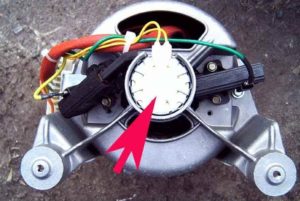
- Disconnect the machine from the power supply, sewerage system and turn off the water supply tap.
- Ensure free access to the unit by moving it away from the wall or removing it from the cabinet.
- Remove the back panel by unscrewing the corresponding screws with a Phillips screwdriver.
- Remove the drive belt by pulling the rubber towards you while simultaneously rotating the pulley.
- Mark the wires connected to the engine and disconnect them.
Important! Be sure to take proper markings or photographs to ensure proper installation and avoid mixing up contacts during reassembly.
- Unscrew the bolts holding the engine and, shaking the motor, remove it from the housing.
- Inspect the Hall sensor connected to the motor, checking the clamping force and the existing contacts. If any of these are loose, tighten the terminals, restore the connections, and return to their original position.
Once there are no doubts about the contacts and fasteners, we test the tachogenerator for functionality. To do this, simply measure the resistance or voltage. First, we check the resistance by unclamping the connectors and placing the multimeter probes across the contacts. If the display shows numbers within 60-70 Ohms, then the sensor is working properly. Another option is to measure the current output. Switch the meter to a new setting and apply the connectors while rotating the motor. The optimal reading is around 0.2 volts.
A negative result requires replacing the tachometer sensor. It's important to avoid mistakes here, so remove the removed part and take it back to the store for clarity. Reinstall the sensor using the same procedure.
Testing the thermal switch
If the result is positive, we leave the tachogenerator alone and continue troubleshooting the thermal switch in the Hansa washing machine. Disconnect the machine from all power supplies again, open the back cover, and inspect the heating element. Disconnect the wires going to the external thermostat and loosen the retaining fasteners. Then, remove the water heater and remove the thermistor located inside.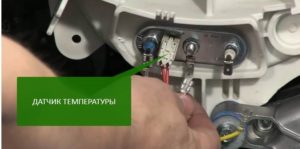
Now we check the sensor for sufficient resistance:
- We take a multimeter and set it to measure Ohms.
- We apply the probes to the corresponding contacts of the thermal switch.
- We record the displayed value: at a temperature of 200 degrees 6000 Ohm.
- We immerse the sensor in hot water.
- We evaluate the results: for a working device, the figure will change downwards, and at a temperature of 500 degrees it will not exceed the 1350 Ohm mark.
If the existing figures are far from normal, the thermistor will have to be replaced. The sensor cannot be repaired unless you purchase a new one based on the serial number and model of the washing machine. Subsequent installation of the device and assembly of the machine will not cause any trouble: simply proceed in reverse order.
Successful tests with the thermostat and tachogenerator indicate one thing: the control board is to blame for the E21 error displayed on the display. It's best not to attempt DIY repairs, as the control module is overly sensitive to outside manipulation. Any incorrect movement will lead to serious consequences, requiring a costly service call. We recommend calling a qualified technician immediately instead of attempting to fix the problem yourself.
Interesting:
1 reader comment
Add a comment
Headings
Washing machine repair




For buyers




For users


Dishwasher




The board was resoldered, the tachometer sensor was replaced, and the thermal switch still needs to be checked. But I don't understand one thing: how is it related to the problem?