
Error code E56 on a Bosch tumble dryer
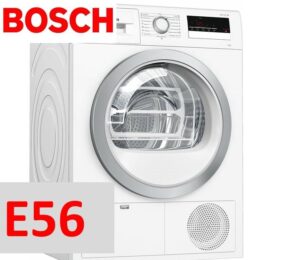 Some dryer problems can be fixed in just a few steps, with minimal time, effort, and expense. Error E56 isn't one of those problems. In most cases, resetting it requires an expensive Bosch dryer repair.
Let's figure out what kind of malfunction error E56 indicates. Is it possible to repair the dryer yourself? How can you prevent this kind of malfunction?
What is the nature of E56 and what caused the error?
Service center technicians, when confronted with this code, understand that repairing a Bosch dryer will likely cost a pretty penny. The main reason for the error E56 – main control unit damage. In most cases, Bosch dryers will behave the same:
- the device will emit three beeps;
- the dryer will freeze;
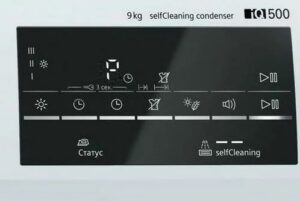
- the display will show error E56;
- the equipment will not respond to user commands.
According to statistics, in 56% of cases, to resolve the E56 error, it is necessary to repair or replace the main electronic module of the Bosch dryer.
How much would such a repair cost? The cost of a control unit varies greatly depending on the Bosch dryer model, ranging from $60 to $170. Before purchasing an expensive module, you need to make sure it's the culprit, as in the remaining 44% of cases, the cause may be different.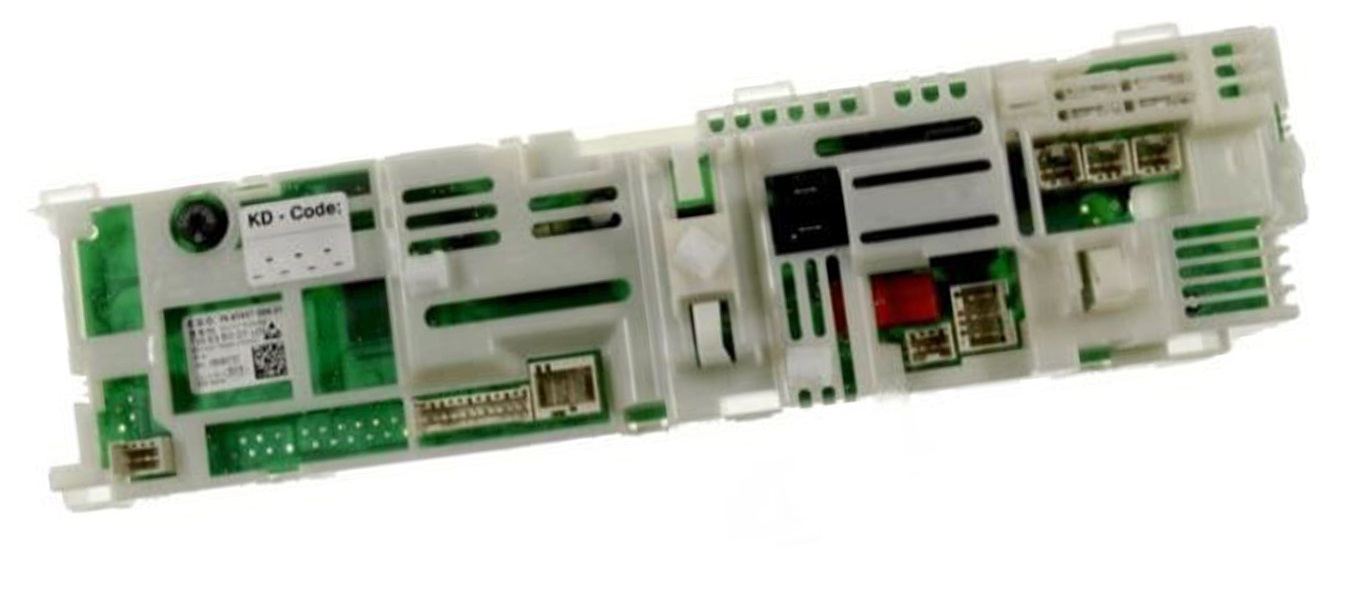
- A faulty electrical outlet. A poor connection within the power outlet can trigger the code. To check, connect another powerful electrical appliance to it. It's recommended to use a separate, high-quality, moisture-proof outlet for dryers.
- A damaged sensor. This element monitors the temperature in the drying chamber. A faulty sensor can cause an E error. The sensor is tested with a special device – a multimeter.
- A faulty heating element. Sometimes the E56 error indicates a problem with the heating element. In this case, replacing the heating element is sufficient.
- Dirt accumulated inside the dryer. In some cases, dust, especially in the airflow system, causes the error. This leads to overheating, causing the display to show an E. Regular cleaning of the machine will help prevent this problem.
If you notice your Bosch dryer displaying the E56 error code, begin troubleshooting. The checklist works from the simplest to the most complex. Make sure the outlet is working, the appliance is clear of dust, and the heater is functioning properly. However, most often, it's the control module that needs to be addressed.
How to repair a dryer?
A dryer displaying the E56 error code will not function until the user resolves the issue. If the problem lies with the outlet, dust accumulation, sensor, or heater, you can fix it yourself. If the module is the culprit, it's best to entrust the repair to professionals.
A complete replacement of the electronic unit is not always required; sometimes the module can be restored.
If the board can be repaired, this will be reflected in the repair cost. To restore the control module's operation, it is sometimes sufficient to solder the tracks, clean the contacts, or replace the semiconductors. Then the dryer owner will only need to spend $30–$40. This is much cheaper than installing a new electronic unit.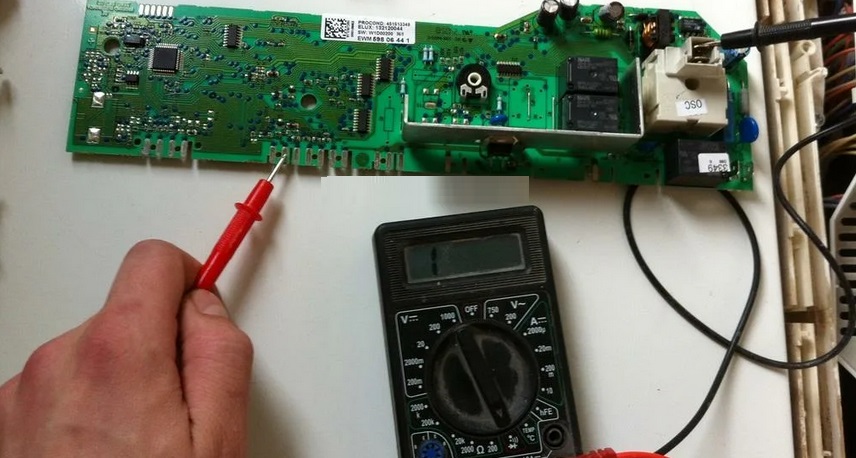
In situations where the control module is damaged beyond repair, the only solution is to replace the component. Before installing a new board, you need to determine the cause of the damage. Otherwise, the problem will reoccur.
In 95% of cases, the control module of a Bosch dryer is damaged due to a sudden power surge. Electronics are very sensitive to such fluctuations. This problem can be prevented by protecting your dryer from such influences.
Protect your home appliances
Unfortunately, power surges are not uncommon. While users may not notice such fluctuations, household appliances react acutely to them. A strong surge can be detrimental to a dryer, washing machine, electric stove, or refrigerator.
To protect your Bosch dryer, it's best to connect it through a voltage stabilizer.
This device will help prevent damage to the electronic module of your Bosch dryer. A voltage stabilizer is not cheap, but it will prevent damage to all major appliances in your home. Therefore, a single purchase will save you from several costly repairs in the future.
Which stabilizers are worth considering? We'll tell you about the three best protective devices that are 100% effective in their intended purpose.
The RUCELF SRWII-10000-L voltage stabilizer is an extremely reliable device that automatically regulates electrical voltage. Using six-speed relays, it instantly responds to changes in input current. It protects household appliances from: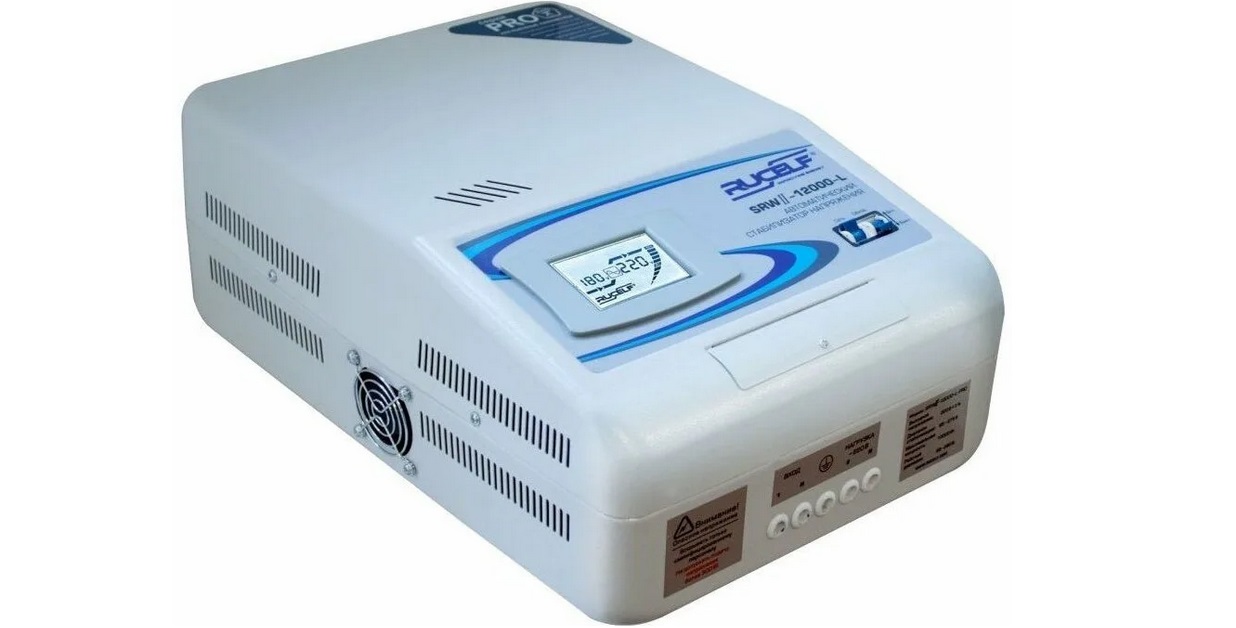
- overheating;
- short circuit;
- high voltage.
The stabilizer has compact dimensions. The housing is 44.5 cm wide, 34 cm high, and 31 cm deep. Efficiency is 97%. The minimum input voltage is 95 V, and the maximum is 275 V. Its modern design allows the device to fit into any interior. All important parameters are displayed on the LCD display.
The stabilizer has an IP20 protection rating, meaning it can operate in high humidity and dusty conditions. Other specifications:
- type – relay stabilizer;
- input voltage – single-phase;
- error – maximum 8%;
- output signal is an undistorted sine wave;
- operating temperature range – from -20°C to +40°C;
- noise level – 40 dB.
The device is connected via terminals, ensuring ease of use and safety. The modern RUCELF SRWII-10000-L costs approximately $200. It is suitable for home or office use.
There are more affordable options. For example, the LUX RESANTA ASN-5000N/1-Ts relay stabilizer. It's designed to protect electrical appliances with a total power of up to 5 kW. The device is equipped with: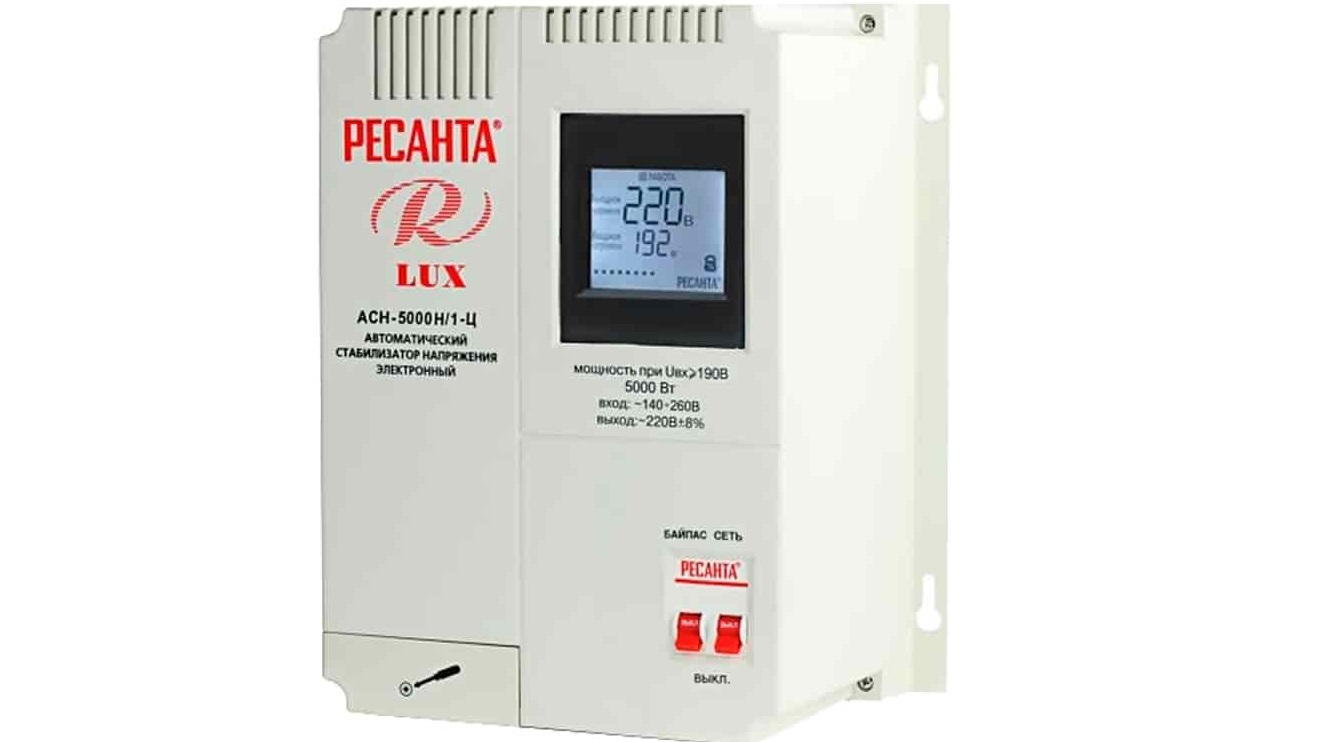
- noise suppression filter;
- microprocessor control;
- digital voltage indicator.
When the voltage threshold is exceeded, the device automatically shuts off power to electrical appliances. The response time is less than 1 second, or 15 ms to be precise. Suitable for single-phase networks.
The Resanta voltage stabilizer also protects equipment from overheating and short circuits. Efficiency is 97%. Output voltage tolerance is 8%. Protection class IP20. Operating temperature ranges from 5°C to 40°C. The device costs approximately $120 and can be wall-mounted.
Another option is the single-phase REXANT ACH-5000/1-C. It is designed to protect household and industrial electrical appliances from voltage surges and short-circuit currents. It is rated for input voltages from 140 to 260 volts. The operating temperature range is from 0°C to 45°C.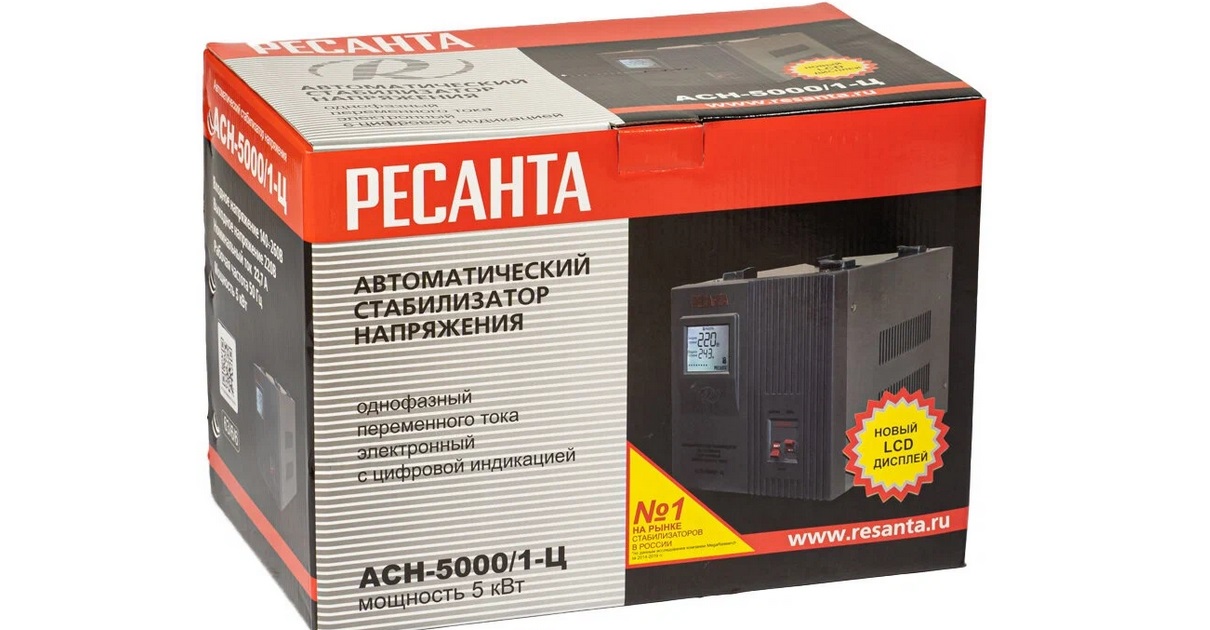
The stabilizer provides an output voltage of 220 volts, plus or minus 8%. The relay-type device has an IP20 protection rating. The device is floor-mounted and weighs 11 kg. The REXANT ACH-5000/1-C costs approximately $110.
Interesting:

Readers' comments
Headings
Washing machine repair




For buyers




For users


Dishwasher




Add a comment