
Error F04 in a Bosch washing machine
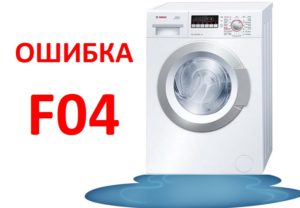 Thanks to a sophisticated self-diagnostic system, Bosch washing machines can automatically detect a malfunction and notify the user via a special code. This error code helps not only users but even experienced technicians, significantly reducing troubleshooting time. Error F04 in a Bosch washing machine is a prime example of the self-diagnostic system's success, and today we'll examine this error in detail.
Decoding this code
Error code F04 is most often deciphered by the user themselves, intuitively, so to speak. Unfortunately, this error indicates very obvious malfunctions that can be seen with the naked eye. In short, error code F04 indicates a water leak.
Typically, when this error occurs, a fairly large puddle forms on the floor beneath the washing machine. This puddle is impossible to miss, so the user will immediately recognize a leak, but where exactly is it? Sometimes only a specialist can answer this question; the user may not always be able to detect the culprit on their own. But let's not give up prematurely.
Bosch washing machines with full leak protection may not drain beyond the tray. A sensor will be triggered and shut off the water flow, but some water will usually end up on the floor.
Causes and methods of elimination
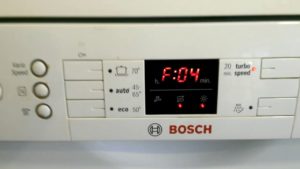 Why might a Bosch washing machine leak? There are many possible causes, so let's look at a few examples.
- Getting sharp metal objects into the washing machine tank: bra underwire, hairpins, pins, etc. The object gets wedged between the drum and the tub wall, damaging the latter. Previously, when many washing machines had metal tubs, this wasn't a problem; nowadays, tubs are made of plastic, which is quite fragile.
- A manufacturing defect. The hose, pump, and perhaps the tank itself were defective. Manufacturing defects are insidious, and they may not appear immediately, but rather after some time. In Russian-made Bosch washing machines, the tanks sometimes burst at the seams.
- The inlet hose is damaged. This is a common problem. The inlet hose experiences significant water pressure. Even the slightest damage can cause a leak.
- A loose dust filter. Your washing machine's dust filter needs to be cleaned regularly. If you've recently done this, you may not have screwed the filter back in all the way. Even the slightest gap can cause a leak.
- Clogged powder drawer. Leakage may occur through the drawer if it is heavily clogged.
- Damaged hatch seal. If the seal is simply torn, it won't provide a reliable barrier to water leaking through the hatch cover directly onto the floor.
These are probably the most common causes of washing machine leaks. To figure out what exactly is leaking, you need to try to at least roughly locate the leak. For example, if water was leaking down the front wall of the washing machine, the leak is located near the detergent drawer. If water is flowing down the back of the machine from somewhere above, you need to inspect the base of the inlet hose closest to the machine. Basically, you need to use your ingenuity and carefully inspect your "home helper."
If you can't visually detect the leak without disassembling the machine, turn off the power, move it to the center of the room, and remove the back panel. Removing the back panel will give you access to the drum and allow you to inspect the drip tray. The source of the leak may still be leaking, allowing you to pinpoint the exact location of the damage.
A leaking tank, pipe, hose, or other component must be replaced. That's the first rule. No tape, soldering, or other unnecessary or ineffective repairs. Such repairs are not reliable. Purchase an original part and install it in its place. If you can't handle the repair yourself, calling a professional is even better. Good luck!
Interesting:


Readers' comments
Headings
Washing machine repair




For buyers




For users


Dishwasher




Add a comment