
Siemens washing machine error code F12
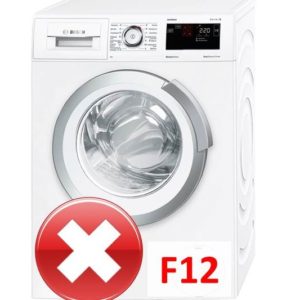
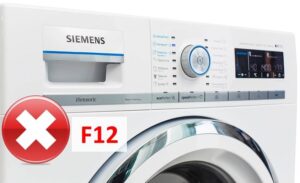 If your Siemens washing machine displays the F12 code, you'll need to check the motor. Typically, this means the machine can't spin the drum: the motor is faulty or has lost connection. With this error, the drive belt often remains in place, and the control board is also unsuspected—a different combination is used to cause it. So, we immediately move on to diagnosing the motor, assessing the condition of the brushes, windings, and fins.
We will find and check the motor
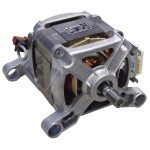
Checking the motor's functionality yourself is easy. The main thing is to know in advance what to do and in what order. Be sure to study the type and operating principle of the motor installed in your Siemens. Siemens washing machines, for example, are equipped with commutator motors, which require a drive belt. Unlike inverter motors, they are cheaper, more compact, more powerful, and easier to operate and repair. However, there is a downside: commutator motors are more prone to failure, as some components wear out quickly and require replacement.
Error F12 indicates problems with the motor: a broken unit, worn out brushes, peeling fins, or damaged windings.
The design of a commutator motor includes a rotor, a stator, and two brushes. The fins and winding are responsible for transmitting current through the mechanism. A sensor is always present that monitors the speed of the motor. When performing a DIY diagnosis, each element mentioned is checked sequentially. But first the engine needs to be removed: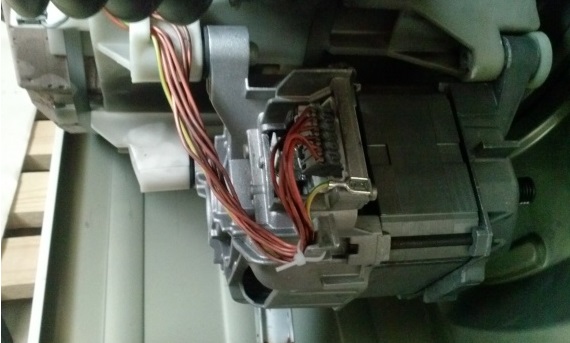
- remove the back panel from the Siemens case;
- pull the drive belt off the pulley;
- find the engine located under the tank on the right side;
- take a photo of the connector or remember the location of the terminals to make reconnection easier;
- disconnect the wiring connected to the motor;
- loosen the fixing bolts;
- After rocking, remove the engine from the "nest".
The first step is to test the motor itself. The procedure is simple: connect the wires from the stator winding to the rotor and apply 220 volts to them. If the motor starts running and spins the shaft, then the mechanism is working properly. In this case, we move on to diagnosing the individual components of the Siemens washing machine motor. If the motor doesn't move, it's a clear sign of a problem and requires replacement.
Despite the test's simplicity, it must be performed with extreme caution. First, be careful when manipulating the voltage. Second, avoid overheating the motor due to a direct connection. It's better to play it safe and connect the heating element to the circuit, as it will heat up during a current leak, absorbing the full impact. Third, remember that such diagnostics are only superficial and don't provide insight into how the component will operate at different speeds.
The brushes are worn out
The second diagnostic step involves the electric brushes. They are attached to the motor housing and are responsible for smoothing out the outgoing friction force using specially designed carbon tips. If the carbon tips wear down significantly, the motor begins to spark, and the board detects overheating and generates error code F12. The electric brushes are tested as follows: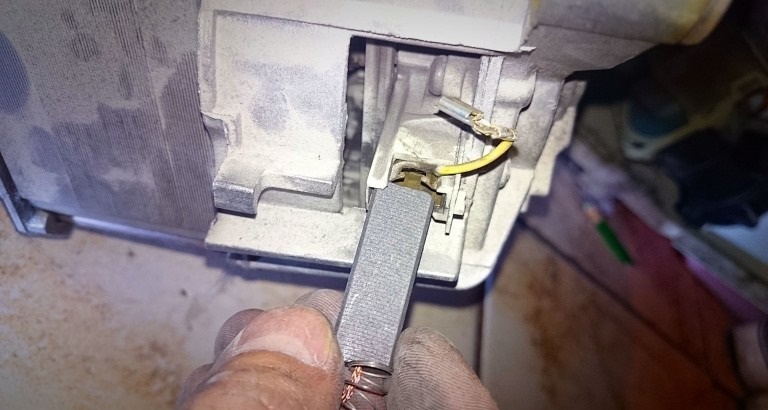
- unscrew the fixing bolts;
- compress the spring;
- we detach the brushes from the housing;
- we open each “case”;
- We measure the length of the tips.
When purchasing new brushes, refer to the Siemens model serial number.
An error code is displayed if the length of the "carbon" on one of the brushes is less than 1.5 cm. There is only one solution: replace the brushes, and always in pairs. Install the new brushes according to the instructions in reverse order.
We check other engine parts
The repair continues with diagnostics of the lamellas. These are metal plates that are glued to the shaft and transmit current to the rotor. Over time, they become damaged or peel off, leading to motor failure. In case of minor peeling, it's enough to smooth out the burrs with sandpaper, but severe peeling will require a complete replacement of the device.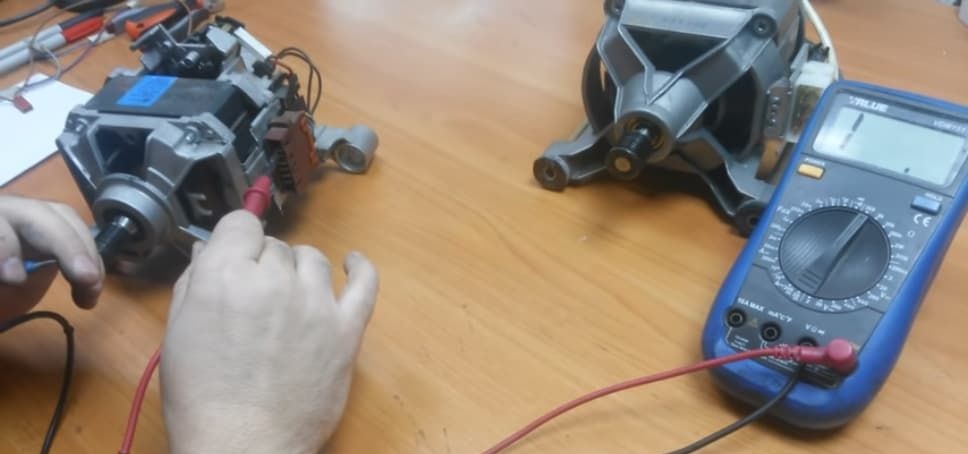
Winding problems can also cause error F12—the motor won't start or accelerate quickly. When current is applied, a short circuit occurs, the motor heats up, the thermistor detects overheating, and the control board is forced to reset the program. Ultimately, either the temperature sensor or the motor itself fails. The winding is tested with a multimeter:
- turn on the "Ohmmeter";
- we touch the lamella with feeler gauges;
- We look at the result (the norm is from 20 to 200 Ohms, deviations indicate a short circuit or an open circuit).
Then we turn on the buzzer and test the stator for breakdown. If a current leak is detected, the situation can only be corrected by replacing the motor. We buy a new motor, install it and run a test wash.
Interesting:

Readers' comments
Headings
Washing machine repair




For buyers




For users


Dishwasher




Add a comment