
Siemens washing machine error code F18
 While the machine is washing and spinning reliably, housewives don't realize that the display not only allows them to monitor the washing status and time, but also promptly detect any system malfunctions. Any malfunction detected by the system is immediately displayed on the display as a combination of alphanumeric characters, which, once deciphered, makes it easier to diagnose the source of the problem and resolve the issue.
For example, error code F18 in a Siemens washing machine indicates a malfunctioning drain. We'll explain in detail what caused the malfunction, where to look for the culprit, and how to repair your "home assistant" yourself in this situation.
Why did the error occur?
No Siemens washing machine error code will pinpoint which system component is causing disharmony in the otherwise well-oiled machine. The error code will only help promptly detect the system's SOS signal and narrow down the range of possible problems. The F18 doesn't have many:
- Clogged pipes, filter, pump impeller, hose or sewer.
- Pump failure.
- Kinking or displacement of hoses or pipes.
- Control module failure.
The last cause involves a loss of communication between the pressure switch and the corresponding triac. The former is a water level sensor, consisting of a small disc on top and a long tube lowered into the tank to measure pressure. It registers the amount of water in the machine and transmits the collected information to the control board. If the information is not received due to a faulty triac, the system will not issue a drain command or allow the spin cycle to begin.
To avoid guessing, it is recommended to conduct diagnostics yourself. There is a high probability that error F18 is the result of a blockage, which can be easily fixed without the help of professional repairmen. To begin with, we recommend conducting several tests and identifying your home assistant’s “sore spots.”
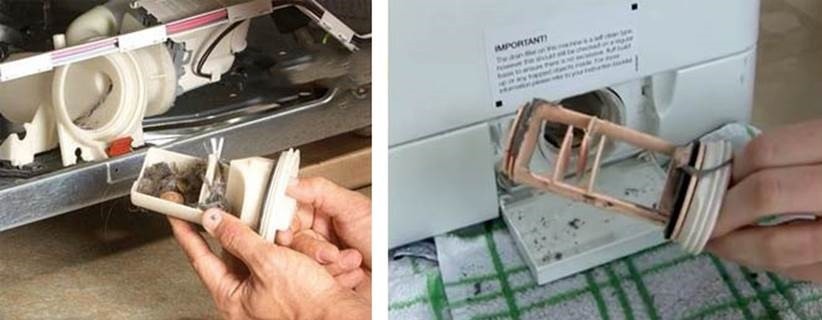
We will check for blockages in accessible places
Knowing what to do when the F18 code appears allows you to check the drainage system yourself, without any assistance. Moreover, repairs don't require any special knowledge or experience. The key is to act consistently and follow the instructions.
First, let's inspect the plumbing components for blockages. Here's how:
- Disconnect the washing machine from the power supply.
- We find the drain hatch in the front, in the lower right corner of the body.
- We open it with a flat-head screwdriver so that the two latches holding the door are engaged.
- Prepare dirty rags and a container to collect water.
- We take the emergency hose located next to the filter, loosen the clamp and drain the water.
Important! If the emergency hose is empty, the drain pipe is clogged and water is unable to drain from the tank (see the end of this section for instructions on what to do in this case).
- We unscrew the trash filter.
- We thoroughly clean it from scale and dirt.
- We inspect the pump impeller, and if there is any hair wrapped around it, we ensure that it rotates freely.
- We remove the clamps on the drain hose, remove it and clean it under a strong stream of water.
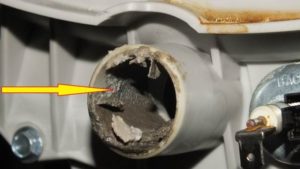 Although rare, it does happen that debris has accumulated not in the machine itself, but in the building's sewer system. It's easy to check: turn on the spin cycle and insert the drain hose into a toilet, sink, bathtub, or basin. Freely flowing water clears the machine of any suspicion.
Now let's return to the drain hose. It connects the pump and the drum, and if there's debris in the hose, the water becomes blocked and can't drain out of the drum. To confirm this, we'll need to access the pump housing through the bottom of the machine.
Siemens units often lack a bottom panel, so simply tilt the housing back, reach the tube, disconnect it, drain the accumulated liquid, and check for blockages. Rinsing with high-pressure water will help clear the blockage. If there is a tray, first unscrew the retaining bolts, not forgetting to carefully detach the leak sensor wire. The latter is designed for emergency shutdown of the machine when water enters the base compartment to avoid flooding and short circuits.
Let's check the pump thoroughly.
If the hoses and pipes don't look suspicious, check the pump. It could be clogged, burnt out, or cracked. In some cases, a DIY repairman can handle the problem. But first, you need to get to the part.
- We de-energize the machine, turn on the water supply tap and disconnect the drain hose from the sewer pipe.
- We open the drain hatch located in the front lower right corner.
- We empty the machine through the emergency drain or trash filter.
- We provide free access to the unit from all directions.
- We prepare rags and containers to collect water.
- We take out the powder receptacle by pulling it sharply towards ourselves.
- Turn the washing machine over onto its right side.
- We remove the bottom by prying it up, pulling off the latches and disconnecting the leak sensor wire.
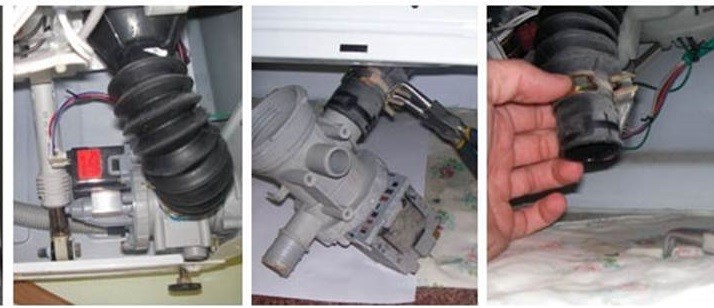
Don't rush into checking the pump's functionality with a multimeter. Most often, the problem lies not in the electronics, but in debris inside the housing. Despite a well-designed filtration system that traps foreign objects and dirt in the debris filter, some hair and fur still get caught in some parts. Therefore, you'll need to disassemble the pump and clean it of any debris that might hinder its operation. This is easy to do:
- we fix the location of the wires on the camera or using markings;
- we disconnect the connected wiring;
- loosen the clamps with pliers;
- remove the hose and branch pipe;
- We hold the pump firmly by the body and turn it half a turn counterclockwise.
Insert a screwdriver into the existing hole at the center joint and remove the top cover. Now carefully inspect the internal mechanism, clean away any scale and dirt, check the integrity of the gaskets, and clean the contacts. Afterward, test with a multimeter. If the pump is working properly, the display will show a three-digit number, while a "0" or "1" indicates a complete replacement is needed.
Even if the hoses are clean and the pump is working, there's a good chance the control board is damaged. Trying to fix the problem yourself can lead to further damage, so we strongly recommend entrusting electronic repair to professionals.
Interesting:
Readers' comments
Headings
Washing machine repair




For buyers




For users


Dishwasher




Add a comment