
Error F6 in the Atlant washing machine
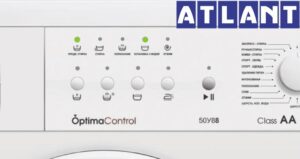
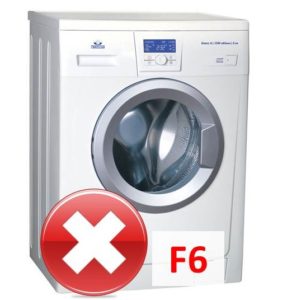 The F6 error code appears on my Atlant washing machine at the very beginning of the wash cycle. The user starts the cycle by pressing the "Start" button, but the drum remains motionless, and the self-diagnostic system displays a "six" on the display. The program freezes and requires the code to be reset. We suggest understanding what the F6 error code means and how to reset it.
Let's decipher the code
Understanding this code isn't difficult. In the manufacturer's instructions, the "F6" code stands for "reverse relay failure." Simply put, the Atlant washing machine's motor won't start.
Error F6 on Atlant washing machines indicates a motor failure.
From a technical standpoint, a normal engine start looks like this:
- the user starts the machine by turning the selector and pressing “Start”;
- the control board gives the command to start the machine;
- the starting current is supplied to the engine, or more precisely to the relay coil;
- a magnetic field is formed, which gradually draws in the core;
- the core in turn sets the contact in motion and closes the circuit;
- The motor winding is activated, the engine starts and picks up speed.
If the engine does not start, then a failure occurred in the fourth step. Main reasons: overheating of the winding or damage to the relay contacts. Damaged electric brushes and peeling lamellas also cause malfunctions.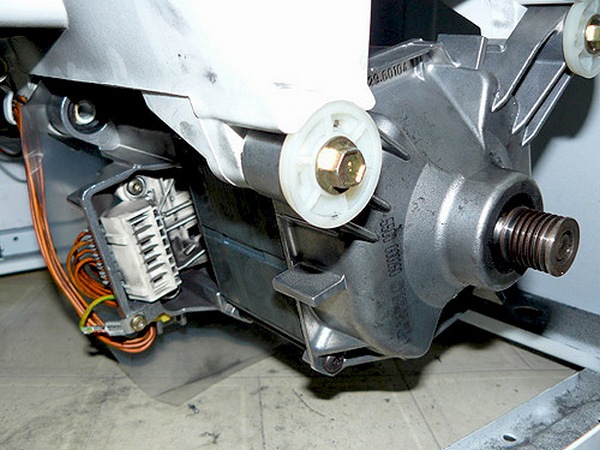
Diagnostics will help more accurately determine the nature of the malfunction. But before testing the engine, it's important to rule out a random system glitch. Therefore, unplug the power cord from the outlet, wait 15-20 minutes, and try again. If the error persists, you'll need to troubleshoot the problem.
Engine test
It's best to entrust engine diagnostics to a professional repairman. However, you can figure out what to do and in what order on your own. The main thing is to first familiarize yourself with the engine's design and remember safety precautions. Our instructions will help you with the task.
Before starting the repair, let's review how the motor works. Atlant washing machines are equipped with a brushed motor, which is compact and more powerful. The drive is belt-driven – a belt connects the motor and the drum shaft via a pulley wheel. Internally, the motor consists of several main components: a rotor, a stator, and electric brushes. A tachogenerator, which controls the acceleration speed, is also present.
Atlant washing machines are equipped with collector-type motors.
To begin checking the motor, you need to remove it from the machine, following these steps:
- remove the back wall of the machine by unscrewing the corresponding screws;
- by rotating the pulley, unhook the drive belt;
- take a photo of the position of the wiring connected to the engine;
- release the wires;
- loosen the engine retaining bolts;
- swing the part and pull it towards you.
After removing the motor, place it on a dry, level surface and begin testing. Connect the wiring from the stator and rotor windings, then apply 220V power. The motor should begin to accelerate. If this doesn't happen, the motor is damaged and requires repair.
This method has its drawbacks. Firstly, it's impossible to test the motor's operation in various modes. Secondly, connecting the motor directly is risky due to the possibility of a short circuit. However, in a pinch, you can reduce the risk by adding a ballast, such as a heater, to the circuit. If a leak occurs, the heater will heat up, protecting the motor from fire. However, applying current is only the initial diagnostic step; other components of the device, such as the brushes, fins, and winding, must be checked next.
At the same time, we look at the brushes, lamellas, and winding
Error code F6 is also displayed due to faulty electric brushes. There are two of them on the motor, located on the sides of the housing. These small casings contain springs and carbon tips. The carbon tips wear out during use, as they smooth out the friction force emitted by the motor.
It's necessary to check whether the carbon deposits on the brushes are significantly worn down. Here's how to do it: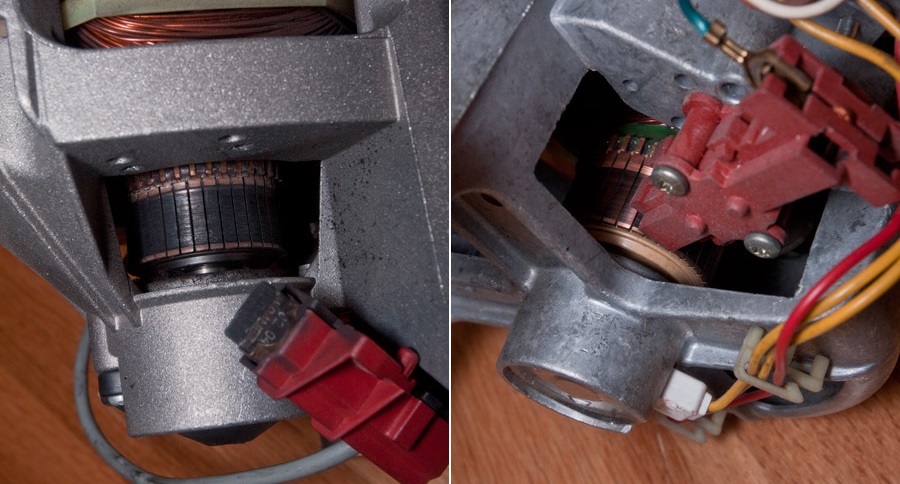
- loosen the bolts holding the brushes;
- we compress the springs and detach the brushes from the housing;
- we open the case of each brush;
- We evaluate the length of the tip (normally the length is more than 1.5 cm).
Electric brushes are changed only in pairs!
If the carbon on the brush is less than 1.5 cm, they need to be replaced with new ones. Replace the parts in pairs, even if the second one hasn't worn out yet. A replacement is selected based on the serial number of the engine or washing machine. Ideally, you should bring the damaged electric brushes to the store and ask them to find a replacement. For installation, follow the instructions above, but in reverse order.
Next in line are the lamellas. These are metal plates that are glued directly to the shaft, transmitting current to the rotor. However, over time, the layers deteriorate and peel off, leading to disrupted current flow. If the peeling is minor, the defect can be sanded down on a lathe or with sandpaper.
The motor also fails to start if the winding is damaged. A break in the wire circuit causes a short circuit, causing the motor to overheat. The temperature sensor detects the critical temperature and automatically cuts off the current. The problem repeats itself the next time the motor is started, and repeated starting will damage the thermistor. To repair the device, a few simple steps are required.
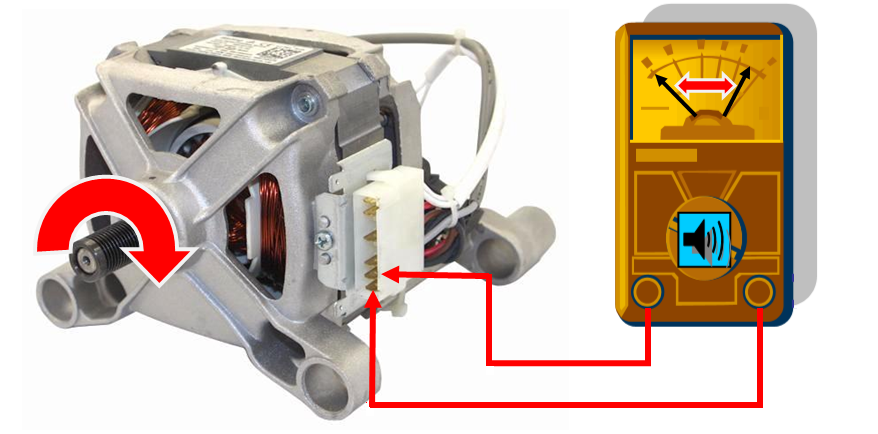
- Take a multimeter.
- Enable Resistance mode.
- Apply the feeler gauges to the lamellas.
- Evaluate the result (normal: 20-200 Ohm).
If "1" lights up, there's a short circuit; if "0" lights up, there's an open circuit. It's also a good idea to check the stator for breakdown: turn on the buzzer and attach the probes. Repairing a damaged motor is pointless—it's cheaper to buy a new one.
Interesting:


Readers' comments
Headings
Washing machine repair




For buyers




For users


Dishwasher




Add a comment