
Electrolux dishwasher error code I30
 What should you do if the I30 error has paralyzed your Electrolux dishwasher? Will you have to go back to washing dishes by hand? We suggest you don't panic and instead try to figure out the cause of this error code yourself. This article will cover how to do this and how to fix the problem once identified.
What does the code mean?
The Electrolux dishwasher user manual provides a brief explanation of the I30 error code. Apparently, the I30 error code indicates that the Electrolux dishwasher's overflow protection has been activated. This description is rather blunt, considering there can be many possible causes for an overflow. How can you figure out what exactly is wrong with your dishwasher?
In this case, it's necessary to identify the causes of the I30 code to at least roughly define the search area. We'll begin with this step, after first disconnecting the inoperative dishwasher.
- It is necessary to inspect the dishwasher for leaks, and if there are any, look for the places where these leaks occurred.
- Inspect the waste filter and drain line for blockages.
By the way! A clog can occur not only in the dishwasher but also in the drain, in which case the dishwasher will also respond with an I30 error, so be careful.
- Inspect the drain pump for blockages and damage.
- Check the fill valve; it may be clogged and not closing completely, or it may be completely out of order.
It's all about the leak
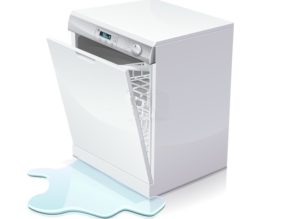 Now that we've identified the list of possible problems that could trigger the I30 code, we need to find the specific fault that's occurring in your machine and then figure out how to fix it. The vast majority of Electrolux dishwasher models have a tray that collects water in the event of a leak. The first thing you need to do is check for water in the pan. If there is no water, skip this step and move on to the next one. If there is water, drain it, dry the pan with a hair dryer, and then:
- unscrew the top cover;
- remove the side walls;
- Do not remove the tray yet, but instead start the machine.
You might be wondering, why bother with a faulty dishwasher, especially one that's partially disassembled? It's very simple, as this is how you can see where the water is leaking or dripping. Once you've identified the leaking part or component, you can carefully remove the tray and replace it. As a last resort, you can seal the leak with sealant, although experts strongly advise against this, as this repair is short-lived. However, if you don't have the necessary part on hand and can't afford it soon, this repair is better than being without a dishwasher.
If you must use sealant for a temporary repair, carefully monitor the dishwasher while it is running, and when the opportunity arises to replace the damaged part, do so immediately.
Blockages
Once we've confirmed there's no leak, we'll check the dishwasher for blockages. It's best to start by checking not the dishwasher itself, but the drain hose and sewer line; this is easier than accessing the inside of the dishwasher. The hose can be removed and visually inspected, and the sewer line can be inspected as follows:
- open the mixer tap, ensuring a decent water pressure;
- see how the water goes into the sewer;
- If the water drains slowly, we clean the drain with a plunger or a cable; if the water drains well, we look for a blockage in the dishwasher.
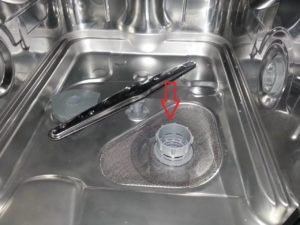
We start searching for a blockage in the dishwasher with the trash filter. Replacing and cleaning the dishwasher filter, usually helps resolve these types of issues. Statistically, the I30 code is triggered 27% of the time by the debris filter, so regularly cleaning it is a priority even during normal dishwasher use, not to mention when a breakdown occurs.
Next, we need to remove the oil pan and inspect all the hoses and other components. This is a meticulous job that requires some effort and time, so it's best to hire a professional who can do everything quickly and professionally.
Problems with the drain pump
An overflow can also be caused by the drain pump. The pump may be working poorly or not working at all. The I30 error code usually occurs if the pump is clogged, meaning the impeller is blocked by foreign objects or scale. It's also possible that the impeller is damaged and needs to be replaced, which is why the pump isn't pumping water properly. In either case, the pump should be inspected, and a decision should be made based on what a disassembly reveals.
Despite the fact that the Electrolux dishwasher has a built-in ion exchanger, the water quality leaves much to be desired. Along with the water, a large number of impurities enter the machine, which over time damage the internal components.
Disconnect the pump, disassemble it, and inspect it. Clean the blocked impeller, check its rotation, and reassemble the pump. If the impeller is broken, replace it with a new one. If the impeller is intact but the pump shows no signs of operation, test it with a multimeter. If a fault is detected, the entire pump must be replaced.
The inlet valve is faulty
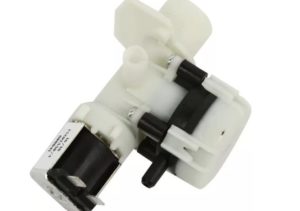 Let's look at it from a different angle. The problems that trigger the I30 error may be related not to problems with the water drainage, but to a problem with the water supply to the dishwasher. The inlet valve, which is programmed to open when water needs to be filled into the machine and close when the water is filled, could be faulty. The following may happen to the valve:
- the electrician or electrical wiring fails;
- the mechanism fails;
- The mechanism will become clogged with debris, which will prevent the valve from closing completely.
The inlet valve needs to be removed and disassembled. We won't explain how to do this; it's all fairly straightforward. We check the valve for blockages, measure the contact resistance with a multimeter, and observe the mechanism's operation. We also check the electrical system powering the valve. If a fault is detected, we either replace the wiring or replace the valve.
So, we've covered the general meaning of the I30 code on an Electrolux dishwasher, the malfunctions that can cause this error, and how to troubleshoot and fix them. We hope you find this information helpful. Happy repairing!
Interesting:
6 reader comments
Add a comment
Headings
Washing machine repair




For buyers




For users


Dishwasher




Great article! It was really helpful! Thank you for people like you who share useful tips!
I wouldn't say the topic is fully covered, but it does give you the idea that you can handle it on your own. Which is what we did, after spending a day. 🙂
The pipe in the kitchen was clogged, the machine couldn't drain the water and a stream started to flow and flood the bottom tray, which I found out after searching the internet.
I cleaned the drain, the motor drained the water, but then it continued to run, draining the empty pan. The i30 error persisted even after unplugging.
It turns out there's a tray underneath the car that holds the mechanisms, electrical components, and a float valve to prevent leaks. The tray is located behind the dashboard at the bottom of the car. No need to lift the car; just unscrew the panel while the car is unplugged!
We drain the pan with a syringe and use rags or napkins to lower the float. We turn on the machine and there's no error, the machine works.
This was a disassembly for a clogged/cleaned drain pipe. If the pan is flooded due to a malfunction, the procedure is more complex.
Thank you. You were very helpful. The i30 protection worked.
There is water in the tray, under the float.
I dried and washed the filters, as they were covered in a thick layer of grease and oil. The car started.
Good afternoon! This morning, the dishwasher shows i30. We found the info. Thank you! There's water in the drain pan, and it's greasy. I checked it according to the instructions on this website, and it's not dripping. We live in a private house. The reason: the septic tank is completely full. But we still haven't figured out where the water in the drain pan is coming from.
In my case, it was necessary to blow out the level sensors and correct the bend in the drain hose.