
Kaiser dishwasher errors
 Dishwashers from the young German company Kaiser delight not only Germans, but especially those in Eastern Europe and Russia. However, no matter how good these dishwashers are, they occasionally break down. Kaiser dishwasher errors are often accompanied by these very same defects. To understand what's wrong with their beloved "home helper," users need to understand the meaning of each code. Let's take a look.
How to avoid making mistakes when identifying a defect?
Decoding error codes can help identify virtually any problem with your Kaiser dishwasher, but don't rely too heavily on them, as in some cases they can only confuse the technician. These errors typically involve electronics, specifically the Kaiser dishwasher's control board and firmware. In half of the cases, one or another firmware failure negatively affects the operation of the self-diagnostic system. It starts to spontaneously generate various error codes without any reason, forcing the user to disassemble the machine and look for faults where there are none.
Some error codes have such a broad explanation that they don't identify a specific defect, but rather a range of potential defects that should be addressed first when troubleshooting. Therefore, be extremely careful and don't rely on the explanations 100%, but they are essential, otherwise the troubleshooting process will be significantly delayed.
Some Kaiser dishwasher models are equipped with a special self-diagnostic system with an extended package of error codes.
Description of codes
If you encounter an error code during normal operation of your Kaiser dishwasher, don't panic, let alone try to disassemble the machine yourself. Turn off the dishwasher and then completely disconnect it from the power supply. Let the appliance sit for about 30 minutes. Turn the machine back on. If the error code reappears, repeat the procedure two more times before attempting to decipher the code.
- E1. This error should alert the user to a defective door lock in the Kaiser dishwasher, as the control module is not receiving a signal that the door is locked. In this case, the door may be partially open, the lock or sensor may be broken, or the wiring between the control board and the lock sensor may be damaged. The bus responsible for the locking device may also be faulty. The door locking mechanism should be checked, and the lock and sensor themselves should be inspected and replaced if necessary.
- E2. This error appears if the inlet valve is not allowing enough water to flow within the specified time period. This error is often associated with low water pressure, a broken solenoid valve, or a clogged inlet valve filter. What should you do? First, check to see if the water supply to your home has been shut off. Next, check the inlet valve with an ohmmeter. If the resistance is between 2 and 5 kOhm, everything is fine; if it's less, the part needs to be replaced. You should also check the valve filter for blockages.
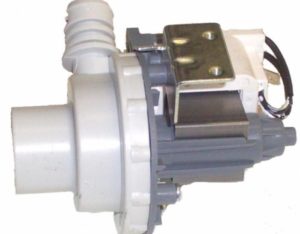
- E3. Water is taking too long to drain. If the pump can't drain the system within the specified time, it's not working properly. This could be due to a clogged pump or debris filter, or a clog in the hose, trap, or sewer pipe. To solve the problem, you'll need to clean the debris filter and then check all the indicated areas where the clog could have formed. Clearing the clog will eliminate this annoying error.
- E4. The water level sensor indicates there's too much water in the dishwasher. The inlet valve may be broken, the pressure switch itself may be faulty, or there may be an issue with the electronics. How can these problems be fixed? First, access the pressure switch and blow out its tube after removing the hose. Then, measure the resistance of the component. If the resistance gradually drops and reaches zero, the component is working properly. Next, check the resistance of the inlet valve, and finally, check the control module. Be aware that replacement components may be necessary.
- E5. The thermistor is giving incorrect readings. This error usually requires replacement of the thermistor. In rarer cases, it indicates a faulty heating element or an open circuit. This annoying defect can be corrected by replacing the thermistor, heating element, or their power wires. Beforehand, the components should be thoroughly checked with a multimeter.
- E6. This is a more specific error that detects a break in communication between the heating element, temperature sensor and control module. Any of these parts could be broken, and the wiring could be severed as well. You'll have to check everything with a multimeter and replace any defective parts.
- E7. A very dangerous error that indicates a shorted thermistor. Before accessing the dishwasher or touching its body at all, disconnect the power. Then, remove the faulty thermistor, discard it, and replace it with a new, original part.
For safety reasons, the manufacturer does not recommend dealing with the E7 error yourself and instead calling a technician.
So, we've deciphered the Kaiser dishwasher self-diagnostic codes. If you're serious about repairing your "home helper," read the article. Kaiser dishwasher repair, and that's it for now, and we wish you all the best. Don't forget to visit our website.
Interesting:
Readers' comments
Headings
Washing machine repair




For buyers




For users


Dishwasher




Add a comment