
Bosch Maxx 5 Washing Machine Errors
 Certainly, some Bosch washing machine problems require professional help, but in some cases, any homeowner can handle the problem themselves. So, to understand when to sound the alarm and when to simply be patient and have time, you need to know the list of Bosch Maxx 5 washing machine errors. Manuals are usually not kept, or the information in them is incomplete, so it needs to be systematized.
Problem of decryption
The difficulty is that not all homeowners immediately understand what exactly has happened, simply not knowing how the machine behaves when it displays an error code. Of course, with units with a display, everything is simple and straightforward—you look at the combination, find the meaning, and figure out what to do next. But what about those whose models don't have a display? The diagnostic system in these cases works the same way, but a little differently, namely, by flashing lights on the control panel. Consequently, when the machine freezes, and the erratic flashing is the only response to the user's actions, panic sets in.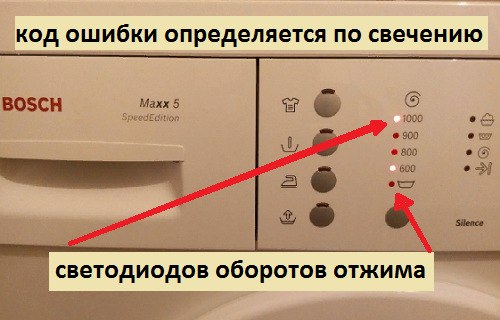
Here you need to calm down and carefully observe the diodes. You need to write down which keys are lit or flashing, and if they are flashing, in what order and at what interval. Only then should you open the manual, guide, or other document that lists the error codes—you'll likely find the one you need. As for what to do next, that's another matter entirely. You might do it yourself, or perhaps with the help of a professional.
Diagnostic system database
Although Bosch Max 5 washing machines don't have many error codes, there's no need to memorize them all. Keeping this kind of information in your head is difficult—you'll inevitably miss something or make a mistake. Simply write out or print out the guide and keep it handy. Here's a list of the codes.
- F16 on the display, or the "Spin 800" indicator is constantly on. The problem is most likely with the door. Open the door and then close it, pressing it gently with your knee if necessary. Now try restarting the program.
- The display shows F17, or the "800 RPM Spin" light and the indicator next to the water basin are on. The problem is with the water intake: either no water at all or too slow. There are several possible solutions: clean the filter mesh, check the water pressure in the pipes. You can also open the washer's tap all the way.
- Code F18 has a similar problem (the "400 Spin" and "800 Spin" lights are also on). In this case, the water doesn't drain, or it drains much longer than expected. Check the drain filter for debris and remove it. Also, check the pressure switch. If it's faulty, replace it with a new one.
- F19, or the following combination: basin of water, spin cycle 800, spin cycle 400. This indicates problems with water heating. It may not heat up at all, or it may literally boil. The problem is almost certainly the thermostat or the heating element and its contacts. Repairing these components is pointless; it's easier to replace them with new ones. Power surges can also be the cause. Check the level to ensure it meets standards.
- Error F20 and the spin-400 and spin-600 lights indicate a subtype of error F19—untimely water heating. See the section above for troubleshooting instructions.
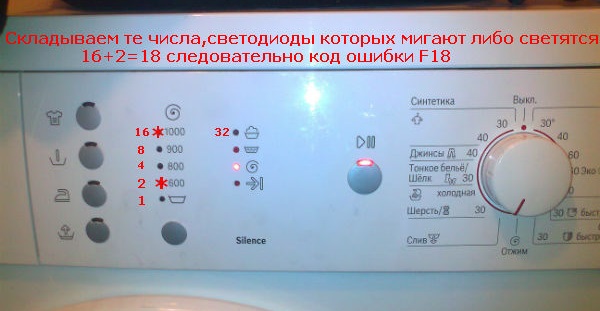
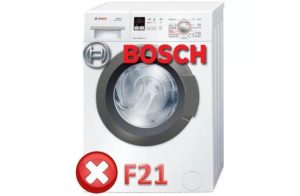
- Error F21 and the simultaneous illumination of the spin-800, spin-600, spin-400 indicators, and the basin icon. This error code indicates that the drive motor has stopped or is rotating unevenly. This can lead to the drum not rotating properly. In this case, it's recommended to check three components: the motor itself, the tachogenerator, and the control module.
- F22 or, on machines without a display, the spin lights are 800, 600, and 400. Most likely, something has shorted out inside the NTS sensor, or the wiring has burned out. Therefore, the solution involves checking and repairing/buying a new sensor.
- F23 or the same three spin buttons (800, 600, 400) are lit along with the basin. This means water has been detected in the machine's tray, or there's a leak somewhere. To determine this, inspect all parts that come into contact with water. A break in the Aquastop circuit is also possible.
- F40 — the second light in the "Spin" column is on, as is the top light in the right column. This is a fairly complex error—the equipment is out of sync. Check the machine's power supply; the readings are likely out of sync.
- F63, in addition to the previous indicators, the other spin lights are added. There's only one solution here: reflash the electronic module or replace it entirely.
As you understand, DIY repairs aren't always possible; sometimes, the help of a competent person is simply a given. However, don't think you're embarking on a difficult adventure. Regular, proper maintenance of your appliances is all that's needed.
Warning! If complex repairs are necessary, do not attempt them without sufficient confidence in your knowledge and skills. Otherwise, subsequent repairs will be even more expensive.
How to test the machine?
By the way, if the machine freezes but displays nothing, you can run a service test to troubleshoot the problem:
- Close the hatch.
- Set the mode to off.
- After a couple of seconds, set the handle to spin.
- Hold down the speed change button.
- When the start light starts flashing, set it to "Drain".
- Turn on "On" first.
- Then "Start".
That's it, after this the machine will either start working as usual, or display an error code if there really is a problem.
Interesting:
Readers' comments
Headings
Washing machine repair




For buyers




For users


Dishwasher




Add a comment