
Why is the salt indicator on in my dishwasher?
 When the salt indicator light comes on in any dishwasher, it's a concern for many users. The best thing to do is get the manual and read about the purpose of this indicator, including when it lights up and when it flashes. If you can't do this because you don't have the manual handy, read our article. It'll tell you everything you need to know.
How does it work?
The vast majority of dishwashers have a salt indicator that can be in three states: idle, flashing, or on. This indicator is connected to a salt sensor located in the ion exchanger tank. Once the sensor is triggered, the indicator begins activating according to the set program. Let's take a closer look at the indicator's states.
- Rest. The indicator is off and not flashing, meaning everything is fine and the user does not need to do anything.
- Flashing. The indicator alerts the user that the salt reservoir is low and needs to be replenished, otherwise it will soon run out.
- Combustion. If this indicator is constantly lit, it means that the salt in the reservoir has run out; it warns that further use of the dishwasher will “kill” the ion exchanger. You need to add salt immediately.
Salt is needed in a dishwasher so that the resin in the ion exchanger can regenerate, and the appliance itself can perform its function.
If you ignore the indicator light and don't add salt to the dishwasher, nothing will happen in a single wash. We believe that even after 7-10 washes, nothing significant will happen, but over time, the ion exchanger will be left without resin, which will wash out over time. The machine will quickly become coated with limescale and fail. The main purpose of the salt indicator is to promptly warn the user that the salt is running low, and then it's up to the user to decide whether to spare their "home helper" or not.
Clogged tank
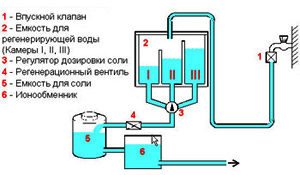 Added salt, but the light is still on? You might be dealing with a blockage or a temporary system failure. Let's check the latter by restarting the dishwasher. First, turn the machine off using the button, then unplug the power cord from the outlet. Leave the machine disconnected for 15 seconds, then turn it on and check the indicator light. If it comes on again, the problem isn't with the electronics.
Even when the user uses the highest quality dishwasher salt, the tank can become clogged. What's more, when the tank is filled with regular dishwasher salt, without any preliminary preparation. Clogging is inevitable. The indicator lights up to detect clogging of the ion exchanger and its salt reservoir. Let's clean the reservoir.
- First, for safety reasons, turn off the machine and turn off the water.
- Open the dishwasher and remove the lower dish rack.
- Unscrew the cap of the salt container.
- Using a bulb syringe or a large syringe, we pump out the water from the reservoir.
- We pour clean water into the tank, mix it with the remaining contents using a wooden stick and pump it out again.
- Pour some water into the tank again, add salt and try to run the dishwasher.
In most cases, this simple cleaning helps, and the indicator goes out. If the problem persists, the salt sensor itself may be the problem and needs to be replaced.
Salt sensor failure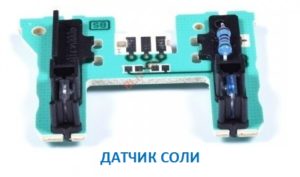
Why doesn't the salt sensor go out even after cleaning the tank? It's possible the sensor itself is broken or clogged. You need to remove the side panel of the dishwasher housing (right or left, depending on the model), remove the salt sensor, and test it with a multimeter. You can see what this sensor looks like in the image accompanying this article.
A simple test will determine whether the sensor is working or not. If the sensor itself is working, you can try cleaning it and also check the wiring that powers it. The faulty sensor must be replaced.
So, all the above measures are intended to resolve the problem of the illuminated sensor. If after all the above steps the problem remains, it's worth contacting a mechanic. The problem may be a burnt-out bus or faulty firmware on the control board, which you shouldn't touch yourself to avoid making the problem worse. A qualified mechanic will perform diagnostics and then repairs. Fortunately, such serious problems are rare, but the key is not to leave things as they are. Ignoring the illuminated indicator light can lead to more serious problems.
Interesting:





5 reader comments
Add a comment
Headings
Washing machine repair




For buyers




For users


Dishwasher




Thanks so much for the review. Cleaning it helped! It remains a mystery, though, what could have caused the clog.
I tried cleaning it and unplugging it—it helped… some kind of magic. Why did it help? What was the reason? But the fact is there.
Thank you so much! It helped me at the "drain the water with a bulb" stage ☺️
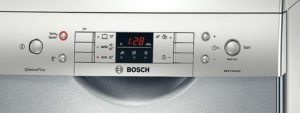
Hello. I have a new Bosch machine. We filled it with salt and water, everything is fine. But the salt indicator light stays on, not blinking. What could be the problem?
Thanks, I did everything as written, but until I stirred it with a chopstick, the salt started burning. I thought I'd made a buck, but it worked out alright.