
Why does my dishwasher give me electric shocks?
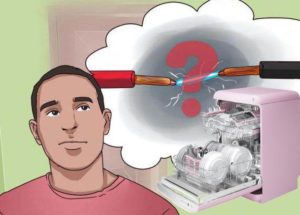 When your dishwasher starts to give you electric shocks, you need to start looking for the cause immediately. It's best to call a qualified electrician who knows all about electrical work. But while you're away, you can read this article to find out what's causing the problem.
Reasons
Why does a dishwasher give you electric shocks? It's because there's a current leak on the machine's body. The causes can be divided into two groups. The first group is related to a malfunction of the machine itself and most often occurs after some time of use. The second group of reasons is related to improper connection of the dishwasher, or more precisely, to the electrical network. Even a new machine can start to "bite." Let's list all the possible causes:
- the insulation of the wiring inside the dishwasher is damaged;
- the car engine is broken;
- heater breakdown;
- the socket is faulty;
- there is no grounding.
If the outlet is grounded but the machine is still giving you a shock, check the outlet itself; the contacts may be corroded. Cleaning them should fix the problem.
Checking the heating element
Most often, the cause of a car's electric shock is a faulty heating element. To check it, you need to remove the heater. To do this, follow these steps:
- disconnect the equipment from the power supply and water supply;
- remove the dish baskets, trash filter and spray arms from the tank;
- if there are any, unscrew the screws under the mesh (at the bottom of the tank);
- turn the dishwasher over to provide access to its bottom;
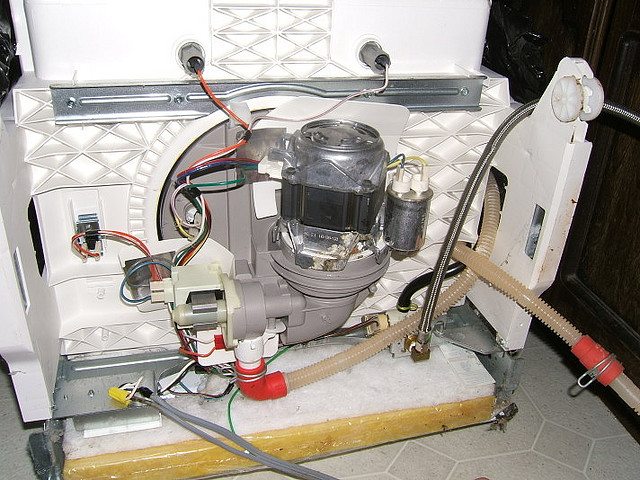
- remove the bottom;
- we find the heater and disconnect it from the pipe;
- we disconnect all the connectors with wires from the heating element;
- We take out the heater and inspect it; at this stage we can already detect a breakdown;
- To confirm the fault, you can immerse the heating element in a salt solution and then measure the resistance between the heater and the solution. If the device shows resistance, the heater is faulty.
Important! The saline test does not always help identify the problem.
- If the part is indeed damaged, replace the heater with a new one.
The second method of checking the heater is carried out dry as follows:
- set the unit of measurement on the multimeter to Ohms;
- we apply the device probe to the heater contacts;
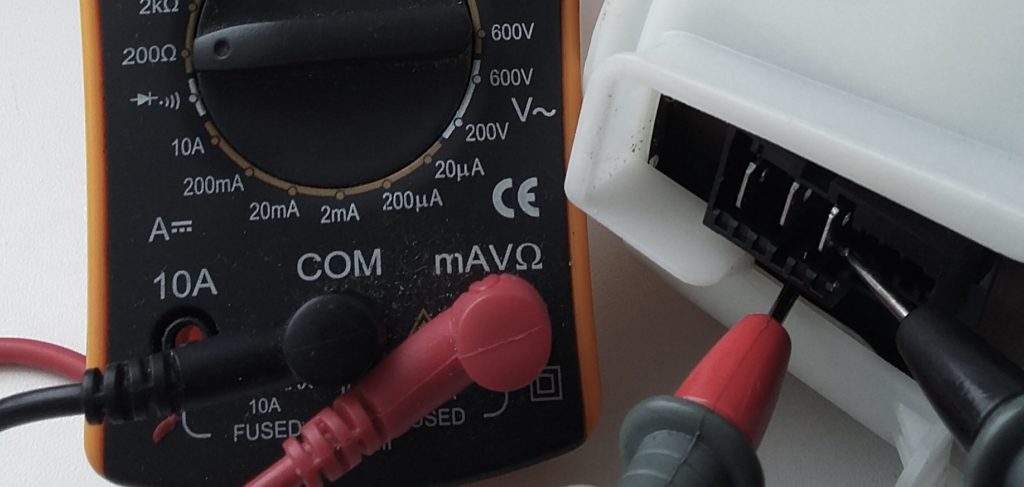
- a serviceable part has a resistance within 21-22 Ohms, a faulty one has an infinite resistance;
- After checking the heater, check the part for current leakage to the housing by switching the multimeter to MegaOhms;
- Place one probe on the heater contact and the other on its body. You can also place the probe on the ground contact instead of the body. If the heater is working properly, the device should show infinite resistance.
Important! When taking measurements, the pump and heater must be completely dry. Otherwise, the RCD will trip when the dishwasher is running, and the resistance will not be infinite.
How to check the wiring and engine
It's clear why your dishwasher is giving you electric shocks, but what should you do when it behaves this way? Quite often, leaks are caused by wiring or the motor housing. We've had cases where mice had infested dishwashers and, by gnawing at the wiring, caused a similar problem.
If you suspect this, smell the inside of your dishwasher. Mice usually have a distinctive, unpleasant odor. If you detect the odor, open the machine.
 Even if there are no mice in the machine, the power wiring inside could be defective, with damaged insulation, or the insulation may have frayed over time. Visually inspect each wire, paying particular attention to the base of each wire where it connects to the connectors or terminals. If you find a damaged wire, replace it.
If you're handy, you can use a multimeter. It can also help locate damaged wires, but a visual inspection is still crucial. If the wiring is intact, check the motor. If the winding is leaking current onto the housing, the motor may very well be electrocuting. This can also be easily checked with a multimeter. A broken winding is not suitable for further use; the motor will have to be replaced. You can, of course, try to rewind the part, but it will be more expensive.
So, you shouldn't ignore this kind of dishwasher problem. But how to fix it is up to you—call a repairman or troubleshoot the problem yourself. Just remember, be extremely careful around electricity!
Interesting:




Readers' comments
Headings
Washing machine repair




For buyers




For users


Dishwasher




Add a comment