
Why is my dishwasher buzzing?
 If your dishwasher hums while running, don't ignore it. This noise is likely a sign of a breakdown, or the dishwasher has already broken down. In any case, you need to immediately begin investigating the cause of the noise and fixing it. In this article, we'll cover in more or less detail the causes of humming noises your dishwasher may make and how to eliminate them.
The procedure for searching for the causes of noise
Before you climb into the dishwasher, it would be a good idea to study its structure. How a dishwasher worksThis is well covered in the article of the same name posted on our website, so we won't repeat it. We'll focus on the procedure for finding the cause of the hum. Noise, of course, doesn't occur on its own; it's caused by some component. However, the cause must be identified using a carefully crafted procedure.
The humming sound is sometimes caused by water hammer or increased pressure in the water supply system.
- The check begins with the most innocent, yet most common, causes: clogged debris and excessively high (or low) water pressure. In the former case, the machine should be cleaned, and in the latter, the pressure should be increased using a pump. If it's too high, wait until it drops and the pressure switch begins to function properly.
- Next, you need to dismantle and inspect the circulation pump.
- Next, you need to remove and check the dishwasher pump.
Drive mechanism
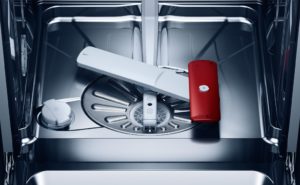 So, open the dishwasher door and empty the contents of the bin, including any dirty dishes and dish racks. Next, remove the upper spray arm and its drive elements, then clean them of any dirt. Next, remove the lower spray arm and O-rings, and unscrew the debris filter. Pay special attention to these parts, as they're where debris most often accumulates.
To prevent your dishwasher from clogging frequently in the future, clean dirty dishes before placing them in the dishwasher. Use a spoon or other handy utensil to scrape off stuck-on food particles from your dishes. These simple steps will help avoid many problems.
Circulation pump bearing
In about half of all dishwasher humming noises, the circulation pump is the cause. This is due to the small thrust bearing, which is a ring made of graphite. The thrust bearing wears out fairly quickly. If the dishwasher is used daily, the bearing will wear out in about 2-3 years.
Interesting! The newer the dishwasher models, the worse their graphite bearings.
At first, the production doesn't affect the operation of the circulation pump, but then it increases, and the pump begins to emit an annoying hum, first intermittently and then constantly. To fix this problem, you must first remove the circulation pump.
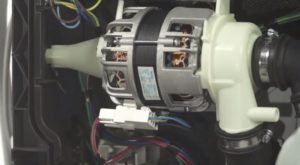
- We disconnect the car from electricity and other communications.
- We unscrew the tray, if there is one.
- As soon as we remove the tray, the pump will be in front of our eyes.
- We disconnect the connector with wires and pipes, having first loosened the clamps.
- Once you've unhooked the pump from the hoses, don't rush to pull it toward you. There are two more wires attached to the back of it that need to be carefully unhooked.
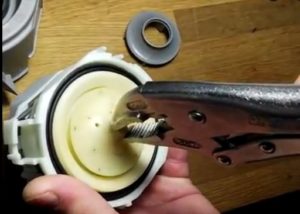 Once the circulation pump has been removed, it's time to disassemble it. First, disconnect the heating element assembly from the electric motor. It comes off with difficulty, so be careful not to break anything. Next, we remove the impeller and pull out the anchor with pliers. At the base of this anchor, deep in the housing, is the culprit of our problem—the rear support bearing. We pull it out with tweezers. Under the bearing is a rubber gasket, which also needs to be inspected for wear.
If the gasket is intact, it can be left alone, but the bearing will need to be replaced. Incidentally, our technicians don't always replace this part, as it can be difficult to access. They often resort to reaming the bearing, which takes little time and produces good results. In any case, a bearing restored this way will easily last for several more years. Once the bearing is replaced, you can reassemble the circulation pump in reverse order and install it.
Drainage pump
For example, we've checked the circulation pump and confirmed it's not the problem, so why is the dishwasher humming? The answer to this question lies somewhere in the drain pump area. Figuring out that the pump is the cause of the problem isn't difficult at all. Listen for the moment the dishwasher starts making the unpleasant noise. If this only happens when the dishwasher is draining, the drain pump is 99% the culprit. Remove it.
- Remove all excess from the dishwasher, including any remaining water.
- We turn off the machine.
- We lower the dishwasher onto its side.
- We dismantle the pallet.
- We detach the hose from the pump by loosening the clamp.
- We disconnect the electrical wiring.
- We unscrew the screws holding the part and remove the pump.
When removing the pump, be careful not to lose or damage the O-rings.
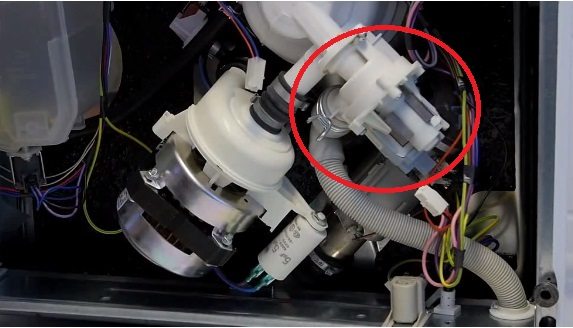
Next, we need to disassemble the pump itself and determine the cause of the humming noise. Pay particular attention to the impeller. If it's deformed, it's best to replace it, or better yet, replace the entire pump. This part is inexpensive and generally not worth repairing.
After installing the new pump, reassemble the machine in reverse order and enjoy your updated dishwasher, which will no longer bother you with that annoying, annoying hum. When assembling and disassembling the dishwasher parts, exercise caution, and everything will be fine. Good luck!
Interesting:




Readers' comments
Headings
Washing machine repair




For buyers




For users


Dishwasher




Add a comment