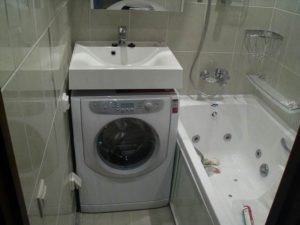
Washing machine in the kitchen under the countertop
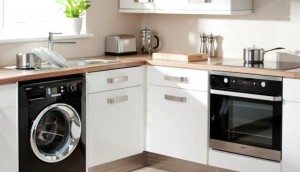
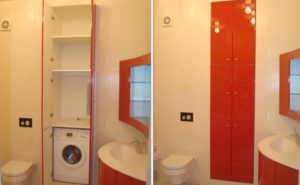
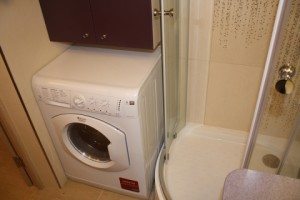
The most logical place to install washing machines is in the bathroom, where the laundry basket, cabinet with detergents, and other essentials are. But what if there's absolutely no room in the bathroom, and the washing machine just won't fit, but you need to put it somewhere? You can install a "home helper" under the kitchen counter, but this will require remodeling or replacing the cabinetry, and a complete redesign of the kitchen. Let's discuss the best way to do this, and what challenges it will entail.
We take measurements
When considering installing an undercounter washing machine in your kitchen, you need to carefully plan the space. A washing machine will require space, and given the size of the kitchens of Khrushchev-era buildings, that's quite a bit. First, let's dot the i's and cross the t's. If you're planning to create a space and install a countertop in a kitchen with old cabinetry, rest assured, it won't look great. It's much better to start renovating the kitchen, changing the furniture, and at the same time preparing a place for the washing machine.
In this article, we'll look at a situation where the kitchen cabinets are being replaced and the homeowners want to install an existing washing machine under the future countertop. Where do you even begin to prepare for this project? It all starts with a plan.
Take a piece of paper, a pencil, and an eraser. Draw a rectangle and mark the dimensions of your kitchen space. If there are any niches, protrusions, or other features, mark them.
Consider and show on the plan the location of the largest appliances: refrigerator, freezer, dishwasher, electric stove. Place them taking into account the dimensions, calculate how much useful space of the room is already occupied.
When you're planning your appliance placement, think about where you'd place your washing machine so it's convenient to use.
After disposing of large appliances, try to furnish the remaining space with the necessary furniture and reflect these ideas on the floor plan. You need to calculate the dimensions and placement of each cabinet, cupboard, sink, etc.
Important! When calculating the dimensions of cabinets and other furniture, remember to take into account the thickness of the material.
Carefully calculate the dimensions of future corner cabinets, as even a 1 cm error can be fatal and result in additional costs.
The niche for the washing machine also needs to be calculated very carefully. Measure the exact dimensions of your washing machine. Don't rely on the dimensions listed in the data sheet; one overlooked protrusion on the frame may prevent the machine from fitting into the niche. What else should you consider when calculating the niche for a washing machine under a kitchen countertop?
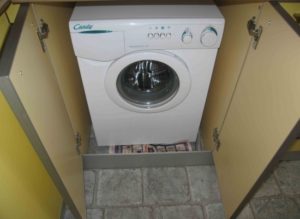
The depth of the niche under the countertop should be calculated with a fair margin: at least 10 cm from the back wall of the machine to the wall will need to be left for hoses and filters, the front panel should be completely recessed into the niche by at least 2-3 cm.
The height of the washing machine is adjusted by the feet, but the height of the feet themselves must be taken into account when calculating the height of the niche for the washing machine in the kitchen. It may turn out that you will have to completely unscrew the legs so that the machine fits into the niche at the right height - this should not happen.
The niche width should be at least 2 cm wider than the washing machine body to allow for a centimeter-wide gap on the sides. This is because the washing machine vibrates and rocks heavily during the high-speed spin cycle. If you want the entire countertop and kitchen cabinets to rock along with it, you don't need to leave a gap.
The niche itself should not obstruct unimpeded access to the front panel of the washing machine. The door, detergent drawer, waste filter, and emergency drain hatch should all open easily. No decorative trims should interfere with the operation of the washing machine.
Please note! The countertop can be either straight or angled. This won't prevent you from installing a washing machine underneath, as long as you calculate everything correctly.
Preparing the place and tools
To install an under-counter washing machine in the kitchen, it's not enough to simply calculate and draw a plan. You also need to understand the washing machine's technical features and how to connect it to utilities.
When preparing a space for a washing machine, ensure it has access to water, sewerage, and electricity. A separate electrical outlet should be installed, properly calculating the load the machine will place on the electrical network. Learn how to do this in this article. How to connect a washing machine to the power supplyIt is also necessary to arrange for a cold water supply line, as well as a drain pipe or siphon to drain wastewater.
To connect the washing machine to the water supply in the future, install a tee fitting on the cold water pipe and ensure the inlet hose is long enough to reach the fitting. To ensure drainage, install a special trap under the sink with a side outlet for the drain hose. If your drain trap already has a drain outlet, you don't need to do anything. Just make sure the washing machine drain hose is long enough.
Now let's get the tools ready. Open the pantry and take the following out of the toolbox:
small adjustable wrench;
12 mm open-end wrench;
building level;
FUMka;
automotive sealant;
roulette;
pliers.
Depending on the specific features of your washing machine, you may need some other tools, but in any case, nothing special; everything you need is included in a standard toolbox.
Progress of work
We agreed that we would describe the undercounter installation of an old washing machine that was already connected, for example, in the bathroom, but it was decided to move it to the kitchen and install it under the counter. So, how to install an undercounter washing machine.
Before your new kitchen cabinets arrive, prepare all the necessary utilities, especially electrical ones. Level and reinforce the floor where the washing machine will be located.
After installing a new kitchen set, before the craftsmen leave, check that all the elements of this set match in size and correspond to the plan and sketch.
Make sure the recess under the countertop is large enough to accommodate the washing machine.
Dismiss the furniture installers and begin installing the washing machine into the niche under the kitchen countertop.
Remove the washing machine from its old location and move it to the kitchen.
Make sure the drain and inlet hoses are connected and the power cord is in good condition.
Carefully push the washing machine into the niche under the countertop.
Be careful! The washing machine's body or feet must not pinch the power cord or hose.
Connect the drain hose to the siphon outlet.
Connect the water inlet hose to the tee, insulate the connection and secure with a clamp.
Make sure that the front panel of the machine is hidden in the niche by at least 2-3 cm, and there are gaps of 1 cm on the sides.
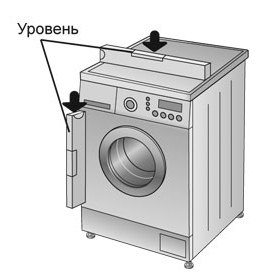
The washing machine must stand level. To achieve this, place a building level on the top cover of the machine, and then begin to alternately tighten the feet until the machine is level.
We connect the washing machine to the socket and run a test wash program – its installation under the kitchen countertop is complete.
What kind of cars are suitable?
There's another issue that requires discussion. It's not uncommon for people planning a kitchen renovation and only planning to buy a washing machine, but already believing that the only option is under-counter installation. This gives them much more freedom in both planning the kitchen cabinetry and purchasing the appliances.
If you have the opportunity to buy a new car, it is better to choose one that is more suitable for you. Built-in. In general, automatic washing machines are:
freestanding;
built-in;
compact.
Freestanding undercounter washing machines are the least suitable, so we'll rule them out right away. Compact washing machines are certainly nice and require less space, but they also only have a load capacity of 3-4 kg. It would be best to take a washing machine with built-in option, it will suit our purposes better. Well, and of course, when purchasing a specific model of washing machine, measure its actual dimensions; do not look at the technical documentation, as it may indicate the machine's dimensions inaccurately.
In conclusion, installing an undercounter washing machine is not difficult if you've done all the necessary calculations and preparation in advance. You need to take care of the utilities, take measurements, draw up a plan, and prepare your tools. If all this is done properly, there's nothing to worry about; the undercounter washing machine installation will be a success. Good luck!

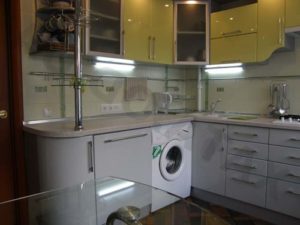 The most logical place to install washing machines is in the bathroom, where the laundry basket, cabinet with detergents, and other essentials are. But what if there's absolutely no room in the bathroom, and the washing machine just won't fit, but you need to put it somewhere? You can install a "home helper" under the kitchen counter, but this will require remodeling or replacing the cabinetry, and a complete redesign of the kitchen. Let's discuss the best way to do this, and what challenges it will entail.
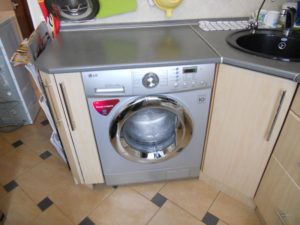
 When preparing a space for a washing machine, ensure it has access to water, sewerage, and electricity. A separate electrical outlet should be installed, properly calculating the load the machine will place on the electrical network. Learn how to do this in this article. How to connect a washing machine to the power supplyIt is also necessary to arrange for a cold water supply line, as well as a drain pipe or siphon to drain wastewater.
 Built-in. In general, automatic washing machines are: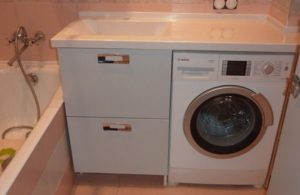














Add a comment