
How to connect a washing machine and dishwasher
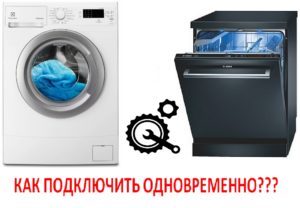 A dishwasher and washing machine can be connected simultaneously in the same room, without any significant modifications to the existing plumbing. This is necessary when placing a washing machine in the bathroom is not feasible, so it is moved to the kitchen and placed next to the dishwasher. In this article, we'll explain how to connect a washing machine in this way and the specifics involved.
What will you need?
To simultaneously connect two such utility-dependent appliances, these utilities must be installed. It would be very simple if the kitchen already had separate water and sewer lines specifically for the dishwasher and washing machine, but since there aren't any, something else will have to be done.
First, let's gather the necessary materials that will help us "integrate" into existing communications. Here's a list of them:
- Triple tap made of bronze with a 3/4 section. Don't take a plastic tee; if you don't have a bronze one, take a silumin one. We will use this tap to make a high-quality double branch pipe for the water supply.
- Straight-through bronze valve with two outlets (2 pcs.)
- FUMka.
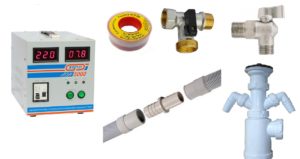
- Siphon with two fittings for connecting two drain hoses.
- Adapters for drain hoses.
- Longer drain hoses or an additional hose kit to extend the stock hoses.
- Flow filters with 3/4 cross-section.
- Voltage stabilizer rated for at least 3.5 kW.
A voltage stabilizer will help us avoid radical redesign of electrical systems, and at the same time, it will provide effective protection for expensive household appliances from power outages.
We'll also need some tools—we can't connect the washing machine and dishwasher without them, but the list is much more limited. You'll literally only need a small adjustable wrench, pliers, a spirit level, and a screwdriver.
Preparing for installation of two devices
Let's imagine this situation. You already have a dishwasher in your kitchen, but you need to connect a washing machine as well. First, you need to find a place for it, as a washing machine is far from a small appliance.
It's difficult for us to offer advice in this case, since it's your kitchen after all. Installing and connecting a washing machine may require some compromise, such as removing some furniture or rearranging the space. In any case, try to place the washing machine and dishwasher closer to the sink, since it is under it that the connection to the water supply and sewerage will be located. You also need to strengthen and level the floor where the washing machine will be installed; for this, use a building level.
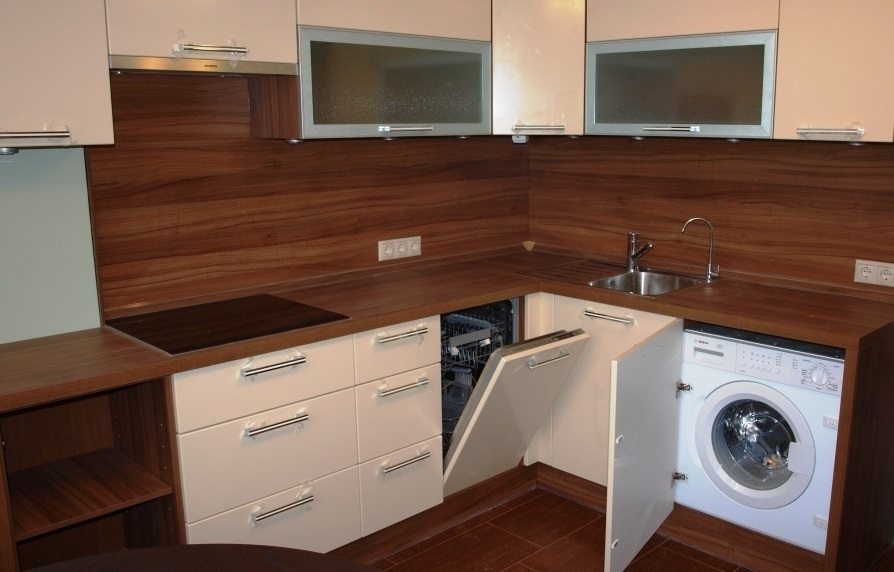
Please remember that there should be a gap of at least 1.5 cm between the washing machine and surrounding objects, as the machine vibrates heavily and rocks from side to side during the spin cycle.
You can install the washing machine and dishwasher to the right and left of the sink; this will make it much easier to drain the water and sewer lines. You can also place the dishwasher directly next to the sink, and the washing machine next to the dishwasher, leaving a 1.5 cm gap between the appliances. There are many options, but you'll ultimately choose the one that best suits your needs, so we won't force our opinion on you.
Connecting to the water supply
There are two ways to arrange a water supply outlet to simultaneously connect both a washing machine and a dishwasher. The first method involves connecting to the cold water pipe outlet on the sink, and the second to a special cold water pipe outlety. Both methods are common, so let's look at them in more detail.
If the kitchen renovation was done a long time ago, and no one expected a washing machine or dishwasher to be installed in this room, then there are no available water pipes. But that's not a problem. We'll create a branch pipe from the cold water pipe that goes to the sink. Here's how to do it.
- A hose extends from the cold water supply pipe, which in turn is connected to the faucet. We need to shut off the water first and then disconnect the hose from the pipe.
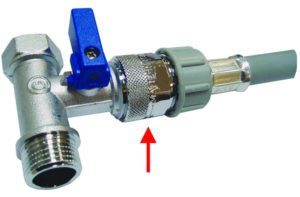
- We'll install a bronze faucet with four outlets between the hose and the pipe using an adapter. Two of the outlets will connect the pipe and the hose going to the faucet, and the other two outlets will be used to connect the washing machine and dishwasher to the water supply.
- Next, we will install two flow-through taps on the two tap outlets and thoroughly insulate the connection.
We install flow-through taps to shut off the water to the washing machine and dishwasher separately, but if necessary, we can shut off the water to both the washing machine and the dishwasher simultaneously.
- We screw the inlet hose of the washing machine to the thread of one flow-through tap, and to the thread
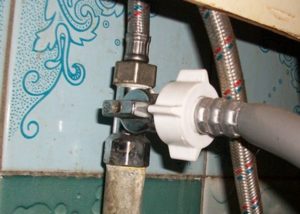 another dishwasher hose. Now the water supply outlet is organized.
The second option for connecting to the water supply is very similar to the first, only in this case we will use a tee tap. We screw a tee tap onto the finished cold water pipe branch using an adapter. This way, instead of one outlet, we get two. Next, we screw the straight-through valves onto the outlets in the same way and connect the inlet hoses of the washing machine and dishwasher.
Connection to the sewerage system and electricity network
Now we need to solve the problem of connecting two household appliances to the sewer system. Extending the drain hoses is only half the problem. You can buy adapters and additional hoses of the appropriate diameter, and the job is done, but how do you connect these long hoses to the drain? Plumbing fixture manufacturers, particularly sink trap manufacturers, have long since answered this question. There are traps available with two outlets for the drain hoses, in other words, traps with two nozzles.
So, we simply buy a new two-way trap for the kitchen sink, install it in place of the old trap, and connect two drain hoses from the washing machine and dishwasher to it, respectively. The connection points of the siphon and hoses must be secured with clamps.
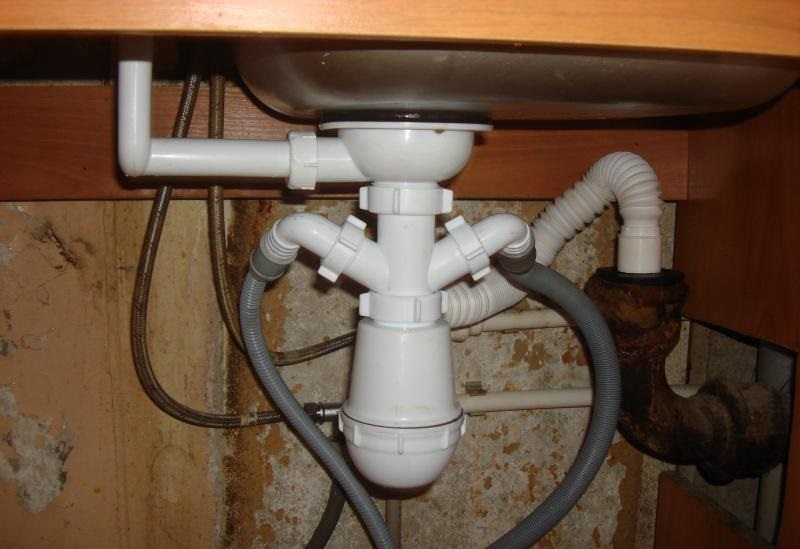
Remember to follow the height requirements for the drain hose connections to prevent a siphon effect and prevent water from flowing back from the sewer into the washing machine and dishwasher.
Connecting to the power grid is more difficult, especially if the kitchen only has one suitable outlet with a moisture-resistant housing, and the wiring is designed for only one large appliance. Connecting two large appliances directly to such an outlet is dangerous, but a trick is to connect through voltage stabilizer for a washing machineYou can read more about these devices in the corresponding publication posted on our website.
Checking the work
 We connected both the washing machine and the dishwasher simultaneously. Since the connection process was more complex than usual, we needed to check everything thoroughly. We loaded the washing machine (you can run it empty on a special cycle), put the dirty dishes in the dishwasher, and ran both appliances simultaneously. While the washing and dishwashing cycles were running, we carefully monitored the plumbing, paying particular attention to the connections between the faucets and the hoses.
If a leak is suddenly discovered, it is necessary to immediately turn off the water and stop both appliances from working, so as not to flood the entire kitchen floor and the neighbors. After that, you need to unscrew the problematic connection, wind it more carefully, and then twist it again.
To summarize, connecting both your washing machine and dishwasher doesn't require hiring a professional or paying a fortune. Simply read this article carefully and, with the help of a friend or relative, complete the connection yourself. We believe you won't encounter any significant difficulties. Good luck!
Interesting:
Readers' comments
Headings
Washing machine repair




For buyers




For users


Dishwasher




Add a comment