
How to connect a washing machine to the power supply if there is no grounding
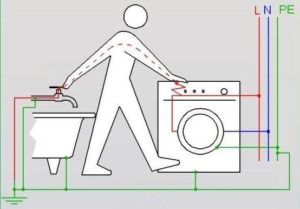 Connecting large household appliances to the power grid must be done properly. Powerful power consumers, such as washing machines, are connected to grounded electrical systems. However, in most apartments, not to mention private homes, grounding is either absent altogether or poorly installed. Let's figure out how to connect a washing machine to the power grid in accordance with all regulations.
Why is this necessary?
When purchasing and connecting a washing machine, it's essential to ensure its safe operation. If the machine is installed incorrectly, there's a high risk of electric shock even from lightly touching the body. Also, plugging it into an ungrounded power outlet can cause damage to the washing machine's electronics, which can be difficult to repair.
What should you pay attention to? Modern automatic machines are designed to be connected to a three-wire electrical network, which has not only a phase and neutral wire, but also a ground contact. In old houses, the wiring is two-wire, including only neutral and phase.
Washing machines are equipped with a surge protector, designed to eliminate unwanted electrical surges exceeding 50 Hz. This protector is directly connected to the washing machine's body. If the washing machine is connected to a power outlet in an apartment with two-phase wiring, a residual current of 110 volts will flow through the walls of the washing machine, which has a surge protector. Considering that these machines are typically installed in bathrooms or toilets, areas with high humidity, the risk of electric shock only increases.
It's precisely because of these circumstances that grounding is essential. Let's look at how to set it up, thereby ensuring the washing machine's safety.
We are looking for a connection option
In older homes equipped with outdated electrical systems, there are several ways to ground a washing machine. Here are the main options for grounding the unit:
- preparation of a separate electrical point connected to a grounded electrical panel;
- connection of RCD;
- connecting the machine body to the house's utility lines or heating radiators;
- organization of a potential equalization system for household appliances;
- development of a personal grounding circuit (relevant for private houses).
The method of connecting the ground wire to a water or sewer pipe is very effective, but it has several significant drawbacks. First, it can lead to rapid wear of the pipe, a leak, and, as a result, flooding of the neighbors below. The same fate awaits the heating radiators. Secondly, this method is prohibited by electrical safety regulations, so it is better to avoid using it in practice.
Connecting to the power grid correctly
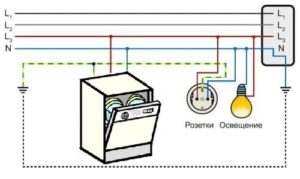
An excellent option is to connect to the electrical panel found in every high-rise building. If there's no grounding, a separate three-wire cable from the distribution board specifically for the washing machine is an excellent solution. The cable must be routed carefully and correctly, connecting the wires to the appropriate busbars, as mixing up the contacts can cause a short circuit. Another, easier, but less safe and aesthetically pleasing option is to run a copper cable from the grounding conductor and attach it to the washing machine body.
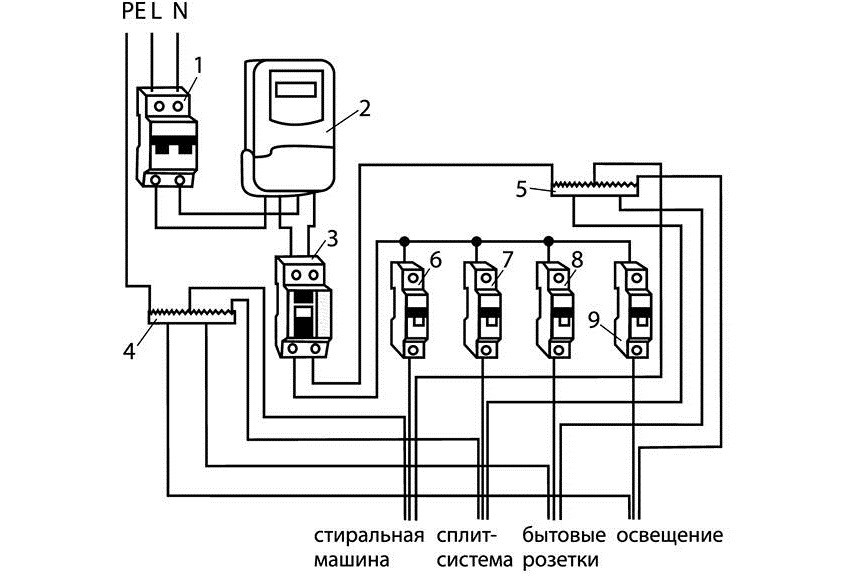
The next correct way to ensure grounding when connecting an automatic washing machine is to install a residual-current device (RCD). An RCD operates by detecting current leakage and quickly activating the circuit breaker. By triggering the RCD, the user is protected from electric shock in the event of an emergency. In other words, the protective device reads voltage changes in the phase and neutral wires and automatically disconnects the section of the protected electrical network.
Connecting an RCD and a residual-current circuit breaker is the most effective and reliable method of all those proposed, fully complying with electrical safety requirements.
The potential equalization system being created will work as follows: all household appliances with metal housings are interconnected via conductive devices. This ensures a uniform potential distribution between the devices and minimizes the risk of electric shock to users. This system is simple, so you can build it yourself.
 Installing a washing machine in a private home with a two-wire, ungrounded electrical system is a bit more challenging. In this case, both the washing machine and the entire structure must be grounded. To do this, you will have to build your own circuit, connect a grounding cable to it and run it to the distribution board.How to do this?
Near the wall of the house, dig a triangular trench with equal sides at least 3 meters long and approximately 0.5 meters deep. One vertex should point directly into the wall of the building. Drive three-meter-high metal rods into the ground at all three vertices of the triangle. Connect the rods with metal wire. From the resulting contour, dig a small trench for the grounding cable and connect the wire to the electrical panel. Afterwards, fill the structure with soil. This is the best method for grounding a private home.
Interesting:



Readers' comments
Headings
Washing machine repair




For buyers




For users


Dishwasher




Add a comment