
How to connect a dishwasher to the water supply and sewerage system
 Having purchased a long-awaited dishwasher, you may wonder whether to call a professional for installation or connect it yourself, saving a couple hundred dollars. Generally, if you have the right tools and know how to use them, connecting the dishwasher shouldn't be too difficult. Furthermore, armed with detailed instructions, the process will be even easier.
Preparing for installation
Connecting a dishwasher to the water supply should begin with an inspection of the appliance while it's still packaged. Even at this stage, you can determine whether the appliance was packed properly and whether it was damaged during transportation. Simply shake the box and listen – there shouldn't be any sounds or knocks. If there is, something is broken, and the appliance shouldn't even be accepted.
Once you've verified the dishwasher is in good working order, unpack the box and bring it into the kitchen. Next, check the drain and inlet hoses, which should have been included with the machine. Make sure they're long enough to connect and install the dishwasher in your intended location. It is important that the hoses are not stretched, but also not too long.
Please note! Original hoses are typically 1.5 meters long, which is usually sufficient to connect the dishwasher to the hot and cold water supply, as well as the sewer system, near the sink.
Consider what tools you might need, depending on the type of hot and cold water pipes (metal or metal-plastic). Screwdrivers, pliers, and an adjustable wrench may be useful.
The following components may be required:
- a siphon with two outlets, if the washing machine is connected to the dishwasher;
- if you have standard pipes, then a 3/4 inch tee (or maybe two tees if you also need to connect to hot water; if you have non-standard pipes, you need to take a tee with a transition diameter);
- ¾ inch diameter tap;
- water filter (not necessary, but it will help your dishwasher last longer);
- tape winding;
- If necessary, you may need extension hoses, clamps, and connecting adapters. You can read about how to extend hoses in the article. Replacing the drain and inlet hose.
Important! Before connecting the dishwasher to the sewer and water supply, read the instructions included with the appliance to determine whether the inlet hose is connected to cold or hot water.
In general, the use of hot water is not recommended, since its quality is much worse than cold water, because it contains many mechanical impurities, and this can negatively affect the operation of the machine..
Connecting the water supply
Once you've gathered everything you need, position the dishwasher close to where it will be permanently installed. Position it so the hoses reach the water supply and sewer lines. Connecting the hoses should be easy for you, too.
Connecting the inlet hose to the dishwasher is fairly simple. The nut and fitting screw onto the inlet hose outlet, located at the back of the dishwasher (either top or bottom, depending on the model). The other end needs to be connected to either cold or hot water. How do you do this? There are two ways:
- connect via a mixer;
- cut into a hot or cold water pipe.
In our opinion, it is more reasonable to connect the dishwasher directly to hot and cold water than through a mixer; this method is more reliable. The first method is more universal and is done in most cases.
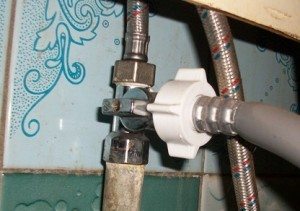 Let's describe both connection options. So, turn off the water supply to the apartment and get to work:
- unscrew the cold water hose going to the mixer from the hot or cold water pipe (depending on what you are connecting to);
- install a tee into the water supply pipe;
- screw a hose from the mixer to one part of the tee, and a tap to the other;
- If necessary and desired, connect a deep water purification filter to the tap;
- Connect the machine's inlet hose to the filter; if there is no filter, screw the hose to the tap.
Important! All threaded connections must be covered with FUM tape.
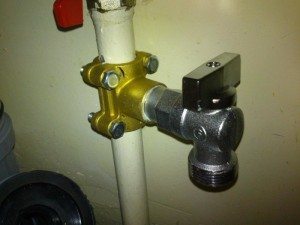 If the cold water supply pipe runs near the dishwasher, you can tap into the pipe instead of extending the inlet hose to the faucet. To do this, turn off the water supply and then:
- using a grinder and another special tool, you need to cut the pipe to fit the squeeze coupling;
- then install the coupling,
- connect a ball valve to the coupling;
- Screw the dishwasher inlet hose onto the tap.
If you need to connect several devices to one water supply pipe, you will need two tees., which can be connected as follows.
If there's no running water in the house, such as in a summer cottage, it's still possible to connect the dishwasher to the water supply, albeit inconveniently. This requires a 20-30 liter water tank, which should be placed in the attic (at a height of 2-3 meters) to create a minimum water pressure of 0.1 MPa. A pipe is inserted into the bottom of the tank, and the dishwasher's inlet hose is connected to this pipe.
Connection to the sewerage system
Some naively believe that connecting a dishwasher to the sewer system is the easiest thing to do. Simply plug the drain hose into the trap or sewer pipe, and that's it—it's not like connecting a dishwasher to hot or cold water. This assertion is extremely naive. Connecting to the sewer system may indeed seem simpler than connecting to hot water, but there are nuances that must be taken into account.
- The hose shouldn't be too long. If it exceeds 1.5-2 meters, the drain pump will not last half its lifespan due to the excessive load it will be subjected to.
- The hose connected to the sewer must have the correct bend and slope. Failure to do so will quickly cause the dishwasher to malfunction due to the siphon effect (water flowing back from the sewer into the dishwasher's tanks).
- If the hose is inserted directly into the drain pipe, be sure to leave no gap between the hose and the pipe. Otherwise, the dishwasher pump will pump water under pressure, causing water to splash out of the hose and onto the floor, creating a large puddle.
So, to connect a dishwasher to the sewer system, you need to perform a couple of steps, depending on the chosen method. If the wastewater will be discharged into the sewer through a siphon outlet, the diagram is as follows:
- We move the dishwasher a little to make it easier to work.
- We take the end of the drain hose, place it on the siphon outlet, which is located right under the sink, and tighten it with a clamp.
- Bend the hose upward at the drain trap, then bend it downward at the base of the dishwasher. That's it!
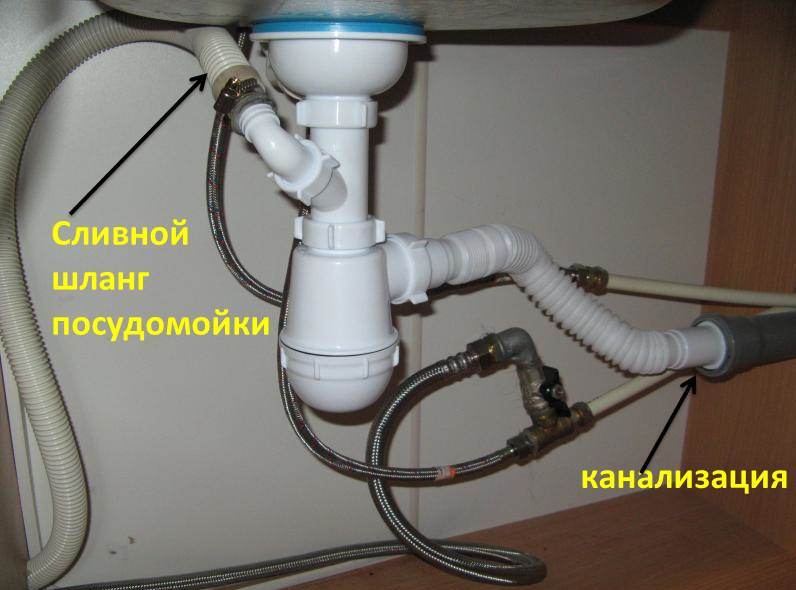
If you decide not to bother with a siphon, or you already have a siphon without branches, and you don’t want to change it for another one, you can stick the end of the drain hose directly into the pipeThe scheme is as follows.
- We move the dishwasher so that there is access to the utilities.
- We insert the end of the drain hose into the sewer pipe outlet and then tape the joint shut. It's not very aesthetically pleasing, but it's inexpensive, reliable, and practical.
- We bend the hose in exactly the same way as we described above – the work is finished.
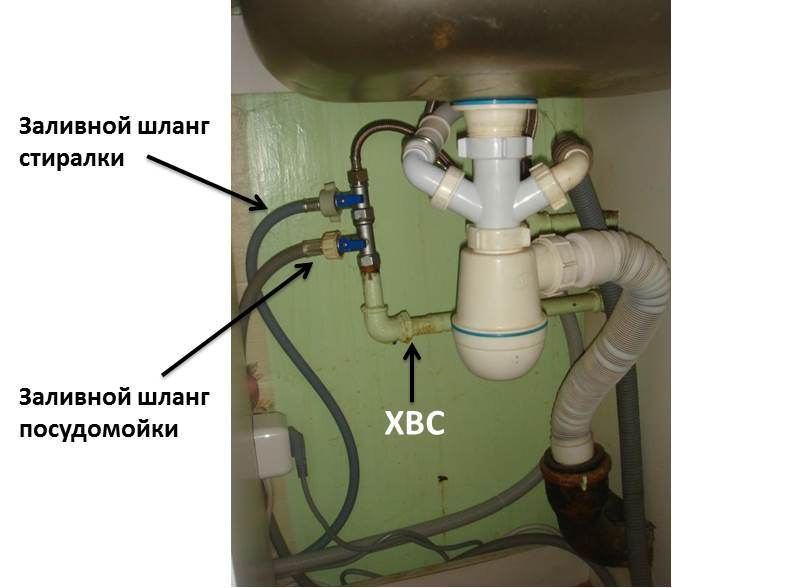
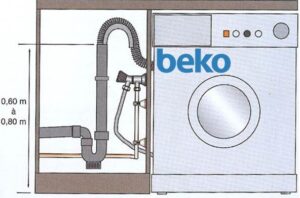
Additionally, you may need to drain both a dishwasher and a washing machine, so the drain trap connected to the sink should have two outlets. It would look something like this:
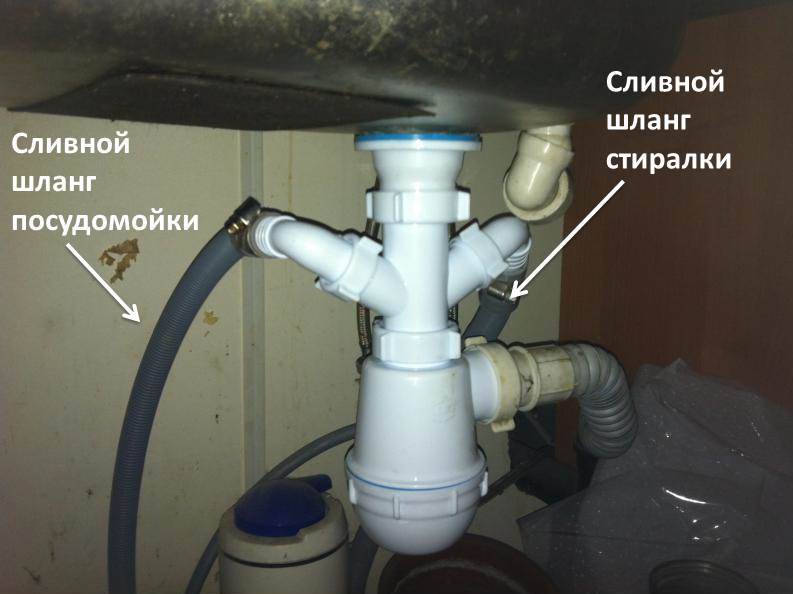
After connecting the water and sewer lines, be sure to check the dishwasher. To do this, turn on the wash cycle and listen to the machine. There should be no unusual sounds. Also, inspect all water connections and drains for any leaks.
In conclusion, it's worth noting that, overall, connecting a dishwasher to the water supply and sewer system isn't all that difficult. However, as with any job, there are some nuances that must be carefully considered. Otherwise, it could end in either dishwasher failure or flooding. It's best to avoid both – do everything correctly!
Interesting:


2 reader comments
Add a comment
Headings
Washing machine repair




For buyers




For users


Dishwasher




Good article, detailed.
Great article! Thank you!