Due to the high humidity found in the bathroom, installing and using electrical appliances there is not recommended. However, for the convenience and comfort of family members, some appliances must be placed in this room. Washing machines and water heaters are most often located here.
Don't rush into installing a water heater and washing machine haphazardly; some people manage to power them from the same outlet. This is unsafe and can lead to fire or electric shock. This article will explain how to properly connect a water heater and washing machine, following all the rules.
General connection principles
Frankly, in the bathroom, people usually don't limit themselves to turning on just the washing machine and the water heater. Besides these appliances, they also use a hairdryer, electric razor, towel warmer, and light fixtures. Of course, this isn't entirely safe, but if you properly manage the electrical supply, you won't have to sacrifice your usual comfort. A proper wiring diagram for devices minimizes the risk of short circuits, fire, or electric shock to the user.
Large power consumers, such as boilers with a power output greater than 3.5 kW, must be connected directly to the power grid from a separate circuit breaker. A low-voltage circuit breaker must be provided to disconnect the power supply in the event of a current leak. Alternatively, a residual-current circuit breaker with a tripping current of no more than 30 mA can be used.
Plugging a heated towel rail into a separate electrical outlet doesn't look very aesthetically pleasing in an interior, so when creating an electrical circuit, it's best to connect it directly to the circuit breaker.
So, what number of sockets is best to provide in a bathroom when installing electrical wiring? If there is no automatic washing machine installed in the room, one or two electrical outlets are sufficient; however, if both a boiler and a washing machine will be located there, it is better to install three or four sockets.
Placement of sockets and electrical appliances
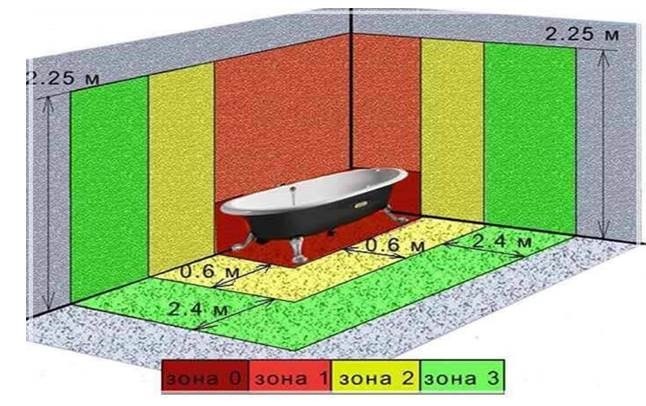
According to GOST R 50571.11-96 (IEC 364-7-701-84), Part 7, Section 701, bathrooms are conventionally divided into zones, which indicate whether electrical appliances can or cannot be installed there. These zones are shown in the figure.
By looking at the image provided, the user can clearly determine where electrical equipment installation is permitted and where it is strictly prohibited. So:
The zero zone includes areas where water is present, such as bathtubs, showers, and washbasins. Using devices with voltages exceeding 12V near water is strictly prohibited. Power sources should also not be located in this zone.
Zone 1 surrounds the previous zone, usually the adjacent walls, it is not allowed to install sockets here, however the area is suitable for placing a water heater;
the second zone is located at a distance of 0.6 m from the boundaries of zone 0. Here you can install a boiler, as well as lighting fixtures characterized by protection class 2;
Zone 3 is relatively safe; electrical outlets can be located here and further into the room, but it's important to note that sockets and switches must be protected from moisture and steam.
In the zero, first and second zones, the installation of junction boxes, distribution and control devices is prohibited.
The Electrical Installation Code (PUE) also regulates wiring in bathrooms. Section 7.1.40 addresses requirements for electrical wiring. It states that both open wiring of the required cross-section and concealed wiring are permitted. The permissible insulation temperature must exceed 170°C.
Clause 7.1.48 examines the extent to which it is considered possible to install plug sockets in a room with high humidity in general. According to the data, installing power outlets is prohibited in public showers, while in apartments, houses, and hotel rooms, sockets are permitted in bathrooms, but only in zone three. It is essential that electrical points be connected via isolating transformers, RCDs or residual current circuit breakers programmed for a tripping current of no more than 30 mA.
Therefore, according to GOST and PUE standards, sockets must be connected via a residual-current device with a tripping current of up to 30 mA and located exclusively in zone 3. As for junction boxes, they are also recommended to be located in zone 3, or even better, outside the bathroom.
Please note that regulations only describe the placement of electrical outlets within designated zones. There is no information specifying the height at which electrical outlets should be located. Therefore, when planning your power point layout, install them in a manner that ensures convenient connection of appliances.
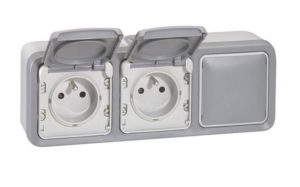
As mentioned above, sockets can be installed in Zone 3, but they must be equipped with a protective cover. The Legrand Plexo series of high-quality electrical installation products is an excellent option.
It is essential to comply with the requirements of the PEU; this guarantees the safety of you and your family.
Electrical communication diagrams
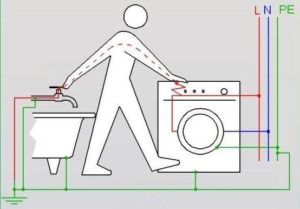
The main rule for placing powerful consumers in the bathroom is to turn them on through RCDA separate circuit breaker for the washing machine and water heater is also required. A possible connection diagram is shown below.
When installing a new bathroom electrical system, you can use both surface-mounted and built-in electrical components. According to the Electrical Installation Code, you can install external wiring if you don't plan to renovate the bathroom, or you can cut through the walls and hide the cables under the finishing materials.
Communications for large consumers
A washing machine and water heater are considered high-power consumers of electricity, so installing them in a bathroom requires separate circuits protected by circuit breakers. Using the same outlet for both the washing machine and water heater is not allowed. It is necessary to provide a separate power point for each device, with an additional panel with a circuit breaker..
What kind of wire is needed to connect the appliance? The cable cross-section is selected based on the appliance's power rating. It is recommended to weld or solder the wires. The connection is made in a sealed junction box, completely protected from moisture.
When installing an electrical circuit, it is advisable not to use terminal blocks; it is best to crimp using sleeves.
The distribution box is installed outside the bathroom, but if this is not possible, install it indoors, choosing a panel with an IP68 protection rating. The water heater must be connected using an electrical panel with a two-pole circuit breaker equipped with an RCD.

 Due to the high humidity found in the bathroom, installing and using electrical appliances there is not recommended. However, for the convenience and comfort of family members, some appliances must be placed in this room. Washing machines and water heaters are most often located here.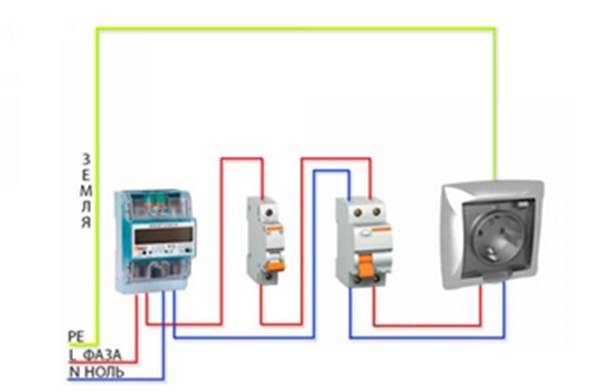
 Clause 7.1.48 examines the extent to which it is considered possible to install plug sockets in a room with high humidity in general. According to the data, installing power outlets is prohibited in public showers, while in apartments, houses, and hotel rooms, sockets are permitted in bathrooms, but only in zone three. It is essential that electrical points be connected via isolating transformers, RCDs or residual current circuit breakers programmed for a tripping current of no more than 30 mA.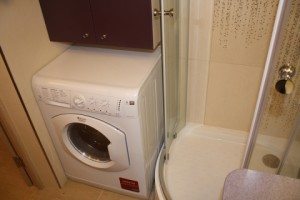
















Add a comment