
How to use a Dexp dishwasher
 People who own a dishwasher for the first time often don't know how to use it properly. Some try to use it intuitively, through trial and error. However, it's better to take a different approach—to thoroughly understand all the nuances of the dishwasher.
We'll explain how to use the Dexp dishwasher, what cleaning products you'll need, and how to load dishes into the racks.
How does the dishwasher control panel work?
After a new dishwasher arrives from the store, owners are eager to try it out. However, there's no need to rush. Before using your dishwasher, be sure to read the instructions for it.
The user manual is included with the dishwasher. It explains how to connect the dishwasher to the water supply and drain, how to load dishes into the baskets, how to prepare the dishwasher for the first use, and describes all programs. It is important to read the manufacturer's recommendations before using the appliance.
Inspect the machine, paying attention to the control panel. Different Dexp models have different dashboard designs. Some machines only have buttons and indicators, while others have a rotary dial.
A description of all the buttons on the control panel can be found in the instructions for the Dexp dishwasher.
For example, the dashboard of the Dexp M9C7PD dishwasher looks like this: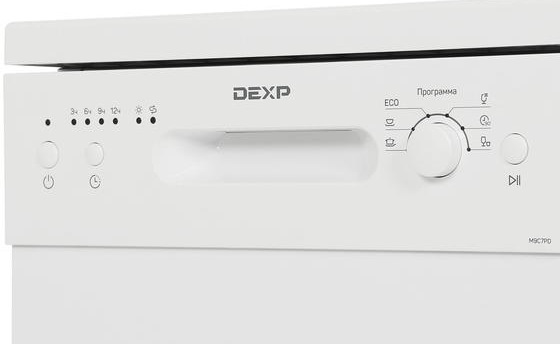
- the far right button “Start/Pause” – when pressed, the cycle is activated and paused;
- The rotary control allows you to select the desired washing program;
- in the upper left corner there is a button for setting the delayed start time (for 3, 6, 9 or 12 hours), and warning indicators (salt and rinse aid presence);
- The leftmost button is the “On/Off” button, used to turn the dishwasher on and off.
There are no program labels around the dishwasher's rotary dial. Instead, there are symbols, each corresponding to a specific mode. Let's take a look at each icon.
- The saucepan symbol indicates the "Intensive Wash" cycle. Suitable for heavily soiled dishes.
- Deep Dish Pattern – "Normal Wash" program. This program is designed for dishes with medium soiling.
- ECO label. Eco mode, suitable for washing normally soiled dishes. This program uses less energy and water.
- The dial with the number 90 indicates the "90-minute" program. Ideal for cleaning dishes that are only lightly soiled and don't require thorough drying.
- The glass and cup symbol indicates the "Quick Wash" mode. Suitable for cleaning lightly soiled utensils.
- Wine glass design – "Glass" program. Designed for delicate, lightly soiled glassware.
The wash cycle is selected based on the type of dishes loaded in the dishwasher and the degree of soiling. Glass should not be washed on an intensive cycle, as this could damage the glass. A gentle cycle is also ineffective for burnt-on pans.
Salt, detergent and rinse aid
For dishwashers, special household chemicals are required. To operate your dishwasher, you will need salt, detergent, and rinse aid. The choice in stores is wide – the user decides at his own discretion which manufacturer to choose.
Salt is vital for dishwashers used in regions with extremely hard tap water. This problem is a real issue in most Russian cities, so a water softener is essential. Salt crystals protect the dishwasher from scale and limescale.
The dishwasher's water softener must be adjusted manually, taking into account the hardness level of the tap water in your region.
You can measure water hardness using special test strips. Place the indicator in the water and measure its color intensity. The dishwasher's softener is adjusted based on this information.
Next, you need to pour the salt into a special container. Follow these steps: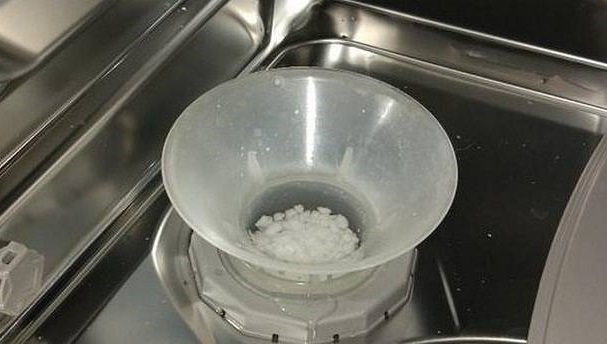
- remove the lower basket from the wash chamber;
- unscrew the lid of the salt container;
- pour 1.5 kg of special salt for dishwashers into the tray;
- add water to the container to the brim;
- Close the compartment and screw the lid tightly.
After filling the compartment, you must run the program immediately. Otherwise, saltwater can damage the filter assembly or the dishwasher pump. We'll explain how to run a test cycle below.
Rinse aid adds extra shine to dishes and prevents stains and streaks on glass and ceramics. It also speeds up the drying process of cutlery by allowing water to drain more quickly. The dispenser is located inside the dishwasher door; fill to the top of the compartment.
The rinse aid dispenser is manually adjusted. It has six settings and is set to position 4 by default. If streaks persist on dishes, increase the rinse aid dosage.
Detergents are essential for removing grease and other stains from dishes. You can choose from three types: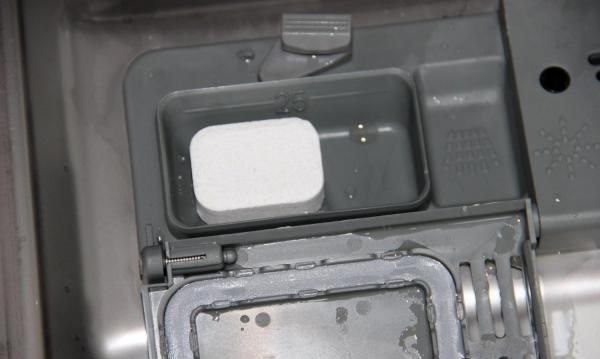
- pills;
- powder;
- gel.
Tablets don't dissolve completely during rapid cycles. Therefore, they are best used when starting long programs lasting at least an hour and a half. Powder or gel are more convenient in this regard – they are suitable for shorter cycles.
Add detergent to the dispenser before each wash. One tablet is needed per cycle. It's best to check the product packaging for the exact amount of powder or gel needed.
How to put dishes in baskets?
There's another important detail when using a dishwasher: loading dishes correctly. Failure to follow these basic recommendations will result in poor cleaning results. All the details are described in the dishwasher's instructions.
Before loading the dishes into the machine, remove any food residue and other small debris from the dishes.
This doesn't mean you need to rinse all your dishes before loading them into the dishwasher. Simply cleaning off any dried-on food particles, fruit pits, and removing tea bags and tea leaves from mugs is sufficient. Small debris left on the cutlery can easily clog the dishwasher's drainage system.
Place dishes in the machine as follows:
- Place deep objects (mugs, soup bowls, pots, frying pans) at a slight angle, with the bottom facing up (this way water will drain off them freely);
- Place the dishes securely so that they cannot fall;
- Make sure that cutlery does not interfere with the rotation of the spray arms.
Dexp dishwashers are equipped with two dish racks and a cutlery drawer. The upper rack should be used for fragile and lightweight items (mugs, glasses, cups, and saucers), while the lower rack should be used for heavier and more soiled items (serving plates, pots, pans, lids, and saucepans).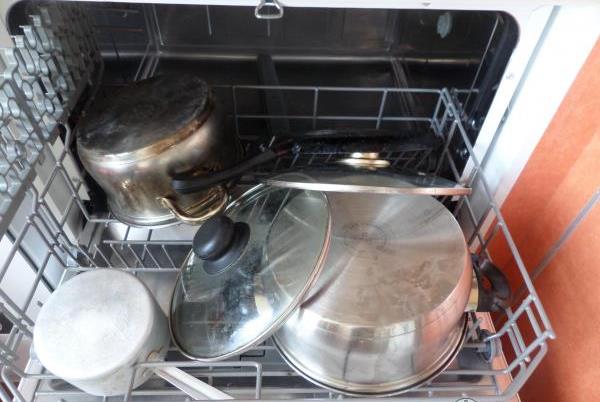
It is important to follow the manufacturer's basic recommendations:
- Do not wash very small items in the dishwasher – they may fall out of the basket;
- the dishes should not lie inside each other, each item is placed separately;
- Glasses and goblets should not touch to avoid damage;
- sharp knives should not be placed vertically - only horizontally, and in the top basket;
- You need to leave some space between the dishes so that they are washed from all sides;
- other kitchen utensils: spatulas, ladles, whisks, are laid out horizontally in the upper basket;
- Do not overload the dishwasher, as this will reduce cleaning quality and affect energy consumption.
The Dexp dishwasher allows you to adjust the position of the upper basket. It can be raised or lowered. This may be necessary when loading large items.
Working with a dishwasher
Having understood all the nuances, you can begin to use it. The first cycle of the dishwasher should be empty – with detergent, but without dishes in the chamber. This is necessary to clean the internal elements of the machine from factory dirt.
During the test cycle, you should also observe the machine's operation. Check for leaks and whether the appliance is heating the water. If all is well, you can use the dishwasher as intended.
To run a test cycle:
- open the door, load the detergent into the dispenser;
- plug the machine into the power supply;
- press the On/Off button;
- select a high temperature wash program;
- Start the cycle with the Start/Pause button.
After a successful test, you can run a full wash. Load the dishes into the racks according to the manufacturer's recommendations. Fill the lower rack first, then the upper one.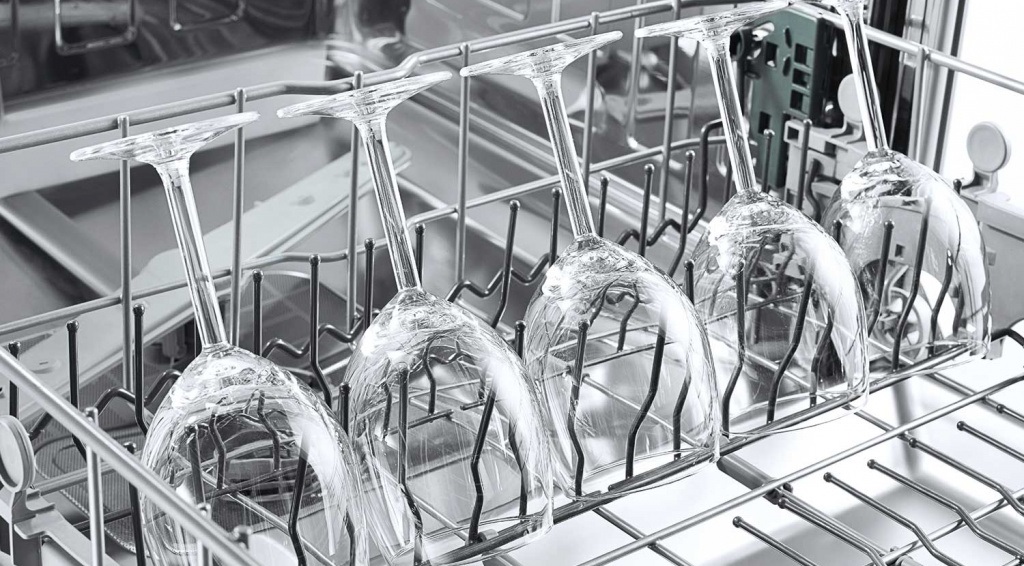
Add detergent to the machine, plug it in, and set the desired cycle. Select the program based on the type of dishes and how dirty they are. Press the "Start/Pause" button to begin the cycle.
Dexp machines have the ability to change a cycle if it was recently started. To do this:
- Press and hold the Start/Pause button for 3 seconds until the machine goes into standby mode;
- select another program using the rotary switch;
- Press the Start/Pause key.
You can also add more dishes while the machine is running, but only if the detergent drawer is still closed. To do this:
- put the machine into standby mode by holding down the “Start/Pause” button;
- open the door and load the dishes;
- Resume the cycle by pressing the Start button.
The dishwasher will sound a signal when the cycle is complete. Turn off the dishwasher by pressing the On/Off button. Open the door slightly and wait 10 minutes. This will allow the dishes to cool and dry.
Next, remove the dishes, first from the lower basket, then from the upper one. Afterwards, clean the filter unit of any debris and wipe the walls of the wash chamber with a damp cloth. Leave the dishwasher door slightly open for ventilation.
Interesting:





Readers' comments
Headings
Washing machine repair




For buyers




For users


Dishwasher




Add a comment