
How to change the noise filter in a washing machine
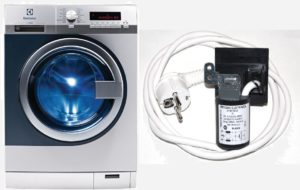 When many people hear the phrase "noise suppression filter," they don't necessarily associate it with a washing machine. In fact, it's nothing more than a surge protector, or, as it's also called, a capacitor—a semiconductor component installed on the washing machine's power cord. What this filter is for, how it works, and, most importantly, how to replace it correctly—we'll discuss this in this article.
Operating principle of the part
It's quite difficult to find a perfect electrical grid anywhere in the world. Periodic outages in such networks are common in both Europe and prosperous North America. The CIS countries are not to mention the situation: tens of thousands of household appliances, including washing machines, burn out every year due to power surges and other faults. A modern automatic washing machine has a sensitive electronic module that can fail if the slightest problem occurs.
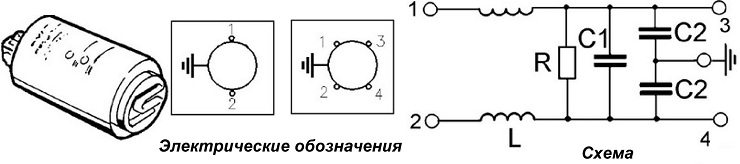
So, to protect the washing machine's electronics, engineers install a surge protector, which smooths out minor power surges. It does this quite effectively, but it can't handle major outages, so experts recommend that users additionally protect their "home assistant" by using a surge protector. washing machine stabilizer.
When a major power outage occurs, the surge protector guards the washing machine's electronics and, as a result, burns out. It can't be repaired—it must be replaced.
How to get to the burnt part?
If we suspect the faulty filter is the cause of the washing machine's failure, we need to access it to inspect the component and replace it if necessary. To access the faulty component, we need to:
- disconnect the washing machine from utilities, especially from the electrical network;
- remove the top cover of the washing machine;
- look inside the case where the power cord goes;
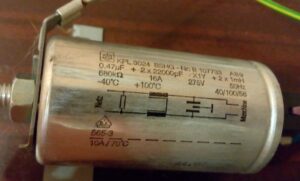
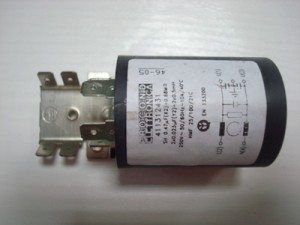
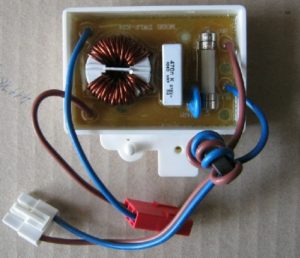
- We need to look for a part that looks similar to the one shown in the picture below.
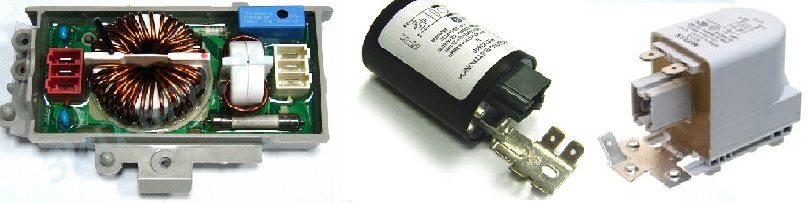
A screwdriver is all you need to access and view the interference suppression filter, but a multimeter may also be needed to check the burnt-out component. Read on to learn how to check and replace this component visually and with a multimeter.
Check and replace
Having found the semiconductor component we are interested in, we must immediately begin to inspect it. Often, a burnt-out capacitor will give itself away by burnt-out contacts or simply an unpleasant smell emanating from it. In 98% of cases, the part can be replaced without a second thought. If the problem isn't so obvious, arm yourself with a multimeter and begin checking.
- Set the multimeter to the dialing mode.
- We place the device probes against the capacitor contacts.
- We check for the presence of voltage first at the input and then at the output.
If there is no voltage at the output, the part is faulty and needs to be replaced.
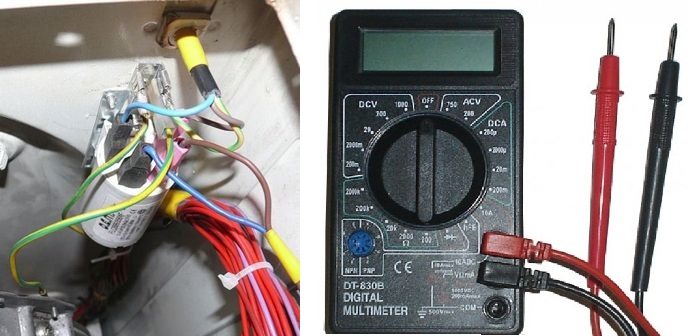
Replacing a washing machine's noise suppression filter can be done very quickly, even by a non-professional; the main thing is to have the right, working part on hand. You usually don't have this part on hand, so remove the old surge protector from its socket, disconnect it from the power cord, or remove it along with the power cord, and head to the store. At a specialized store, show the salesperson the burned-out washing machine capacitor and ask them to sell you a similar one; they'll likely find a replacement for you without any problem.
All that's left to do now is bring the part home, plug it in, reassemble it, and connect the washing machine to the power supply. After all the above steps, the washing machine should work without any problems. Happy repairing!
Interesting:


1 reader comment
Add a comment
Headings
Washing machine repair




For buyers




For users


Dishwasher




What are you writing? How do you measure voltage in dial-up mode? Also, try measuring the voltage in the outlet in that mode!