
Replacing the belt in a Zanussi washing machine
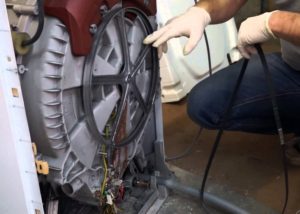 While changing a belt on most washing machines is easy, with Zanussi, the task is significantly more complicated. This manufacturer's machines feature a non-standard, even complex, housing design. This significantly impacts the repair process. But nothing is impossible—replacing a drive belt on a Zanussi yourself is entirely possible. Just follow the instructions.
"Exposing" the drive mechanism
While on most washing machines, removing the back panel requires simply unscrewing a few screws and pulling the housing, with Zanussi it's different. To access the drive unit, you will have to split the washing machine in half, which will require certain actions. First, you need an awl, a flat-head screwdriver, a power screwdriver, and a 7mm or 8mm socket. Then, proceed to disassembly, following the instructions below:
- disconnect the equipment from the power supply and water supply;
- turn the washing machine body sideways;
- find a bolt in the center of the side wall;
- use an awl to pry up the “head” and expose the bolt;
- Using a 7 or 8 mm head, depending on the Zanussi washing machine model, unscrew the fasteners;
- repeat unscrewing the bolt from the other side;
Before carrying out any repairs, the washing machine must be de-energized and disconnected from the water supply!
- unscrew the screws securing the back at the bottom and top;
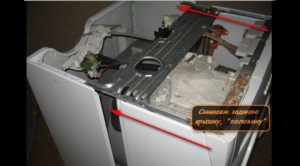
- remove the drain hose;
- remove the top cover by pushing it away from you;
- pay attention to the place where the power cord “enters” the washing machine;
- Use a flat-head screwdriver to pry up the tab on the left side of the power cord retaining element and press it down;
- unscrew the four screws securing the metal strip under the top cover;
- carefully remove the back panel.
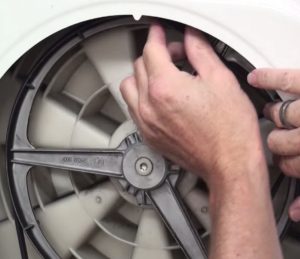
That's it! Just behind the rear wall, you'll see the drum pulley, and the drive belt taut on it. If the rubber has broken or slipped, the "wheel" will be hollow, and the rim will be found on the bottom. We'll discuss how to assess the condition and replace the belt below.
Belt installation
Before saying goodbye to your old belt, you need to assess its condition. The rubber band does not always come off the pulley due to damage or stretching - sometimes the cause is high speed or loose tension. Therefore, first we lift the rim and inspect it for cracks and other defects.
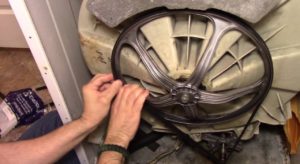 The second step is to assess how much the rubber has stretched. The belt surface is marked with a factory marking, the first four digits of which indicate the original diameter. After noting these numbers, measure the rim circumference and compare the readings. If the difference is equal to or greater than 2 cm, the component should not be used; it must be replaced.
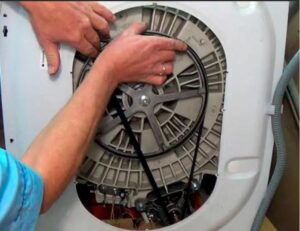
The new belt must be original and match the markings on the old one. To tighten it onto the pulley, you must follow a specific sequence.
- Place the belt against the drum pulley (large wheel).
- Rotate the pulley counterclockwise to firmly place the rubber band on the wheel.
- Slightly lower the belt from the pulley, holding it with one hand.
- With your other hand, place the belt on the motor shaft so that the rubber band “goes” closer to the engine, at least 2 cuts.
- Similar to a bicycle chain, turn the drum pulley clockwise while holding the belt until the rubber band is completely seated on the wheel.
If done correctly, tensioning the belt will be quick and easy. It's best to have a helper the first time—it's easier to do it with four hands. Then, reassemble the Zanussi washing machine in reverse order.
Why do belt problems occur?
To prevent belt replacement from becoming a constant problem, it's recommended to "correct the errors." In simple terms, figure out why the rubber belt has come off the pulley in your Zanussi machine. Several malfunctions in the machine could have caused this.
- A worn belt. The most common and obvious cause. With prolonged and intensive use, the rubber band can wear out, break, or stretch.
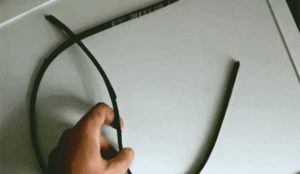
- Imbalance. An overloaded drum shifts as it rotates, hitting the tank and causing other shifts and vibrations. The drive belt may not be able to withstand this pressure and may slip.
- Broken bearings. The bearing assembly ensures the drum rotates smoothly. If the bearing rings are worn out, the machine begins to vibrate excessively, the shaft becomes loose, and with it the pulley. The rubber seal also gives way and breaks.
- Infrequent use. If the machine is used infrequently, the rubber components, including the drive belt, dry out. Eventually, the next time the machine is used, the rubber can't withstand the pressure, fraying, or breaking.
- Poor repair. Sometimes, during repairs, inexperienced "technicians" manage to damage unrelated components, such as the universal joint or pulley. In this case, the drum-shaft assembly suffers greatly and becomes loose, and a broken drive belt is only the initial warning sign.
It's easy to suspect problems with the drive belt. Firstly, modern Zanussi dishwashers will automatically detect a drive belt problem using the self-diagnosis system. The display will show the corresponding code, and the wash will not start until the problem is fixed.
Secondly, the behavior of your Zanussi washing machine will change. However, there are many variations here. Sometimes the machine starts without a problem, but doesn't spin up quickly enough or makes an unusual humming noise. In other cases, the system prevents the machine from starting the wash cycle because the motor isn't capable of reaching the required speed. However, the drum itself can be easily rotated by hand.
You won't be able to operate a Zanussi without a drive belt—you'll either have to replace it yourself or have it professionally repaired. It's important to do the repair promptly and be sure to check the surrounding components, as the rubber belt could have come into contact with nearby sensors and wires when dropped.
Interesting:


Readers' comments
Headings
Washing machine repair




For buyers




For users


Dishwasher




Add a comment