
Replacing the belt on an Electrolux washing machine
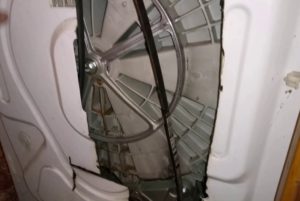 It's helpful to know how to change the belt in an Electrolux washing machine yourself. On machines with a commutator motor, the rubber often slips and becomes damaged, stopping the entire system. There's no need to take it to a service center—you can easily fix the problem yourself. To get the drive working again, you need to know how to properly replace and secure the rim. Detailed procedures, explanations, and recommendations are provided below.
Inspecting the drive mechanism
It is impossible to see the fallen belt without partially disassembling the machine. The rubber band is hidden from view behind the back panel of the case, so you must first remove it with a screwdriver. But you can suspect problems with the pulley by noticing certain “signals” from the washing machine.
Firstly, Electrolux can automatically report a faulty drive. Thanks to a modern self-diagnostic system, the circuit board can detect the malfunction and display a corresponding error code on the display. Reading the instructions will reveal that the fault is due to a slipped belt. If the machine doesn't have a display, an indicator will appear, which can also be read in the user manual.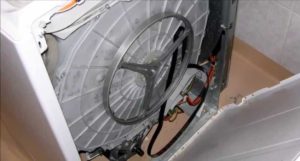
Secondly, problems with the drive can be identified by the machine's behavior. These telltale signs include:
- the wash cycle has started, the tank is full, the motor is humming, but the drum remains motionless;
- the machine's motor hums, then suddenly stops and becomes quiet, while the change of actions occurs at equal intervals;
- the wash starts, the engine runs, but the machine “freezes” and does not respond to button presses;
- The drum rotates freely by hand, but the motor cannot accelerate it.
If there are problems with the drive, do not use the Electrolux - this can lead to overheating and motor failure!
Even if one of these symptoms is present, you should sound the alarm, forcefully stop the cycle, and check the drive belt. This will require partially disassembling the machine and assessing the condition of the rim and pulley.
We tighten the belt ourselves
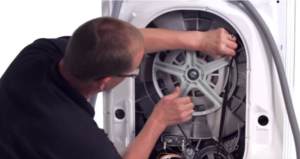 A broken belt isn't a reason to take it to a service center. You can reinstall the rim yourself, the key is preparation and practice. However, this "repair" isn't exactly easy, as tightening the rubber isn't as simple as it seems. It will require a fair amount of patience, time, and effort, but even a novice can achieve a hassle-free repair.
A single belt breakage isn't a big deal. You can simply replace the broken rim without any further intervention. However, if the rubber band falls off regularly, replacement is essential. In any case, you should first remove the belt from the housing and assess its condition.
We act according to the following instructions:
- de-energize the equipment and disconnect it from other communications;
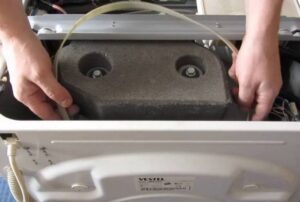
- provide access to the back (move and unfold);
- remove the back from the body;
- find the drive belt.
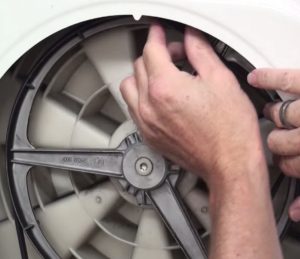
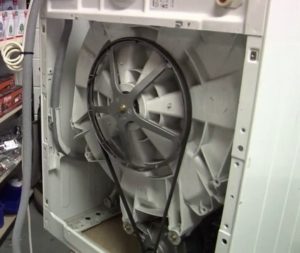
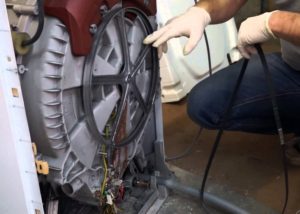
On any washing machine with a collector, including Electrolux, the belt is always located just behind the backplate. It's tensioned over the drum pulley and motor shaft. If the belt isn't in the designated place, it's likely dislodged and lying on the bottom or floor.
The fallen belt should be removed and inspected. First, look at the markings. The first four digits are the factory rim diameter in millimeters. The second step, of course, is to measure the belt's circumference and compare it to the original measurement. A deviation of up to 2 cm is acceptable; any more indicates the belt is too stretched and needs to be replaced.
If the belt has stretched more than 20 mm, it must be replaced with a new one.
To replace or re-tighten a loose belt, follow these instructions:
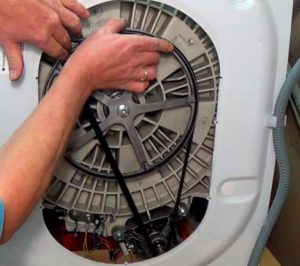
- put the rubber band on the electric motor shaft;
- Pull the large wheel onto the drum pulley, turning it to the right.
The drive belt is installed like a bicycle chain: it's important to be able to simultaneously tighten the belt and turn the pulley. It's recommended to have a helper for the first time—the task is easier and quicker with two people. You should be prepared for the fact that the rubber band used on Electrolux is tight and difficult to remove, which will require a lot of effort from repairmen.
At the end, it's important to ensure the belt is securely seated in the grooves. To do this, rotate the pulley 2-3 times, assessing the degree of tension. If it's too tight, the rim diameter is too small, and a looser option is recommended.
After checking the belt, we complete the repair. We secure the back panel to the body, reinserting all the previously removed screws. Then, we return the washing machine to its original location and reconnect it to the power supply, water supply, and sewerage system. Be sure to run a test cycle and evaluate the performance of the drum and rubber band.
Recurring failure
If the belt comes off more than twice every six months, a single replacement won't solve the problem. Moreover, if the newly replaced rubber band falls off again, the problem isn't a loose or damaged rim. The washing machine likely has other issues, and the belt falling off is a consequence of them, not the cause. To determine the culprit, a comprehensive drive diagnostic is necessary.
Repeated belt failure can indicate several problems at once. These include wear of the belt itself, play in the drum, loose motor mounts, damaged bearings, a deformed shaft, or a damaged universal joint. Let's examine each "diagnosis" in more detail.
- Belt wear. Failure to replace the belt promptly will result in it constantly slipping off the pulley. In this case, even a cursory inspection of the belt will reveal signs of wear: cracks, severe stretching, holes. All of this clearly indicates that the rim is no longer suitable for use and must be replaced.
- There's play in the drum, or more precisely, the drum pulley. The wheel mount may have become loose, causing the assembly to become unsteady. Replacing the rubber isn't enough; you'll need to tighten the retaining screw. It's also a good idea to inspect the rim: if it's damaged or deformed, it will need to be replaced.
- Unsecured electric motor. All parts of an Electrolux appliance are initially securely fastened, but over time, these components become loose. This is especially true if the appliance is installed incorrectly or if the operating conditions are violated. Constant vibration worsens the situation, the motor becomes loose, which leads to problems with the belt drive. The problem is resolved by tightening all the fasteners on the engine.
- A deformed shaft or pulley. If the repair is unsuccessful, inexperienced technicians can damage adjacent parts while repairing one part. For example, they can bend a drum wheel or shaft. Sometimes the parts can be straightened, but more often they must be completely replaced.
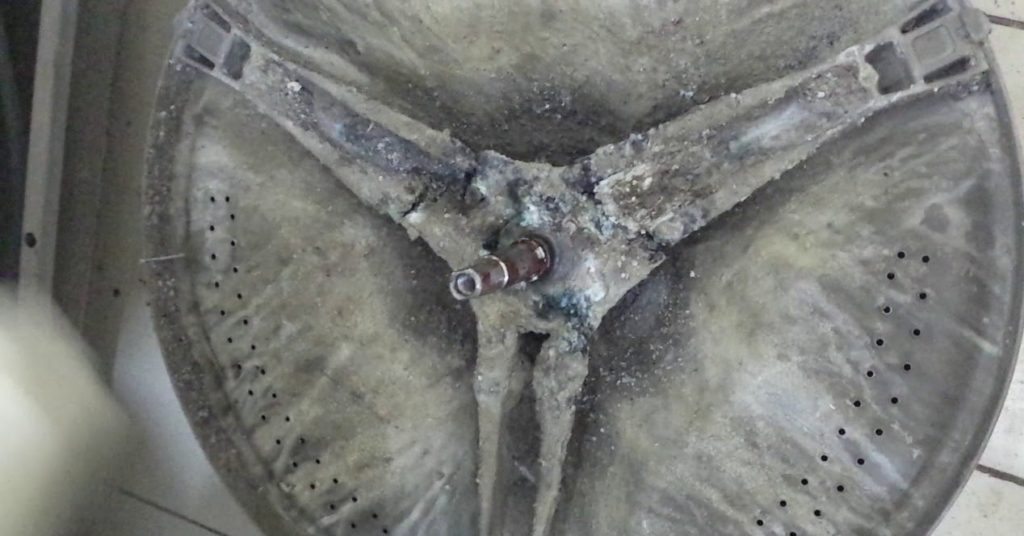
- A damaged spider. This is rare, but it can cause a lot of trouble. Deformation can be caused by a manufacturing defect or by excessive vibration from the washing machine during the wash and spin cycle. In any case, the part must be replaced, otherwise the situation will be aggravated by an unbalanced drum. This imbalance will lead to more serious mechanical damage.
- Worn bearings. A damaged bearing assembly will no longer ensure smooth rotation of the drum—the shaft will begin to wobble and cause distortion. In this case, a broken drive belt is considered a favorable outcome. Other causes, such as imbalance or excessive vibration, will require more costly repairs.
Often the drive belt comes off due to poor installation - it is important to secure the rubber band in the provided grooves.
A new belt doesn't always fall off because of serious problems with the machine. More often, the problem is a poorly selected replacement—buying a non-branded part or a rim of the wrong diameter. To avoid mistakes, it's recommended to choose genuine parts from trusted sellers, using the serial number of your existing Electrolux.
Interesting:
Readers' comments
Headings
Washing machine repair




For buyers




For users


Dishwasher




Add a comment