
Replacing the plug on a washing machine
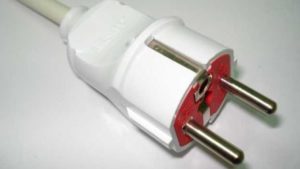 If you need to replace the plug on your washing machine, there's no need to rush to a service center. Almost anyone can handle the removal and subsequent installation, as long as you strictly follow the instructions. The procedure differs for Euro plugs and standard plugs, so we recommend familiarizing yourself with each step, including a thorough inspection of the power cord.
Repairing a Europlug on a car
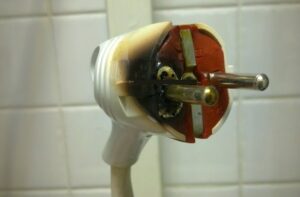
Before opening and replacing the plug, make sure it's damaged. To do this, remove the plug from the socket and carefully inspect the housing and wires. If there are traces of carbon deposits, melting, or a burning smell, then repairs are unavoidable. Let's get a knife, screwdrivers, pliers ready and get to work:
It is recommended to first identify the reason why the plug burned out, so that the situation does not happen again.
- We cut off the old Euro plug.
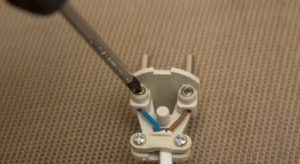
- We remove the top insulating layer from the cord by about 4-5 cm.
- We strip each wire by 1.5-2 cm.
- We twist the wires and cut them, leaving at least 1 cm of exposed wire.
- Using pliers, bend the ends of the wire.
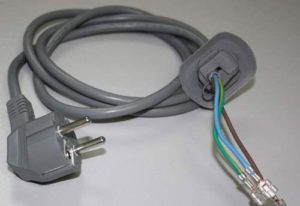
- Let's inspect the wires. A standard power cord has three contacts: blue or light blue is neutral, yellow-green is ground, and black, pink, or brown is live.
- We connect the wires to the new case, connecting the ground to the central contact, and the phase and neutral to the other two (their location does not play a special role).
Next, we clamp the cord with a plastic jumper, which will securely hold it in place. Afterwards, we check all the clamps again and reassemble the plug housing. The final step is tightening the main screw.
We fix a regular old fork
Almost all modern washing machines have European plugs. However, if desired, the European plug can be replaced with a regular old Soviet-style plug. The same option applies if there is no grounding line in the living space. The basic procedure is the same as the previous one, but there are a few nuances. The instructions are as follows:
- we cut off the damaged plug and disassemble its housing;
- remove the top layer of insulation by 5 cm;
- we strip the ends of the conductors by at least 1.5-2 cm, cutting off the excess with a knife;
- bend each vein into a ring;
- Connect the live and neutral wires to the contacts, ignoring their polarity. If the cord also has a ground wire, it must be cut off—Soviet-era outlets don't have a ground connection.
Select a new plug carefully, as it must withstand the nominal and maximum voltage of the network and the washing machine.
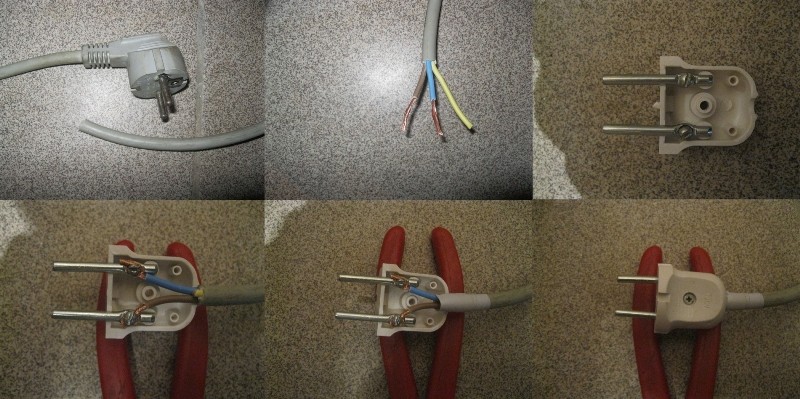
All that remains is to check the reliability of the fixation, clamp the body and tighten the central screw. After connecting to the network, it is recommended to observe for a few minutes. If the plug melts, there is a burning smell, or smoke is coming out, you need to de-energize the electrical wiring and determine the cause of the problem.
If the power cord is broken
Most often, a burnt or melted plug is simply the result of a short circuit, while the source of the problem lies elsewhere. For example, a broken power cord. The power cable can suffer damage after being crushed by a heavy object or externally damaged by a sharp nail or corner. Therefore, don't rush to disassemble the adapter; instead, carefully inspect the surface of the cable for cracks, kinks, or burn marks.
Sometimes a quick external inspection is not enough to detect internal damage, as the insulation layer hides a break in one of the conductors into two parts.
The easiest way to check the continuity of a cable is to use a multimeter. Simply find the tester, set it to "Buzzer" mode, and ring the cable. If the device detects a current leak, you'll hear a high-pitched beep.
If you need to test a circuit longer than two meters, you should prepare an additional wire and include it in the overall circuit. If a spare wire is not available, another option is to twist the live and neutral wires together at one end of the wire. Next, connect the multimeter probes to the nearest contacts. This option has several advantages over the first:
- You can test two wires connected in series into a single circuit for leaks at once;
- there is no need to look for a proportionate conductor and expand the circuit.
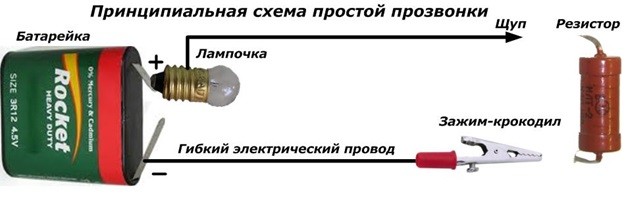
If you don't have a multimeter at hand, you can check the integrity of the conductor using a special homemade universal device. To make it, you will need a 3.5-volt Ilyich light bulb, a power battery (preferably a square one with a capacity of 4.5 volts), two connecting wires and a grip connector. We connect all the elements in the following sequence:
- we connect a light bulb to the positive terminal of the battery;
- We connect a flexible conductor with an alligator clip to the negative terminal of the battery.
When working with high voltage, remember safety precautions, especially if there is a risk of current leakage.
It's best to first test the resulting device on a familiar and working section of the network. Simply attach the clamp anywhere, and if the circuit is assembled correctly and current is flowing into the wire, the light will illuminate. If there's no light, we can logically conclude that there's a leak or a broken wire.
If there are any doubts about the integrity of the cord and plug, or if there are obvious signs of melting or burning, immediate action is necessary. Knowing what to do first and how to repair it can protect your life, health, and property.
Interesting:


1 reader comment
Add a comment
Headings
Washing machine repair




For buyers




For users


Dishwasher




We changed the plug. The machine stopped working. But it turns on. What does this mean?