
Which dishwasher is better: Bosch, Siemens, Electrolux?
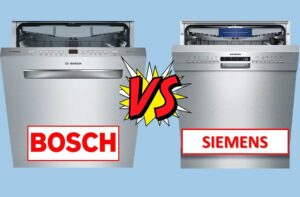
 Bosch, Siemens, and Electrolux dishwashers account for 70% of the dishwasher shelf space in any Russian store selling these products. These three brands lead consumer popularity ratings. Statistically, every second dishwasher purchased in our country is either Bosch, Siemens, or Electrolux. However, the obvious question arises: which brand of dishwasher is better? Who is the leader in this trio? Let's try to figure it out.
Bosch, Siemens, and Electrolux Dishwashers: Pros and Cons of Each Brand
Objectively comparing the three leading dishwasher brands is undoubtedly very difficult. A cursory analysis of the features and technical specifications of the main models reveals that Bosch, Siemens, and Electrolux all offer similar dishwashers in the three price categories.
Of course, there are differences, but at first glance, these differences are very minor. Does this mean all these manufacturers produce identical appliances? Let's not jump to conclusions, as each dishwasher from the three brands has its own unique features that contribute to its advantages. Let's start with the recognized advantages of Bosch dishwashers.
- German reliability. This phrase is often added by salespeople when pronouncing the Bosch brand name, but it's not that simple. If a Bosch dishwasher is assembled in Germany, or at least Poland, then there are no questions – the quality is top notch.But if it was assembled in China, then you can forget about German quality.
- Low price. Indeed, Bosch's dishwasher pricing policy is quite affordable. Although it offers both mid- and high-end models, it currently focuses on budget models.
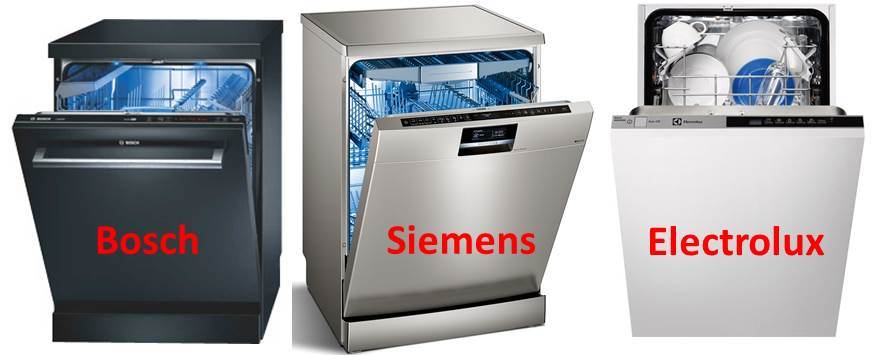
- Ergonomic design. Bosch produces dishwashers with both universal and highly original designs. A Bosch dishwasher fits equally well into a uniquely designed kitchen as it does into the most ordinary one.
Please note! Flexible pricing policies, a caring attitude toward customers, and ongoing collaboration with leading advertising agencies are what characterize the owners of the Bosch, Siemens, and Electrolux brands.
The long list of Bosch dishwasher advantages is endless, as almost all of them are Siemens and Electrolux brands. In the case of Electrolux, however, they point to Swedish reliability. It appears that we've taken a slippery slope in comparing dishwasher brands. Overall, these brands are roughly on par in terms of their advantages, and to determine the winner, we'll have to meticulously compare the specifications of their leading dishwasher models. Only then will we be able to determine which brand has managed to outshine the competition, albeit temporarily.
What parameters should be used to compare dishwasher models of these brands?
It's best to compare dishwashers based on the characteristics that are most important to the consumer. These characteristics include:
- capacity;
- water consumption;
- energy consumption;
- noise;
- protection system;
- drying type;
- number of programs and functions.
The capacity of a dishwasher is measured by the number of standard place settings that the machine can hold. In this regard, Electrolux branded machines win, as they have a load capacity of 6 to 15 place settings, while Bosch and Siemens only hold a maximum of 14 standard place settings. It is worth noting, however, that only Bosch and Siemens dishwashers have compact models that can load 6 and 8 sets of laundry, while Electrolux compact machines are designed for only 6 sets of laundry.
In terms of energy consumption, dishwashers from these brands are in the same league. Full-size models consume an average of 0.8-1.05 kWh, slim models consume 0.7-0.83 kWh, and compact models consume 0.6-0.7 kWh. Water consumption across different models should be compared based on model type, which we've done, and the results are presented in a table.
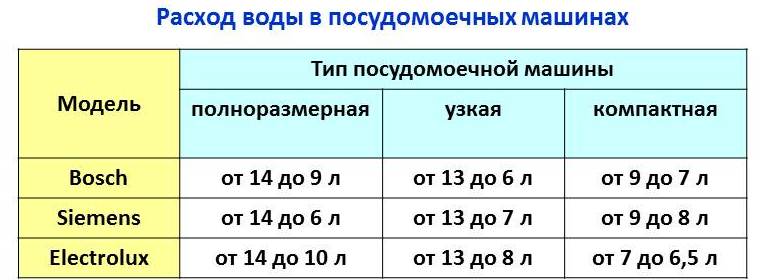
Please note: This analysis was conducted using information from Yandex Market and considered dishwasher models available for sale as of April 2016.
Based on the collected data, it can be concluded that Electrolux offers the most energy-efficient compact models. Bosch and Siemens, however, offer slightly more energy-efficient full-size and narrow models.
One important characteristic is noise level, as many people run their dishwashers at night or during the day while small children are sleeping. Bosch dishwashers range from 54 to 41 dB, Siemens dishwashers from 52 to 41 dB, and Electrolux dishwashers from 51 to 39 dB. In general, the indicators do not differ significantly from each other, so it is necessary to compare specific models with each other.Choosing the best brand in terms of safety system is also difficult. All three brands offer dishwashers with both full and partial leak protection, as well as child safety features.
Electrolux dishwashers are the clear winner in terms of drying type, as they offer both natural drying (condensation) and turbo drying options. Bosch and Siemens currently do not offer turbo drying models.
And finally, the most interesting feature is the number of programs and all sorts of additional features and options that make the dishwasher easy to operate and the cleaning quality high. All three models are generally similar in terms of the number of programs, with an average of 5-6 basic modes, including quick wash, intensive wash, and economy wash. However, Electrolux dishwashers feature a BIO mode (using biodetergents) and an Eat-Load-Run mode (a quick wash in 30 minutes).
A distinctive feature of Bosch and Siemens dishwashers is the presence of the following additional functions:
- HygienePlus – treatment of dishes with high-temperature water and steam;
- IntensiveZone – washing heavily soiled dishes in the lower basket and lightly soiled dishes in the upper basket differs in the water flow rate and temperature;
- Shine & Dry – a special drying technology based on the use of the mineral zeolite;
- VarioSpeed Plus – accelerates washing by increasing energy consumption, saving time by 20 to 50%.
Undoubtedly, in terms of technology implementation, Bosch and Siemens are ahead of Electrolux. However, such technologies also affect the price of the dishwasher. As for the quality of cleaning, it is impossible to say which brand of machine cleans better. Judging by consumer reviews, all machines have both positive and negative reviews, and among them, there are models that handle dirty dishes perfectly. To obtain more or less accurate results, it's necessary to conduct research on specific dishwasher models. Many factors will influence cleaning performance:
- washing program (duration, temperature);
- quality of detergent;
- sprinkler shape;
- degree of contamination of dishes;
- arrangement of dishes in containers.
No one will conduct such a test in a store when you buy a car, so you'll have to judge the wash quality solely by the technical specifications. And the better these specifications, the greater the chance of a better wash.
Review of leading dishwasher models of these brands
Now it's time to finally decide which is the top three: Bosch, Siemens, and Electrolux. Let's compare specific dishwasher models from these brands in three price categories. For convenience, we've presented the information in table format.
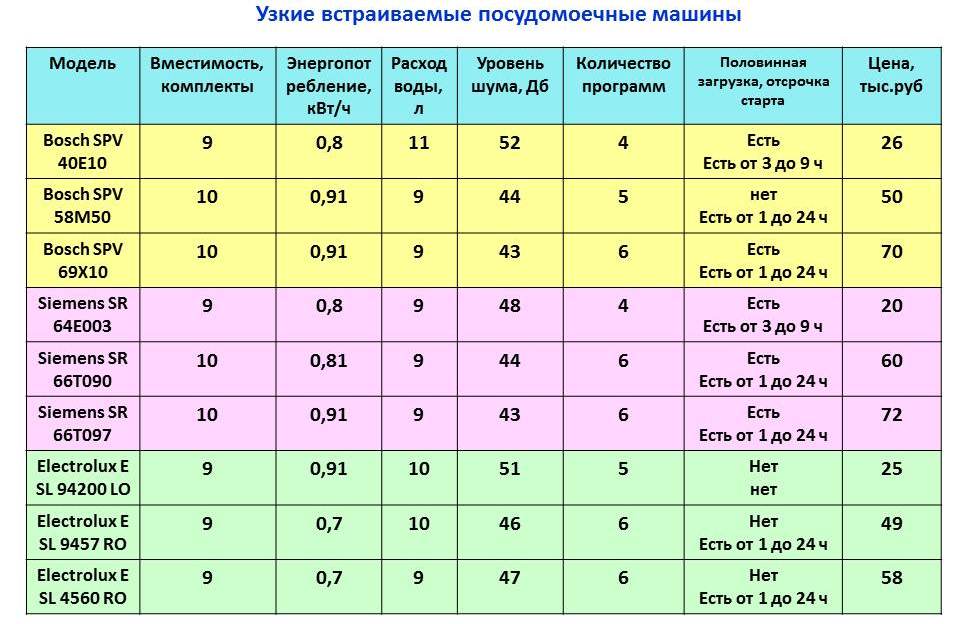
First, we compared the most popular type of dishwasher—narrow, built-in ones. In our opinion, the space allocation can be divided as follows:
- 1st place – Siemens SR 64E. This is a budget dishwasher with good features. Quick wash, automatic program, and tablet compartment – this dishwasher has it all. An audible signal sounds at the end of the cycle.
- 2nd place – Siemens SR 66T If not for its high price, this model would have earned first place, but as it is, it only earned second place. In addition to the above, this model features intensiveZone and varioSpeed, as well as a built-in water purity sensor and a "floor beam" function.
- In our opinion, 3rd place could well have been shared between two models: Bosch SPV58M50 and Electrolux ESL 9457 RO. But the Bosch dishwasher still wins, since it has complete leak protection, while the Electrolux only has partial protection.
We also decided to compare full-size built-in dishwashers in different price categories. Here's the result.
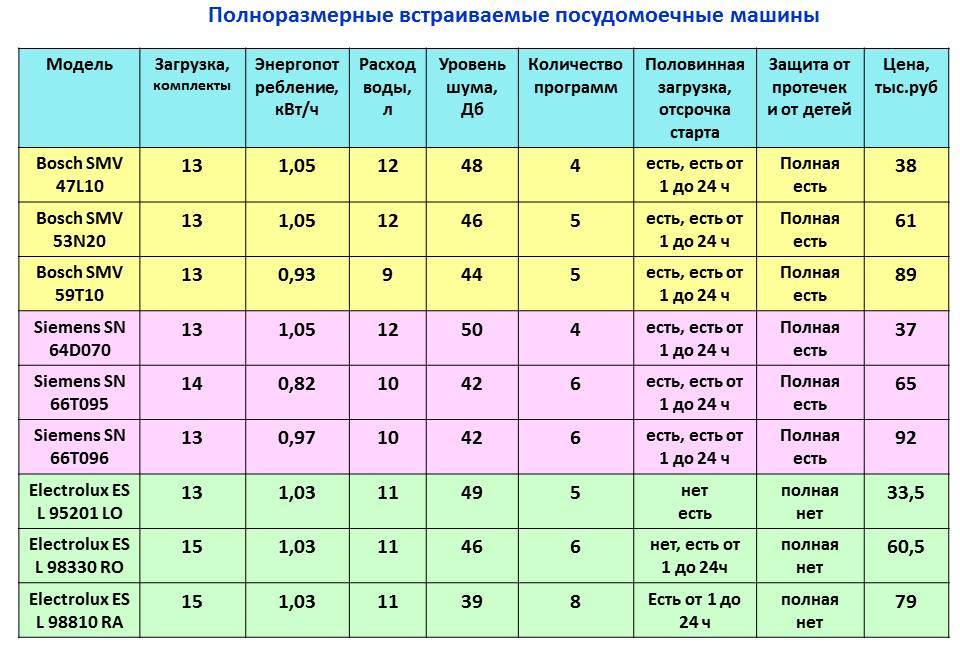
The Siemens SN 66T095 dishwasher is the clear winner among the selected models. It offers an optimal balance between price and technical specifications. Moreover, unlike its competitors, this dishwasher features automatic water hardness detection. The interior lighting is also a highlight of this model.
Second place goes to the Bosch SMV53N20, which features an adjustable basket and VarioSpeed. Third place goes to another Bosch machine, priced at $380. It has everything you need, and the price is very reasonable for German manufacturing.
None of the Electrolux dishwashers made it into the top three because they lacked a reliable safety system and a half-load function.
Thus, German-made dishwashers lead the pack in all aspects. Siemens models are often cheaper than similar Bosch models, but if you're on a budget, you might want to consider an Electrolux dishwasher, especially compact ones. In any case, it's up to you to decide which dishwasher is best, but remember that brand isn't always a guarantee of quality.
Interesting:
2 reader comments
Add a comment
Headings
Washing machine repair




For buyers




For users


Dishwasher




The article is pointless. It would also be worth considering the repair costs, in the event of, say, a heating element failure. Bosch heaters have a heating element integrated into a single unit, along with the motor and pump. The entire unit is replaced. The cost is appropriate.
$80?