
Does a family of three need a dishwasher?
 It's no secret that household appliances make life much easier for homemakers, allowing them to spend more time with their families. Washing machines, microwaves, multi-cookers, and other "helpers" have long been a staple in every home, but some women are still considering dishwashers, unsure whether an expensive appliance is necessary. Obviously, in large families, this appliance certainly wouldn't sit idle, but is it worth buying for a family of three? Let's explore whether it makes sense to buy one and what features to consider.
Is it really a matter of the number of people?
Some dishwasher users claim that this cutting-edge technology is sure to please everyone and won't sit idle, even in a bachelor's apartment. And if you have a family of three, there's no reason to doubt the purchase. What's the basis for this belief? A dishwasher offers tremendous benefits.
- The unit is convenient for use in apartments without hot water or with frequent interruptions. In such conditions, a dishwasher can be a real lifesaver. Of course, you can install a water heater, but this will require significantly more time, energy, and water consumption.
- In today's fast-paced life, people can be so busy that spending a few minutes washing dishes after a three-person dinner is an unaffordable luxury. Adults are usually at work until the evening, and children are also busy at daycare or school. And during those few hours when the family gathers under one roof, it's hard to spend even half an hour washing dishes.
A dishwasher will help save parents' nerves and give them free time to relax with each other and with their child.
- People's health doesn't always allow them to stand at the sink for long periods of time washing dishes. A simple allergy to tap water is possible.
 Water or detergent. People with radiculitis or rheumatism also have difficulty cleaning manually. This equipment will help you clean your kitchen without harming your health.
 - People may have their own views on what constitutes a healthy diet. Today, people strive to eat healthy and varied meals, eating in smaller portions. Even in a small family eating five small meals a day, by evening, a mountain of plates, spoons and forks, a couple of pots, several mugs, a baking sheet, a frying pan, and so on can accumulate. Cleaning this mountain of kitchenware will take at least an hour, and a dishwasher will save you from unnecessary hassle.
You must agree that the arguments presented are quite convincing. The number of family members is not a determining factor when choosing a dishwasher. Sometimes, even in a team of 6-7 people, it may not be necessary, as everyone is trained to clean up after themselves. In smaller families, the situation can be quite the opposite. Therefore, you should decide for yourself whether a machine is right for you, weighing the pros and cons.
The myth of the financial benefits of a car
The question of dishwasher efficiency is controversial. On the one hand, the appliance undoubtedly uses less water. Dishwashers reduce water consumption thanks to the use of various spray arms and sprayers.
Hand washing uses an average of 60-80 liters of water, while a dishwasher can handle the same volume of dishes, consuming only about 12 liters.
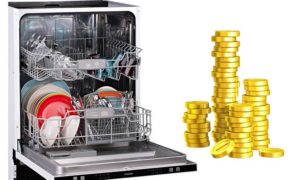 Naturally, a dishwasher consumes electricity during operation. Cold water is heated by a heating element to the preset temperature. Modern models consume approximately 0.8 kWh. On average, the monthly electricity consumption is 65 kWh.
You can calculate the savings from using a dishwasher, which amounts to approximately 1 cubic meter of hot water and the same amount of cold water per month. Energy costs should be subtracted from this figure. This way, the income and expenses simply offset each other. Additionally, you should also add in the cost of detergents and salts to maintain the machine.
This won't confirm the dishwasher's energy efficiency. But that doesn't mean the purchase is pointless or unwise. A dishwasher will save you time, ensure the highest quality of dishwashing, and take care of your hands. Maintenance of the device will be more expensive than hand washing, but any convenience comes at a price.
Advantages of the machines: expert opinions
Is a dishwasher necessary in an apartment? It all depends on the household's preferences. This question is often related to the high cost of the unit and the buyer's reluctance to waste money. Therefore, before paying for an expensive purchase, it's important to understand the main pros and cons of a dishwasher. So, what should you consider when choosing a dishwasher?
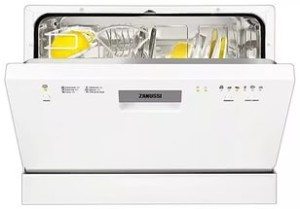
- Capacity. This determines how many place settings the unit can accommodate. The larger the machine, the more dishes it can clean in a single cycle. The most compact units can wash 4-6 place settings at a time, while the most productive ones can wash over 17. A family of three should avoid the smallest units and consider medium-sized models that can accommodate pots, baking sheets, and other essential kitchen utensils.
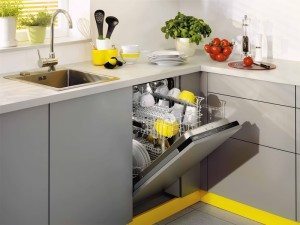
- Cabinet dimensions. Often, a homemaker refuses to buy a dishwasher not because of cost, but because of a lack of space in the kitchen. If this is the case, consider narrow models, just 45 cm wide. A properly sized dishwasher will allow it to fit into even the most compact kitchen area. Built-in appliances are also an option.
- Cleaning cycle duration. Basic wash programs take about two to three hours. This time limit often discourages homeowners. However, what difference does it make how long the machine runs if you load the dishes and forget about it? You can run the cleaning cycle before bed, and wake up in the morning to the joy of clean dishes.
- Washing class. A very important indicator of how clean a set of dishes will be. It's best to purchase machines rated "A." Such equipment will clean items at temperatures of approximately 70 degrees Celsius or higher. Using such hot water is simply impossible with hand washing.The dishes will be completely disinfected, and no harmful bacteria will remain on their surface.
- Number of washing programs. The more different functions available, the more effective the cleaning will be. Some dishwashers offer pre-rinse, half-load, express clean, and soak options. By selecting the appropriate mode based on the degree of soiling of your dishes, you can make your washing even more cost-effective and efficient.
- Drying. This technology is present in every dishwasher; the only difference is how it works. A distinction is made between condensation drying and turbo drying. With condensation drying, dishes are removed from the bin without a single drop of water, eliminating the need for additional wiping.
It's also worth paying attention to the additional options available. Multifunctional dishwashers can sterilize jars and disinfect children's toys. Some models can be controlled via a smartphone via Wi-Fi.
Should I buy a machine?
Whether a dishwasher is necessary for a small family is a personal decision. To help you weigh the advantages and disadvantages of a dishwasher, let's summarize the above and present the information in a concise outline. So, the advantages of a dishwasher are as follows:
- significant savings of personal time;
- high quality of dishwashing;
- sterilization of cutlery;
- preventing the negative impact of detergents on the skin of the hands;
- complete drying of devices.
The main disadvantages that can be noted are:
- high cost of equipment;
- problems with placing equipment in small apartments;
- high cost of maintenance.
Yes, the price of a quality dishwasher can be daunting, but with a one-time investment, you'll get a unit that will function reliably for years to come. And if you're short on space, you can solve it by purchasing a compact unit that fits seamlessly into your kitchen cabinetry. Don't jump to conclusions; before purchasing expensive equipment, it's worth soberly assessing all the advantages and disadvantages of the device.
What do the hostesses say?
Elena, Omsk
For housewives who view washing dishes as torture, a dishwasher will become an indispensable assistant. As for me, the process of washing dishes doesn't stress me out at all; on the contrary, it even calms me down. My husband gave me a dishwasher, but it practically sits idle. I only use it to scrub mountains of dishes after friendly get-togethers.
Tatiana, Moscow
I can't imagine living without a dishwasher. There are three of us, and the machine gets completely full every day. Besides plates, mugs, and forks, pots, pans, baking sheets, baking dishes, and cutting boards pile up. I use the juicer every day, which is just another extra. The machine cleans everything with water heated to 70 degrees Celsius, making the surface sparkle and ensuring it's bacteria-free. Which, you'll agree, is very convenient when you have a small child. We have a dual-rate electricity meter, so I run the dishwasher at night, which is even more energy-efficient. In the morning, all I have to do is put the clean dishes in the drawers. Isn't that every housewife's dream?
Marina, Yaroslavl
I don't regret the purchase; the dishwasher is truly very convenient, it saves water, and it saves me time. But I don't use it every day; I run it a couple of times a week, when, in addition to dishes, I have a pile of dirty pots, jars, baking sheets, and other items.
Valentina, St. Petersburg
In my opinion, a dishwasher is unnecessary for a family of three. I live with my husband and daughter, and it's easier for me to wash the dishes immediately after a meal than to wait until the machine is full. And I don't see the point in running the dishwasher for two hours just for a couple of plates and one pot. I think such a machine would be indispensable for a large family, and even a good housewife can handle three people.
Interesting:




Readers' comments
Headings
Washing machine repair




For buyers




For users


Dishwasher




Add a comment