
Does a family of four need a dishwasher?
 No one can say for sure whether a dishwasher is necessary in a home. Some can handle mountains of dirty and greasy dishes on their own, while others prefer to load even a single place setting into the machine. But modern practice clearly shows that the desire to purchase a kitchen helper is growing every day, especially if there are at least four people in the family. Is it worth it, what are the benefits, and what people say about dishwashers—we'll cover in detail in this article.
It's all about lifestyle
Many grandmothers and housewives over 40 will say that the thought of buying a dishwasher would never even occur to neat and hardworking people. Young and modern people have a different attitude – a frantic pace of life, intense workload, and a desire to relax after a hard day clearly indicate the need to update the kitchen. Moreover, it doesn't matter how many children and adults there are in the family, since it's not about people, but about saving time and effort. A dishwasher can be useful in the following situations:
- Hot water problems. Even single people struggle to wash dishes if there's no hot water or if the supply is regularly interrupted. In this situation, a dishwasher with a heating function will easily remove grease and other stains.
It's a mistake to think that installing a water heater is a more cost-effective or efficient alternative. Firstly, the water will take a very long time to heat up, secondly, it will drain quickly, and thirdly, it will consume a significant amount of electricity.
- Lack of time. The most popular argument for a dishwasher is the simple fact that everyone in the family is busy, with adults at work and children at school or activities. As a result, everyone only gathers for dinner and doesn't want to waste their free time at the sink washing dishes.

- Health issues. Worse, it's when it's physically difficult to spend time at the sink. Allergies to dishwashing detergents, musculoskeletal disorders, radiculitis, rheumatism, and osteochondrosis all dictate the need to install a dishwasher at home.
- Frequent meals. A dishwasher is also useful for families who strictly monitor their diet and overall food culture. They eat 5-6 times a day, always prepare fresh food, and separate meat from vegetables. By the end of the day, a sizable pile of pots, cutting boards, bowls, and plates can accumulate, which is easier to handle with an automatic dishwasher.
- Hand care. Many housewives care about the skin of their hands and nails, which are adversely affected by detergent.
All of these situations become even more pressing if you have a family of four. Then, the workload and fatigue increase proportionally with the number of constantly dirty dishes. A dishwasher can simplify the routine and reduce household clutter. What other advantages does a dishwasher offer, and can we talk about energy savings? Let's explore further.
Does the machine help you save money?
The cost of operating a dishwasher is a pressing issue. It's often argued that it's very expensive to operate due to increased energy consumption, water consumption, and the need for expensive specialized detergents. To understand the truth, let's examine whether a dishwasher actually helps you save money.
Let's first touch on water consumption. It's difficult to calculate the number of liters consumed by hand washing, but on average, it's about 60 liters per day. A washing machine, on the other hand, uses about 12-13 liters per standard cycle, while more efficient models can reduce the amount to 7-8 liters. This doesn't affect the cleaning quality: specially designed sprayers and nozzles, as well as automatic heating, help use water more efficiently.
The size of the dishwasher's chamber doesn't affect water consumption—water consumption is determined by the system and design, which are independent of the actual dimensions. It's not uncommon to find full-size models that use less water in a half-load cycle than in a full cycle in a compact dishwasher.
 Rumors about dishwashers' high energy consumption are true. Moreover, the water savings often don't cover the increased electricity bills. Many machines, on minimum settings, consume an average of 0.8 kWh, which equates to 70 kWh per month. You won't be able to avoid spending money on special detergents, capsules, tablets or powders.Rinse aid, regenerating salt, and anti-scale mixtures are also required. Even choosing domestic and inexpensive brands won't save you money.
Let's be honest – overall, dishwasher maintenance will be more expensive than the standard method. But free time spent with family, well-groomed hands, and a good mood are sometimes more important than the money spent. Especially when it comes to four people.
Experts on the machine's advantages
Dishwashers are typically quite expensive, so before purchasing, it's worth carefully considering the pros and cons. Simply put, you need to decide whether a dishwasher will ease your daily chores or, on the contrary, complicate your life with new problems. So, before you shell out a hefty sum, let's explore the advantages and disadvantages of dishwashers in the kitchen: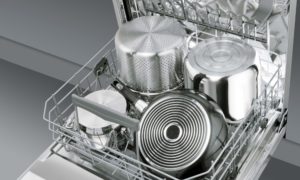
- Easy model selection. A wide selection allows you to choose the perfect model based on capacity, dimensions, appearance, and other performance characteristics. For example, you can choose a dishwasher for 4-6, 8-12, or 18-20 place settings, depending on your family size and meal frequency. Typically, groups of four or more choose mid-size dishwashers with 9-14 place settings.
- Convenient placement. Many people are afraid to buy new appliances because they fear cluttering an already small kitchen. But the compact size of modern models allows for the installation of a full-size machine (60 cm wide), a narrow one (45 cm), or a compact one made to measure. Furthermore, they can be built under a countertop, into a wall cabinet, or under a sink, significantly saving space.
- Easy to use. The average cycle time is 2-3 hours, which often makes housewives reconsider. However, this isn't a deal-breaker, as the machine's automatic mode and high-quality cleaning compensate for the extra runtime. Furthermore, you can always select a night program and empty the dishwasher the next morning.
- Perfectly washed dishes. Most importantly, hand washing eliminates boiling, steaming, and the use of harsh chemicals. The automatic mode, on the other hand, performs complete disinfection, leaving plates and cups spotlessly clean. But only units with a washing class of at least A can boast such washing quality.
The quality of the wash is influenced not only by the stated level of cleaning, but also by compliance with operating instructions, including the correct loading of dishes on the racks and the correct choice of detergents.
- Automatic drying. Another advantage is that you don't need to dry your dishes after washing them. The machine features a condensation or turbo drying function, which gently blows air over your load. This is especially useful when washing glass, crystal, and porcelain.
The machine also boasts additional features and programs. These include soak and pre-rinse modes, allowing for an express wash to remove light stains. Furthermore, the machine can sterilize jars, children's toys, and delicately wash fragile items.
Let's study people's opinions
Reading comments from other homeowners can help you finally decide whether a dishwasher is worth the investment. We've selected several real reviews from consumers who have already gotten the hang of it. Among them are the following opinions:
Tatiana, Krasnodar
I spent a long time deciding whether to buy a dishwasher, as it seemed like a completely useless luxury. But as soon as I bought it, I regretted it. My sister, who "met" hers right after her wedding, convinced me to try one. There are three of us in the house, and we chose a compact, four-placeholder dishwasher. On the second day after purchasing it, I thanked the inventor for such a technological marvel. Now I spend significantly less time in the kitchen: I cook, load dishes, and leisurely attend to other chores. I admit, I was truly amazed at how much time I used to spend washing dishes.
Olga, Volgograd
I thought long and hard, comparing and evaluating options, but ultimately decided against buying a dishwasher. There are four of us in the family, and buying a new appliance would be uneconomical. We calculated the following: 1. It uses a lot of water, which, with our pump, would lead to higher energy consumption. 2. The dishwasher heats the water itself, which would also impact my electricity bill, while I use cheap gas. 3. Washing dishes by hand is faster, taking an average of 5-6 minutes, so I don't want to wait two hours for the dishwasher to cycle.
Lyudmila Alekseevna, Moscow
I think every family needs a dishwasher, whether it's two, four, or six people. There are four of us in the house: three adults and a child. I'm a pensioner, home 24/7, and I notice that a lot of time is spent cooking, and even more on washing dishes. With the advent of an automatic car, there would be fewer worries, and I would be able to play with my granddaughter more oftenAnd in general, it's wonderful when you acquire technology that makes your life easier, allowing you to spend your free time with other family members more usefully and enjoyably.
Interesting:




1 reader comment
Add a comment
Headings
Washing machine repair




For buyers




For users


Dishwasher




Of course, it's profitable for those who save time and effort. If they also have the money, that's what matters. But I don't think it's profitable.
1. Cost of the car.
2. Water consumption.
Dirty dishes aren't loaded. They still need to be rinsed. And that also wastes water. And no one uses 60 liters a day by hand, as described in the article. And by the time you rinse, load, and then unload, that's also wasted time.