
Bosch dishwasher won't finish its cycle
 It's not uncommon for a dishwasher to start acting strange. It seems to be washing dishes, but when the cycle is about to end, the machine freezes, starts adjusting the wash arms, and starts pumping. If not forcibly shut off, it can continue this behavior indefinitely without displaying any system errors. This means the dishwasher isn't finishing its cycle, even though it should have done so long ago. Today, we'll explore the cause of this malfunction and also show you how to fix it yourself.
Why does this happen?
Even when a dishwasher doesn't display an error code, it may exhibit behavior that might lead an experienced technician to certain faults that could be the cause of the problem. However, to a novice, the behavior of their "home helper" may be inconsequential, yet they need to be looking for the problem. If you haven't encountered this problem before, here's a list of possible faults that could cause these symptoms in your dishwasher.
- A temporary or permanent failure in the control system.
- Heating element failure or power supply interruption.
- There is a blockage somewhere in the drainage system.
Most often, this type of breakdown is caused by a clogged fine filter in the dishwasher.
- Pump malfunction or blockage.
- Intake valve defective.
A physical defect in the control module also cannot be ruled out. Our specialists have often encountered such symptoms in Bosch dishwashers, when individual busbars fail or contacts burn out. However, the first step in checking should be not the control board, but the aforementioned components. If you can't identify the problem yourself, a professional will take care of it and test the electronics at the same time.
Short-term failure
First of all, carefully study the symptoms of a faulty dishwasher. We'll describe typical symptoms now, and you can compare them with your appliance's behavior. So, when running a short program, the machine may clean the dishes without stalling, but when running a normal or intensive program, it stalls at the very end, leaving the dishes clean but still wet. The only way to stop the equipment is to switch it off.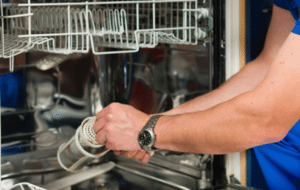
When you restart the machine, the program it was just stuck on may not start at all. Activating a different program can cause an Indesit or any other washing machine to wash dishes and then freeze at the very end. Sound familiar? The machine's behavior may differ in minor ways, but the root cause of the problem remains the same. What should we do first?
First, rule out a temporary system failure as a possible cause. To do this, turn off the machine using the power button, then completely disconnect it by unplugging it. Let the machine sit for half an hour, then turn it back on. If a system failure did occur, a reboot may resolve it immediately, and the machine will function as before.
Clogged system or pump
If restarting doesn't help, don't worry—that's not a reason to disassemble the dishwasher. Check the drain speed. It's possible your drain pipe is clogged, preventing the dishwasher from removing wastewater at the proper rate. If the pipe is clear, remove and inspect the dishwasher's drain hose. Next, clean the debris filter, remove the fine filter, and clean it. If you're unsure how to do this, check out this post. Replacing and cleaning the dishwasher filter.
The fine filter can be found "in the bowl" where the waste filter is placed.
Next, you need to remove and clean the dishwasher's drain pump. To access it, you'll need to turn off and remove the dishwasher, then remove its side panels. It's not uncommon to find a solid lump of dirt stuck to the pump impeller. If the pump appears clean, check the resistance of its coil with an ohmmeter. Replace the faulty part.
The heating element broke
If your dishwasher is not completing the cycle that your selected program suggests, there is a chance that the heating element is to blame. Not every heating element failure will cause the machine to behave this way, but rather a breakdown and current leakage onto the housing, so be careful. If, in addition to the symptoms we've described, the machine body begins to emit a slight electric shock, the heating element is most likely to blame. It should be checked in any case if the problem remains undetected.
We access the heating element through the side of the machine; it's easy. We remove the wires, loosen the clamps, and remove the part. We check its resistance with a multimeter, then test it for breakdown. If the test confirms the defect, replace the part without hesitation. A breakdown is a very dangerous failure.
Let's check the intake valve
Lastly, we have the inlet valve. The likelihood that it's the culprit in our situation is very low, but it's still worth checking. Remove the valve and pay special attention to the diaphragm, specifically how it opens and closes. If the valve doesn't close or doesn't open fully due to debris or limescale deposits, it needs to be cleaned. If the valve's poor opening and closing is due to other, unknown reasons, the part simply needs to be replaced.
So, what's causing your dishwasher to fail to complete a wash cycle? There are a multitude of reasons, and to pinpoint the specific problem, you'll have to check numerous parts, but there's no other way. Otherwise, call a technician, who will charge for diagnostics and repairs. Good luck!
Interesting:





Readers' comments
Headings
Washing machine repair




For buyers




For users


Dishwasher




Add a comment