
Is a dishwasher profitable or not?
 Those who have already purchased a dishwasher or are considering one are wondering: is a dishwasher cost-effective, or is its cost-effectiveness nothing more than a myth concocted by advertisers and household dishwasher manufacturers? This is a very serious question, as the answer to it determines whether you'll purchase the dishwasher or use it in the future. We'll try to be as objective as possible and draw conclusions based on real-world testing.
How much money does a dishwasher save?
There are quite a few arbitrary factors involved. Savings will depend on the dishwasher model, how often it's used, water and electricity rates, the composition and cost of detergents and salt, etc. Nevertheless, we decided to experiment and calculate how much money it saves.Bosch SMV23AX00R dishwasher per month, serving a family of 3.
The house has a water heater, so we calculated in advance how much cold water and electricity the family uses for washing dishes. It turns out that the family uses 1.5 cubic meters of cold water per month (they pour terribly, so they could use more energy) and approximately 29 kW of electricity (+/- 5 kW) per month on hand washing dishes. This is despite the fact that the family uses warm water, not hot water.
- 1 cubic meter of cold water costs a family approximately $0.17, and one kW of electricity $0.04.
- $0.255 – water, $1.15 – electricity.
- We add up the costs and get $1.4005.
But that's not all the expenses. For hand washing dishes, you'll need detergent and a sponge. A sponge wears out completely within a month, so we can factor in the cost of one sponge, which is about $0.10. Now for the detergent. An inexpensive detergent can be purchased for $0.90. A bottle contains 0.5 liters of detergent, which will last about 3 months – 90 / 3 = $0.30. So, to sum it up: $1.40 + $0.10 + $0.30 = $1.80. If you ignore some calculation errors, this is your monthly cost for hand washing dishes.
Now let's calculate how much money it costs to wash dishes for a month using a Bosch SMV23AX00R dishwasher. Assuming the dishwasher was turned on only once a day in the evening to wash the day's load and ran on a standard cycle for 2 hours and 10 minutes, it consumed 63 kW of electricity over 30 days. 63 * 3.95 = $2.48. Our machine uses 11.7 liters of water per wash. Multiply by 30 days, we get 351 liters, that is, 0.351 cubic meters. 0.351 * 17 = $0.0597. Add the costs for water and electricity: $2.48 + $0.06 = $2.50.
Of course, these aren't all the costs. We haven't yet calculated the most important expense: detergents and salt.
Our family used Somat dishwasher tablets. They're inexpensive and clean well. We purchased a box of 84 capsules for $3.13. We used exactly 30 capsules in one month. Using some simple math, we found that each capsule costs approximately $0.04. $3.73 * 30 = $1.12.
That's the cost of detergent. Now let's calculate the cost of salt. We used Elly salt, which costs $2 for 3 kg. Over the course of a month, we used just under 1 kg of salt. To make the calculations easier, let's round the cost to the nearest 1 kg, which is about $0.67.
And finally, we've come to the most interesting part: adding up all the costs. So, $2.5482 for water and electricity, $1.1190 for detergent, and $0.6666 for salt. $2.5482 + $1.1190 + $0.6666 = $4.3338. That's how much the Bosch SMV23AX00R dishwasher spent in one month of operation. Total: $1.8005 for hand washing and $4.3338 for machine washing.
You can't wash without wetting your hands.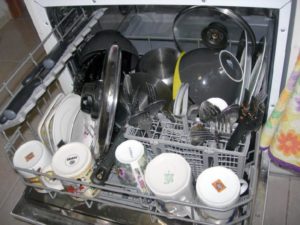
So, which is better: a dishwasher or hand washing dishes? It's difficult to draw conclusions, as not everything can be measured in money. Many families are even willing to pay a little extra for a modicum of convenience. It's so nice to just load dirty dishes into baskets, and the machine will do the rest for you, without even having to get your hands wet. The advertising image of a happy housewife is always evoked, but let's get back to reality.
Not all dishes fit perfectly and clean perfectly in the dishwasher. Large baking sheets, trays, and bowls either don't fit at all, or they fit but don't clean well. They have to be either washed from scratch or washed in the dishwasher, which is doubly unpleasant.
Let's move on. Not all items are dishwasher safe. For example, let's say you used a meat grinder. Its aluminum parts should never be washed in the dishwasher, otherwise they'll turn black and have to be thrown out. So, we'll wash them by hand.
Wooden cutting boards, wooden spoons and spatulas will also be damaged in the dishwasher; they should also be washed exclusively by hand. In fact, there are many examples. This means that before turning on the washing machine, you need to sort the dirty dishes. Wash some by hand, and wash others in the washing machine. Basically, you'll have to get your hands wet one way or another, whether you have a dishwasher or not. And it'll take time:
- sort the dishes;
- put the dishes into baskets;
- wash by hand those items that cannot be washed in the machine;
- After everything, wash the sink and faucet.
The dishwasher itself also needs to be cleaned from time to time to remove dirt, otherwise it will stop working properly, and this is usually done manually.
Myths about the benefits of a dishwasher
After such calculations and reasoning, you begin to seriously consider whether to continue using a dishwasher or wash dishes by hand. Those who don't yet own a dishwasher will likely reconsider after reading this article. We don't want to be anti-dishwasher, but listening to the arguments of dishwasher salespeople, we can't help but take a sober look. Some of the advantages they tout are incredibly implausible.
- A dishwasher takes up little space in the kitchen. This is usually said about narrow dishwashers with a 45 cm wide body. Indeed, the phrase "little space" is highly evaluative, but a look at the average Russian's compact kitchen is enough to make you want to cry. It's difficult to fit a microwave, let alone a dishwasher. Items are stacked on top of each other, making it difficult to turn around.
- A dishwasher helps save money. We dedicated the first point of our article to this. This assertion, frankly, is unfounded.
- A dishwasher helps you stop washing dirty dishes by hand. We've outlined several reasons why completely eliminating hand-washing is only possible if you hire a housekeeper. A dishwasher will make the task easier, but you won’t be able to completely abandon hand washing.
So, some of our calculations and arguments may seem far-fetched, but we didn't claim 100% accuracy. Our calculations were initially intended as estimates, but even they make it clear that using a dishwasher is incomparably more expensive than washing dishes by hand. Do your own calculations and see for yourself. Good luck!
Interesting:





10 reader comments
Add a comment
Headings
Washing machine repair




For buyers




For users


Dishwasher




Thank you for your detailed answer!
Thank you, now I know for sure that I won’t buy it.
1.5 cubic meters of water per month for washing dishes by hand? The author of this calculation, did you even wash the dishes?
And how many cubes?
You forgot to factor in the cost of the dishwasher itself. If you're lucky, 25,000 rubles for 10 years is another 200 rubles per month. If not, it's twice as much. And then there's the repairs. 🙂
It's brutal, you bookkeepers. Have you even considered how much time you spend washing dishes? It pays for itself quickly. Better yet, take a rest during that time.
I was also surprised by the fact – 1.5 cubic meters per month. They don't eat at home? Yes, to wash greasy dishes, you need at least a dishwashing liquid and rinse it well. And that's several liters of water. For those who are thrifty, here's a tip: buy plastic bags, put them on the dishes, and throw the bag away. Soup is a bit more difficult, but don't eat it, you can save water and electricity.
Thanks for the article! I'll give it to my wife to read so she can stop bothering me with this purchase.
The post-2000s generation of young people are completely brainwashed, living on advertising and thinking exclusively in terms of "trends." They have no brains of their own! It's sad, but it's a fact. And this applies to the entire world.
The calculations were incorrect - in addition to water consumption, water disposal also needs to be taken into account.