
Compact under-sink dishwashers
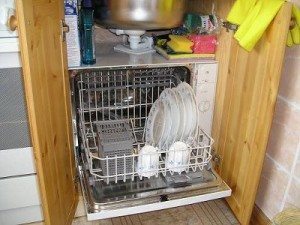 Limited kitchen space and the growing number of appliances being placed there force people to come up with new ways to integrate appliances. One such solution is installing a dishwasher under the sink. And why not? After all, the sink often contains nothing but a trash can, meaning the space isn't used efficiently. Let's figure out what kind of dishwasher can fit into this small space.
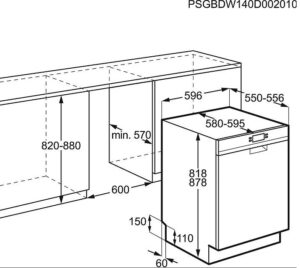
Dimensions of compact dishwashers
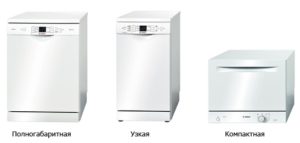
Compact dishwashers can be different: built-in and freestandingHowever, their dimensions also vary significantly. Freestanding dishwashers can have the following dimensions:
- height – 44 cm, width -50 cm, depth -55 cm (for example, Candy CDCF 6);
- height – 45 cm, width -55 cm, depth -50 cm (for example, Bosch SKS 51E88);
- height – 60 cm, width – 55 cm, depth – 50 cm (for example, Ginzzu DC281).
As you can see, the width of compact freestanding dishwasher models varies from 50 to 55 cm.
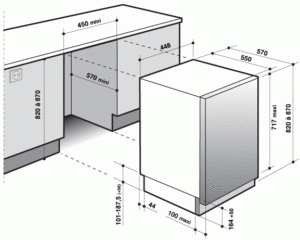
The dimensions of built-in models differ slightly from freestanding ones:
height – 44 cm, width -55 cm, depth -50 cm (Flavia CI 55 HAVANA);
height – 45 cm, width -60 cm, depth -55 cm (Siemens SK 76M544).
The conclusion is that the smallest compact dishwasher model with a width of 50 cm exists only among freestanding ones.
Which dishwasher is best to install under the sink?
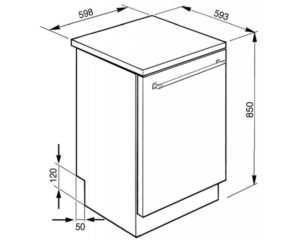
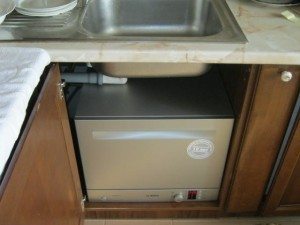 So, which model can be installed under the sink? The sink's dimensions are paramount here. In small kitchens, sinks are typically no wider than 55 cm to save space, so you should choose a model slightly smaller than 55 cm to ensure it fits easily between the cabinet walls. As for height, even a taller model (60 cm) will fit perfectly if it's floor-standing and the drain trap is modified.
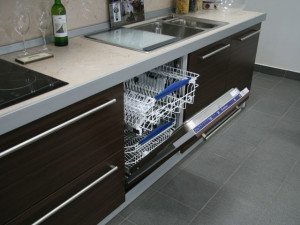
You can choose from both partially built-in and freestanding models. Fully integrated under-sink dishwashers are less convenient because they require a separate front panel, meaning the sink doors will have to be removed. If you plan to install a kitchen set at the same time as purchasing a dishwasher, then no problems should arise.
Some people believe that installing a dishwasher under a sink is completely unacceptable, but why? Because water lines run under the sink, there's a risk of moisture and water getting onto the dishwasher's body and inside. But when there's no other way out, you have to take this risk, and it all needs to be organized properly.
Installing a dishwasher under the sink
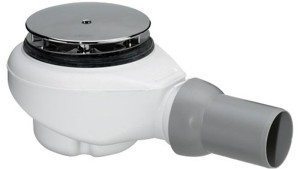 To install a dishwasher in a sink, you first need to connect all the utilities. The first step is to fix the drain connection—you need to redesign the trap. Special flat traps are available for installing a sink over a dishwasher or washing machine, like the one in the photo. Installing this type of trap is no different from a regular one. Don't forget to turn off the water before starting work.
Important! If possible, locate the sink drain in a corner so that any leaks will direct water away from the dishwasher.
After replacing the trap, connect the dishwasher drain hose to it. If necessary, connect the washing machine drain hose as well. This requires two branches in the trap. Now connect a tee with a faucet to the hose going to the faucet. A flow-through filter is connected directly to the faucet, but it's not necessary. The dishwasher inlet hose is screwed onto the filter.
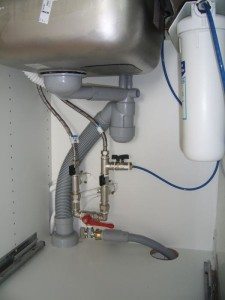 Once the utilities are connected, carefully insert the dishwasher into the sink. Please note that the bottom shelf on which the machine will stand must be securely fastened and be able to support the weight of the machine and the dishes.If it's a freestanding model, this completes the installation process. A semi-built-in model can be secured to the cabinet's side walls using metal strips.
In addition to the sewer and water lines, you'll need a 220V outlet for connection. If one isn't available, don't plug the dishwasher into the outlet through an extension cord. It's best to hire a professional to install one for your dishwasher.
Thus, compact under-sink dishwashers are essentially small countertop machines cleverly concealed within the sink. Installing such a machine presents some challenges, but with the right approach, they are all quite solvable.
Interesting:
Readers' comments
Headings
Washing machine repair




For buyers




For users


Dishwasher




Add a comment