
How a Dishwasher Works (Basic Principles)
 Dishwashers are relatively uncommon in the CIS countries. According to statistics, only about 5% of households use dishwashers, even though the prices for such appliances are currently reasonable.
The main reason for this is people's doubts about the performance of these household appliances, claiming they can't clean dishes better than we could by hand. By examining how a dishwasher works, we'll try to dispel this myth and convince you that a dishwasher is a very useful appliance.
Description of the processes occurring in a dishwasher
Despite the prejudice that dishwashers are complex and finicky devices, this is far from the case. A dishwasher is a technically simple machine, and understanding its operating principles is quite straightforward. Once we install the dishwasher, connect it to the water supply, sewerage system, and electrical outlet, and then load the dirty dishes, a number of interesting processes occur.
- First, we set the washing program, press the start button, and then go about our business.
- The washing cycle begins without our intervention. The control unit sends a command, the water inlet valve opens, and water flows into a special container.
- Next, the water is mixed with salt. Salt softens water and makes dishwashing more effective. At the same time, the control module activates the heating element. Further processes are not initiated until the water in the chamber reaches the desired temperature (set by the user).
Please note! Some dishwasher models are connected to both hot and cold water. In this case, the system mixes the water, and a temperature sensor determines whether the temperature is appropriate for the program.
- The dishwasher's further actions depend on the set program. Let's assume,
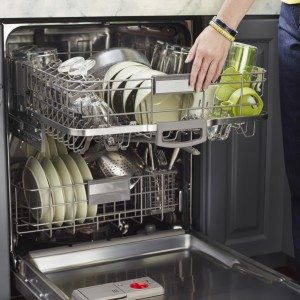 The dishes we loaded were very dirty, so we started with the soak mode. The control module instructs the circulation pump to dispense a mixture of water and detergent in very small amounts into the spray arm, which then sprays droplets onto the dirty dishes over a long period of time to loosen dried-on dirt.
 - Next, the primary rinse is activated. Now the circulation pump feeds the mixture into the spray arm, and food residue is washed away under pressure. The main spray arm is located at the bottom of the bin under the lower dish rack. It not only sprays water and detergents, but also rotates, which makes it possible to cover all dishes.
- Subsequently, the rinse water is not drained but passes through coarse filters and returns to the tank. There, the system increases the detergent concentration and re-sprays the dishes, removing most of the dirt.
Important! Rinsing with detergent can be repeated several times, depending on the selected program; this will extend the wash time.
- The system then commands the wastewater to drain. The dirty water is pumped out by the drain pump, replaced by a small amount of water that rinses the inside of the tank, and then drains into the sewer.
- Now the valve opens and clean water is poured into the tank to rinse the dishes.
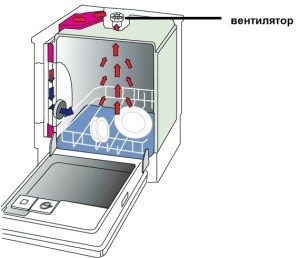 Residues of dirt and detergent are removed. The algorithm is simple: clean water under high pressure is supplied by a circulation pump to the spray arm, which then rinses away any remaining detergent from the dishes. The device can repeat the rinsing process of the dishes, which increases the program execution time.
 - The control module then sends a command to drain the waste water, and the pump removes water from the tank into the sewer.
- Now it's time to dry. If your dishwasher has a forced-dry function, a special fan forces hot air, heated by a heating element, into the dishwasher, drying the dishes very quickly. If there's no forced-dry function, drying occurs naturally in convection mode.
We've described, in general terms, what happens inside a dishwasher. If our description seems complicated, you can watch a video demonstrating how a dishwasher works. Alternatively, you can find and watch a video and compare it with our description. Whatever you choose, it'll give you an idea of how dishwashers work; it won't take you long.
How does a dishwasher work?
To better understand what happens inside a dishwasher during operation, we need to examine its design. If we disassemble the dishwasher and examine its internal structure, we'll see a system of interacting components and sensors. Even though the car is designed quite simply, if you're going to disassemble it for the first time, record your actions on video. The video will help you put all the parts back in place correctly after the repair work is completed.
The dishwasher's main components are located at the bottom of the cabinet, which looks quite interesting from the inside. The interior contains:
- A tray in which to place dirty dishes.
- A closer that allows the door to open and close smoothly.
- Sprinkler bar (there can be two or even three).
- A sensor that measures water temperature.
- Mesh filter and coarse water filter.
- Hose for draining waste water into the sewer.
- Pressure limiting valve.
- A pump that drains waste water.
- Water tank.
- Element of the leak protection system.
- Control module.
- Main pump (circulation).
- Condensing element.
- Rinse aid container.
- Blocking element.
- Container for detergents.
- Fill valve.
- A rubber seal located along the edge of the door.
- Salt compartment.
- Flow-through water heating element.
- Inlet hose.
- Guides for dish trays.
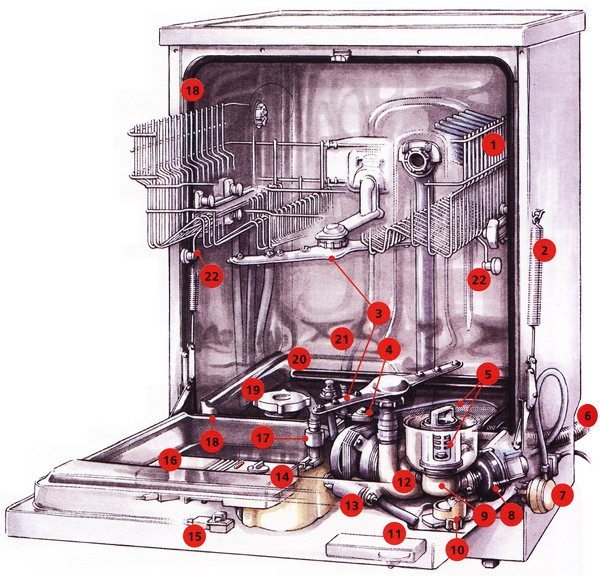
Here's a general list of the components installed in a dishwasher. You can see where and how they are installed in the picture above. If this isn't enough to understand the overall picture, you can find a video online that demonstrates the dishwasher's parts.
Why does a dishwasher clean even the dirtiest dishes?
Now let's dispel the myth of dishwasher inefficiency. Numerous tests, both in laboratories and in the average home, confirm that a dishwasher is perfectly capable of cleaning a mountain of dishes. Why does it do this? There are at least three compelling reasons:
- washing dishes is done using a solution of special salt and detergents that dissolve food residues and grease;
- washing takes place in water heated to the optimal temperature;
- The dishes are sprayed with water, which is supplied under high pressure in a fan-shaped manner, which allows all items being washed to be sprayed from all sides.
Certainly, If you stuff a pot with a centimeter of soot on it into the dish tray, the dishwasher is unlikely to be able to handle that much dirt. However, it's a known fact that after a wash cycle, even such dirt softens significantly from the inside and can then be removed manually with a small amount of abrasive cleaner. In short, it's no exaggeration to say that a dishwasher is one of the most essential appliances in the kitchen. If this story doesn't convince you, read on. Bosch dishwasher reviews, perhaps the opinion of consumers will be more significant for you.
FYI! Young mothers value dishwashers not just for washing dishes, but for the care they provide for their children's toys. Online videos show mothers filling their dishwasher trays with toys, only to have everything come out spotlessly clean.
In conclusion, without going into technical details, the operating principle of a dishwasher is very simple. However, understanding this principle is important for the user, both during the daily use of the "home helper" and in case repairs are needed later. Thank you for your attention, and good luck!
Interesting:






2 reader comments
Add a comment
Headings
Washing machine repair




For buyers




For users


Dishwasher




Since when is salt used for washing dishes? It's used to clean the membrane of a water softener's ion filter.
It doesn't have an ion filter, but a softener, which uses ion exchange resin to replace hardness salts (potassium and magnesium) with sodium salts.