
How a Candy washing machine works
 Modern home appliances make life much easier. Thanks to smart devices, we have more time for truly interesting and important things, quality rest, spending time with loved ones, and taking walks with children. However, few people consider the processes that occur inside these complex mechanisms. Let's take a look at how a Candy washing machine works and the parts that make it happen.
What happens inside the machine?
Users are accustomed to seeing the front of the device, turning the dial, pressing buttons, locking the machine from children, loading dirty laundry into the drum, and watching it sway in the water. Few people know exactly how the main wash cycle, rinse, and spin cycle work. It's actually quite fascinating.
Like all washing machines, the Candy has a drum covered by a door. Dirty clothes are placed inside, where they are cleaned of dirt, rinsed of detergent, and drained of excess water. All this happens thanks to the rotation of the drum. To make it rotate, a motor with a complex drive mechanism is required. The Candy uses a belt drive, and it operates as follows:
- the electric motor rotates at a set speed;
- A special belt is attached to the motor, transmitting revolutions to the drum pulley;
- the pulley is attached to the crosspiece that holds the drum;
- The part rotates thanks to bearings.
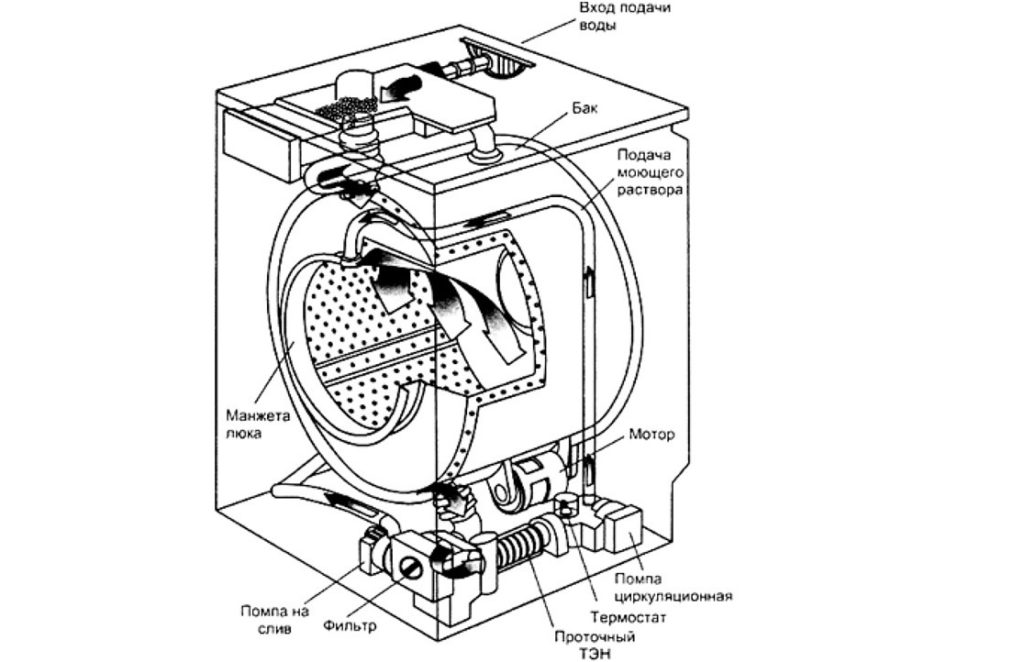
The drum itself is housed in a plastic tank, whose primary function is to hold water. The walls of the two elements never touch, preventing the drum from jamming. A drain valve allows the machine to draw clean tap water. When sufficient water has been collected, it closes.
Once the water has been used, it is drained using a pump. It starts working after the wash, rinse, and spin cycles. The washing machine needs to know how much liquid is left inside. For this purpose, the unit is equipped with a water level sensor (pressure switch). There is also a temperature sensor that detects the temperature of the water heated by the heating element.
All processes are regulated by the control module. It stores the parameters set by the user and ensures the uninterrupted execution of commands. The control module activates the heating element, monitors the pressure switch and thermostat, determines engine operation, and is involved in the operation of each mechanism.
Important! Equipment with inverter motors operates differently.
Features of the program implementation
Candy is an automatic washing machine that can handle all stages of the laundry cycle without any intervention. Sometimes, the machine malfunctions. Some problems can be resolved on your own, while others require professional help.
 Let's look at the general operating principle of all Candy washing machines. Before starting the wash cycle, place the soiled laundry in the drum. All pockets must be empty, and clothing must not contain removable decorative elements (pins, stickers, brooches) that can be easily detached. Detergent is then poured into a special compartment. The detergent will be washed out of the dispenser during operation, and the detergent will be completely used up when the machine switches to the rinse cycle. The user plugs the machine in, opens the water tap (if it was turned off), and starts the selected wash cycle.
The machine automatically draws water, washes, rinses, and spins the washed clothes. Each mode involves a specific algorithm, programmed by the manufacturer. The heating element heats the water to the set temperature, and the main wash begins. The drum rotates, constantly swishing the laundry around in a solution of detergent and water, removing dirt.
When the main wash is complete, a special valve opens, and the pump drains the liquid. If there is no moisture left in the drum, clean water is supplied through the drain valve. A pressure switch monitors the water level, and when a certain level is reached, the rinse cycle begins. This stage is repeated several times. Then the spin cycle begins, and the drum begins to spin vigorously. Excess water first enters the drum and is then discharged by the drain pump.
Interesting:



Readers' comments
Headings
Washing machine repair




For buyers




For users


Dishwasher




Add a comment