Bearing failure in a washing machine is one of the most common problems. Replacing a bearing is usually very difficult, as the machine must be completely disassembled. Before attempting such a complex task, you need to be 100% certain of the problem. You can initially identify bearing failure by its external signs without disassembling the machine, but to ensure the diagnosis is correct, you need to partially disassemble the machine. This article explains how to identify the signs of bearing failure.
Diagnostics without disassembling the machine
Only a professional technician can 100% determine whether a washing machine bearing is failing without disassembling it. And if the bearing is just beginning to fail, it's impossible to determine anything without disassembling it. However, there are several signs that may indirectly indicate this type of failure.
Extraneous noise during washing and rinsing. During the spin cycle, it is more difficult to distinguish extraneous sounds, so listen to how the machine works during the washing and spin cycles. What sounds might we be talking about? Typically, it's clanking on metal, knocking, grinding, etc.
The machine doesn't spin laundry properly. Due to damaged bearings, the drum can't reach sufficient spin speed, which means the spin quality is degraded.
A slight imbalance may occur. If the bearings fail, the machine's balance may be partially disrupted, causing it to wobble more violently. The imbalance will be minor, so be careful.
Pay attention to the edges of the cuff; if they are damaged, this indirectly indicates problems with the bearings.
Let's continue our washing machine diagnostics without disassembling it. Unplug the machine, open the door wide, reach in, and place three fingers on the top edge of the drum. Rock the drum. It should swing along with the spring-loaded tub, but there should be no play between the tub and the drum.
If there is play, it means that the bearings have already begun to deteriorate.
Now, spin the drum with your hands as hard as you can. The drum should rotate relatively freely, emitting a slight hum. If, instead of a slight hum, you feel a beating or, even worse, a clanking sound, there's likely a problem with the bearings. There aren't many reasons why these parts fail. It could be simple wear and tear or a manufacturing defect, so draw your own conclusions.
Let's analyze it, check it, make sure
Partially disassembling the washing machine and identifying direct evidence of bearing failure will help us confirm the accuracy of our preliminary conclusions. The drum and tub won't need to be disassembled, so we'll try to keep things simple for now. What should we do?
We disconnect the machine from all communications and pull it out to the middle of the room.
We go from behind and unscrew the back wall of the case.
Pay attention to the rear wall of the tank; to make it easier to see, you can remove the drive belt.
When a bearing fails, grease leaks almost always occur, and parts without grease are susceptible to corrosion. So, what can we find on the back wall of the drum? We can detect rusty streaks and traces of grease. If this is the case, the bearings have failed. The machine shouldn't even be used again, as it's impossible to operate it with this kind of defect.
Well, no. We had an Italian Indesit, and it washed and spun, and there weren't a single stain or rust. But the bearings failed. The technician replaced them, and the machine worked for many more years, but it's an old washing machine, and that was about 20 years ago.

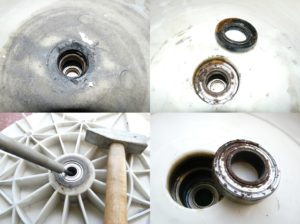 Bearing failure in a washing machine is one of the most common problems. Replacing a bearing is usually very difficult, as the machine must be completely disassembled. Before attempting such a complex task, you need to be 100% certain of the problem. You can initially identify bearing failure by its external signs without disassembling the machine, but to ensure the diagnosis is correct, you need to partially disassemble the machine. This article explains how to identify the signs of bearing failure.
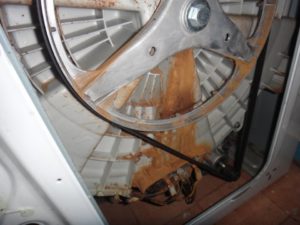 Partially disassembling the washing machine and identifying direct evidence of bearing failure will help us confirm the accuracy of our preliminary conclusions. The drum and tub won't need to be disassembled, so we'll try to keep things simple for now. What should we do?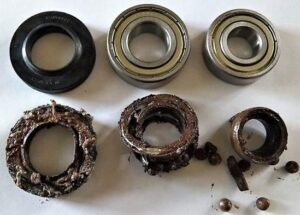
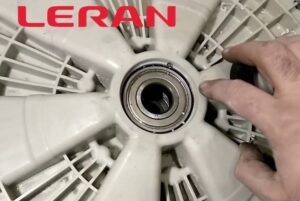
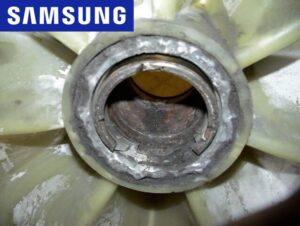
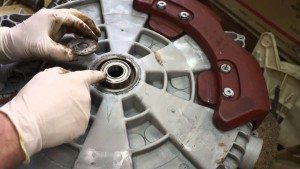
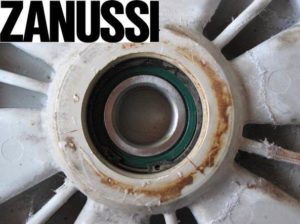














Lubricant leaks along with rust, leaving stains on the laundry after washing.
Well, no. We had an Italian Indesit, and it washed and spun, and there weren't a single stain or rust. But the bearings failed. The technician replaced them, and the machine worked for many more years, but it's an old washing machine, and that was about 20 years ago.
Of course that's true, if the seal is intact then nothing will leak inside.