
The washing machine is clogged - what should I do?
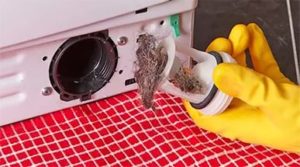 A clogged washing machine usually occurs unexpectedly, but for a reason. It's usually the user themselves who causes a clog, failing to maintain their "home helper." Sometimes, through carelessness, a small object gets into the washing machine's tub, causing a clog. Whatever the cause, the problem must be addressed. How? We'll discuss it in this article.
How to tell if your car is clogged
If your washing machine suddenly becomes clogged, it's quite difficult to identify the blockage based solely on external signs. Typically, if a severe clog occurs, the drain stops working, and the washing machine simply can't drain the wastewater from the drum and freezes mid-cycle. You can see through the glass door that there's standing water in the drum.
With a more severe clog, the washing machine can't drain quickly enough. This causes the machine to display an error code and freeze mid-cycle, leaving residual wastewater in the drum. These are symptoms typical of a blockage, but this does not mean that these symptoms are not typical of other malfunctions. In the article washing machine pump repair, We consider exactly the same symptoms in the case when the drain pump fails.
Some people think a broken pump makes no noise. This is not true; a broken pump can hum just as well as a working one, but still not perform its intended function.
The same symptoms can occur if the washing machine's control module or pressure switch is faulty. In short, a more detailed investigation is essential. What can be done to determine the problem? Is it a blockage or not?
Unfortunately, there are no simple solutions in this case. You'll have to check the entire list of possible faults one by one, moving from the simplest and most accessible options to the more complex ones, until you finally find the problem.
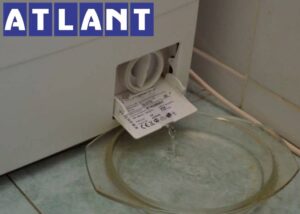
- First, open the waste filter drain, having first unscrewed the filter itself. A blockage often
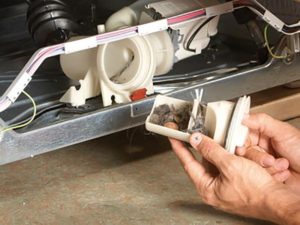 It forms directly in the drain, if this is the case, then the search can be stopped.
 - If there's no debris in the drain, unplug the washing machine from the power supply and the water supply, and move it to the center of the room. Tilt the machine onto its left side and access the pump and the pipe attached to it through the bottom. At this stage, we check the pump, the adjacent pipe and the drain hose.
- If a blockage or other problem still hasn't been detected, unscrew the pump from the bottom of the washing machine, then the motor. Now we can check the main hose running from the tub to the waste filter. This isn't particularly convenient, but it's still better than removing the front panel of the washing machine.
- If the problem or blockage is still not detected, don't hesitate to contact a plumber. It's likely a serious issue and you won't be able to resolve it on your own.
Getting rid of the blockage
 If you discover that one of your washing machine's internal passages is clogged, the easiest way to fix the problem is to physically remove the debris on the spot using your fingers, a screwdriver, or other available tools. This method is good, but it doesn't guarantee a solution if, for example, this is not the only clog.
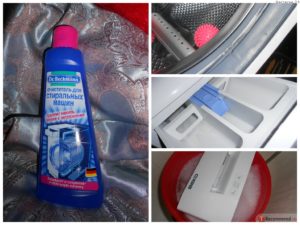
We recommend dry cleaning in addition to physical cleaning. After you assemble and install the washing machine, purchase a universal cleaning product for washing machines, such as Dr. Beckmann or Mister DEZ. Pour this product into the washing machine's drawer and run a wash cycle with boiling water at 90°C.0WITH. Firstly, you will rid your "home assistant" of any remaining dirt, and secondly, you are guaranteed to restore its functionality, unless, of course, another problem arises.
The easiest way to clear a blockage is in the waste filter, but the hardest way is to clear a blockage in the pipe that goes from the tank to the waste filter.
How to prevent this from happening again
A clog can occur when a foreign object gets into the drain (whether it's a pipe or a hose) and gets stuck. Dirt will quickly settle on it, and a large plug will clog the drain. What can you do to prevent clogs in your washing machine? It's actually very simple. Regularly following a few simple steps will almost certainly prevent you and your washing machine from encountering these problems.
- Regularly remove and clean the dust filter. It was designed to catch all sorts of gunk that gets into the car.
- Check the pockets of items you put in the washing machine drum. If there are any poorly sewn items on the item, it is better not to wash it in the machine or use a laundry bag.
- At least once every six months, give your washing machine a preventative dry cleaning using a special cleaning product. Just be sure to do this regularly!
In conclusion, a clogged drain isn't the most serious problem a washing machine can have. However, if a clogged drain isn't cleared promptly, it can cause more serious problems. So don't delay your search; try to get your washing machine back in working order as quickly as possible. If that doesn't work, call a professional immediately; they can clear the drain and fix many problems.
Interesting:





Readers' comments
Headings
Washing machine repair




For buyers




For users


Dishwasher




Add a comment