
How to choose an industrial washing machine?
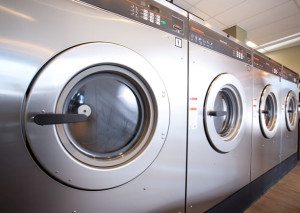 Industrial washing machines are the foundation of any laundry. They must perform as efficiently as possible, last as long as possible, and be as cost-effective as possible. This naturally raises the question: how to choose such a machine, given the vast number of options on the market, making it difficult to decide which to choose. Let's try to clarify this question.
Features of washing machines for business
Some people try to compare household and industrial washing machines. They say that modern household machines approach the maximum load capacity of industrial ones (10, 12, and even 15 kg), yet cost much less. So, why pay more? In fact, professional equipment has a number of fundamental differences, and let's explore them.
- Washing machines for laundries are assembled from more reliable and expensive components and parts. This allows these machines to last much longer than household machines.
- The design and assembly features of this equipment not only ensure long-term operation but also the ability to withstand significant loads. For comparison, a high-quality household washing machine is rated for 4 hours of continuous operation per day, while an industrial washing machine is rated for 8-10 hours.
- Laundry machine control units are equipped with high-performance microprocessors, which allows them to store a large number of specific washing programs and user settings.
- Although some household automatic washing machines have a load capacity of 10 kg or more, they are still far from some professional laundry machines, which can wash 30, 35 or more kg of laundry at a time.
- Industrial washing machines feature intelligent powder dispensers, high-quality automatic laundry weighing systems, and even onboard computers capable of storing and processing a significant amount of information, which is good for business.
- Industrial washing machines have many more connectivity options. For example, simultaneous connection to hot and cold water supply, steam supply device, wastewater treatment plant, etc.
Please note! This industrial washing machine inspires confidence with its robust design and fasteners, reliable, virtually wear-free control panel buttons, and multi-layer hoses and pipes that are difficult to cut even with a knife.
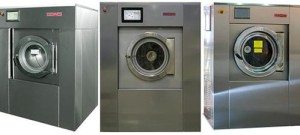 Despite the fact that industrial washing machines with a load capacity of 30 and 35 kg experience heavy loads, they can serve without servicing for 5-7 years. And with proper maintenance and regular preventative maintenance, such a machine can easily last up to 30-35 years. This is precisely the lifespan for which the electric motors of such machines are designed.
Industrial washing machine service is also top-notch. After all, every hour of downtime for such equipment costs the business, so only those companies that provide high-quality repairs in the shortest possible time remain on the market. Laundry machine manufacturers also offer extended warranties for their equipment.
Types of washing machines for business
There are so many types of industrial washing machines, it's easier to consider them within a classification system. Experts identify several classification systems that allow us to encompass and explain the features of most industrial washing machines. Let's take a look at them.
- Depending on the drum design, a distinction is made between barrier and barrier-free machines.
- Depending on the installation features, there are two types of machines: sprung and static.
- Depending on the number of laundry care stages, there are washing machines, washer-spinners, and washer-dryers.
- Depending on the possible intensity of the drum operation, a distinction is made between machines with a high drum rotation speed and machines with a low speed.
- Depending on the control features, a distinction is made between automatic machines with control units and automatic machines with computer control.
- Depending on the method of heating water, there are heating element, steam and mixed connection machines.
So, what's the difference between barrier and barrier-free industrial washing machines with load capacities of 10, 30, 35, and more kg? The drum capacity plays a secondary role in these cases; the capacity can vary from 10 to 240 kg; the design is what matters. Barrier drums have special sections that allow you to wash laundry separately. This makes it possible to wash different types of laundry at the same time, including those with different types of dirt.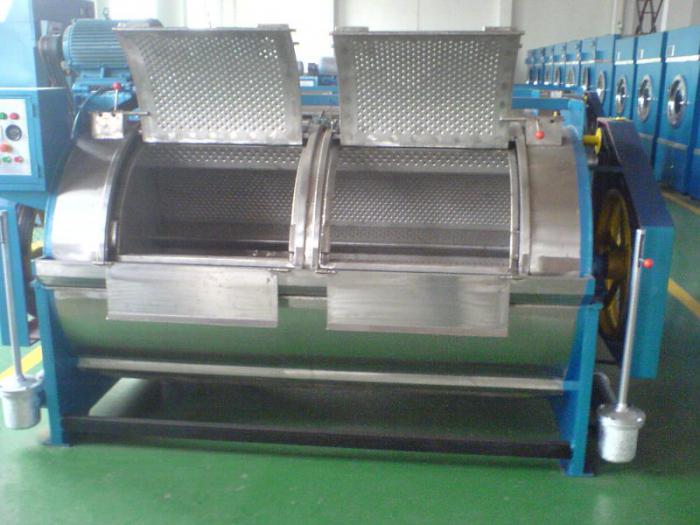
Barrier-free washing machines are similar in design to household washing machines, as their drum is a single, undivided container. Sprung washing machines differ from static washing machines in that they have built-in spring-loaded centrifugal force compensators, meaning they can be installed anywhere, on any surface, without restrictions. Static washing machines, however, lack springs, so they vibrate more intensely when the drum rotates, requiring installation on a special vibration-damping surface.
Different models of industrial machines offer different functionality. Some are designed solely for washing, requiring the laundry to be removed and sent to a centrifuge for spinning, followed by a tumble dryer. Others can wash and spin but not dry, while others can do it all: wash, spin, and dry.
Please note! Washer-dryers are convenient due to their versatility, but they are not energy-efficient. Most of these machines require connection to commercial electrical systems.
Typically, industrial machines with a load capacity of 150, 200 kg or more have slow-rotating drums, up to approximately 500 rpm. These machines can only wash clothes, with spinning and drying performed by other equipment, although there are exceptions. In contrast, industrial machines with drum capacities of 10, 30, 35, and 50 kg are much more versatile and can wash, spin, and dry clothes fully automatically.
Modern industrial washing machines are equipped not only with familiar control units but also with fully functional onboard computers. This allows the units to be programmed to suit the entrepreneur's needs for more efficient operation. Industrial machines can also heat water using a heating element (a heating element), steam, or a variety of other heating methods. Machines with a combination of heating options are much more cost-effective than others.
Manufacturers overview
Let's start with rating of manufacturersIt's worth noting that different experts have different approaches to compiling ratings, making it difficult to reach a consensus. However, we have managed to create a consolidated rating that more or less reflects the true picture.
- Three companies producing industrial washing machines took first place in our ranking: Electrolux, Miele, and Akira Industrial. They produce the highest quality equipment in the world, and also provide a very long warranty (24 months).
- LG rightfully takes second place. While their machines are somewhat inferior in quality to those from Miele and Electrolux, their technology is far more advanced, opening up new opportunities for businesses.
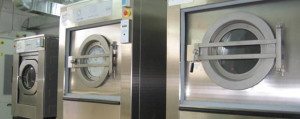
- Third place goes to domestic brands Vyazma and Prokhim. These companies produce high-quality and affordable industrial washing machines. In addition to their attractive price, these machines are highly energy-efficient and can be connected to various utilities.
- We awarded fourth place to the Spanish manufacturer Fagor. This company's industrial washing machines are compact, ergonomic, and equipped with computers, but their price often puts off business owners, which is unfortunate.
- Fifth place goes to the Italian manufacturer Candy. Their equipment doesn't boast any "supernatural" characteristics, but they provide very high-quality service for their equipment and have a very flexible pricing policy.
Please note! Italian appliances break down quite frequently, which is probably why manufacturers try to compensate for this shortcoming with inexpensive components and high-quality service.
Model review: which machine is better?
Now that we've covered the manufacturers, our task is to review the best professional washing machine models. We'll use the same approach as with the manufacturers and highlight several of the best models, according to the majority of experts.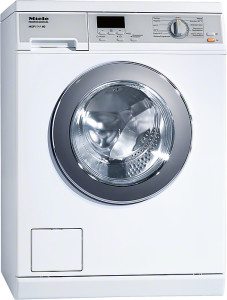
Miele PW6321. One of the world's best professional washing machines, featuring computer control and an enormous service life. It has a maximum drum load of 30 kg, 1000 rpm, and electric heating. This is, without exaggeration, the best German technology, with impressive functionality and reliability. The price is also impressive. The average price of this model in the CIS is $30,000.
LG WD-1069BD3S. This professional washing machine has rightfully been ranked among the best by experts. It's an ideal choice for small businesses like self-service laundromats. This machine has a drum capacity of up to 10 kg, is highly reliable, and has intuitive controls that are not much different from those of household washing machines. The price is also quite attractive—on average, $1,400.
Vyazma VO6001. An excellent professional machine for a large laundromat or hotel. This machine is truly capable of washing laundry on an industrial scale, as its drum has a real load capacity of up to 60 kg. The machine's reliability and performance are unparalleled, coupled with affordable spare parts and competent service, and you have the best equipment for serious business. Average price: $20,000.
Fagor LR-11ME. A practically ideal machine for any small laundry room. This model has a maximum drum load of just 10 kg, but it features an extremely reliable inverter motor with a colossal lifespan. Some experts jokingly call these motors "indestructible," and that's not far from the truth. The machine is equipped with a powerful programmable microprocessor, and its drum spins at 820 rpm. Price: $4,000.
Please note! Our review shows the average retail price per unit of equipment. When purchasing wholesale for business, the price may vary significantly.
What should you pay attention to when choosing such a machine?
Now it's time to prioritize your industrial washing machine selection. What should you focus on first to ultimately purchase the best equipment for your business?
- Nature of the business. The features of a future professional washing machine will depend on the industry for which it is being purchased. For example, if the machine is needed for a large laundry, then it might be worth considering universal models with a drum load of at least 30-35 kg. If it's a hair salon, then perhaps a model with a load capacity of up to 10 kg that can be plugged into a household power outlet would be appropriate.
- Load capacity. Estimate the expected load on the machine. Machines with a longer lifespan and a minimum load capacity of 30-35 kg will cost significantly more. Why overpay for a more powerful machine if you don't need it?
- What kind of laundry will you be washing? When choosing a washing machine, consider what items will be washed in it and what types of stains they will typically contain. For example, hospital bed linens are best washed in barrier machines, as they provide much better disinfection. Most models have a drum capacity of at least 35 kg.
- Utility connectivity. This is a crucial factor for small businesses, as it's not always possible to install the necessary utilities in rented premises. Therefore, it's important to select equipment models that are easy to install and commission.
- Reliability and price. These selection criteria can be considered decisive for any businessman, as they directly impact his depreciation costs. You need to try to choose equipment that represents an almost ideal balance between price and quality. We have already given examples of this technique.
In summary, it's important to note that industrial and domestic washing machines cannot be distinguished by their maximum drum load. An industrial machine can have a load capacity of 7, 10, 20, 30, 35, or more kg, yet it surpasses a domestic washing machine in many other respects. Choosing a professional machine is not easy; you need to weigh many factors, study model and manufacturer ratings, correlate this information with your business plan, and only then make a final decision.
Interesting:


Readers' comments
Headings
Washing machine repair




For buyers




For users


Dishwasher




Add a comment