
How to test the motor of an LG washing machine?
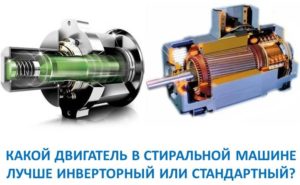
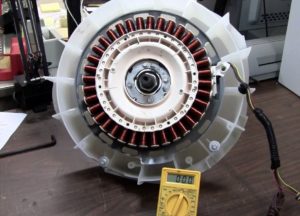 Washing machine motors come in two types: brushed and inverter. The latter significantly increases motor efficiency and allows for more precise control of its operation and required RPM. While checking an LG washing machine motor may seem straightforward, an inverter motor can be a bit more involved, especially if the problem is real.
How does such a motor work?
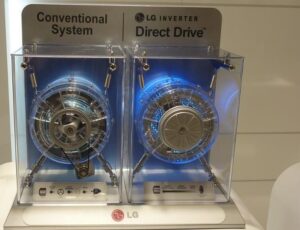
Incidentally, direct-drive washing machines (motors without brushes, pulleys, or belts) are currently only produced by LG and Samsung. So, to diagnose a motor, you need to thoroughly understand its design and operating principles. Otherwise, you risk making mistakes, practically blindly, due to a lack of understanding of your own actions.
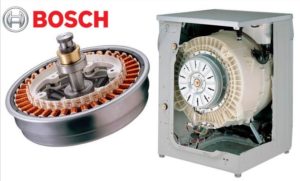
The LG washing machine electric motor consists of the following elements:
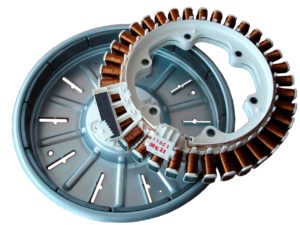
- The stator is the stationary part. It is assembled from 36 coils connected by star-shaped windings. The coils themselves are wound around cores. The entire structure is fused into a polymer fiber, which is attached directly to the bottom of the machine body.
- The rotor is the moving part, a steel bowl with 12 magnets located around its perimeter. The rotor itself is attached to the drum via a cylindrical plastic element and special spokes. The plastic protects the drum shaft from magnetization;
- Hall sensor. This device monitors the position of the moving part relative to the stator coils.
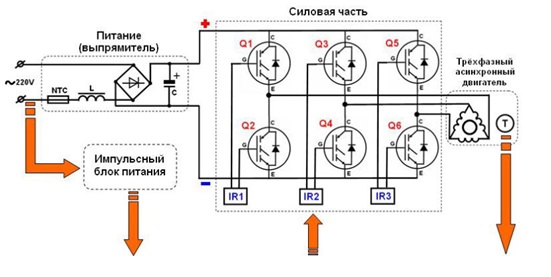
The entire operation of the electric motor is controlled by special power switches assembled with transistors. These switches open, close, or partially unlock, which influences the process. The function of the power keys is to change the direction of the current in the coils and the value of the magnetic flux inside. The keys themselves are controlled by the inverter using the method of pulsating switching the device on and off.
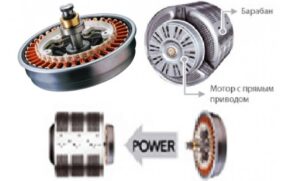
Important! This means the direct-drive motor is directly connected to the machine without the need for any additional devices like a drive belt or anything else.
Inspection progress
 Inspecting such a motor yourself is difficult, but LG washing machines rely on the automatic diagnostic system. If the motor is faulty, the display will show the corresponding error code, and the user will know for sure why the machine is not working. For a personal inspection of the motor, it's best to have it checked by a professional, but you can also do it yourself.
- Disconnect SM from all communications.
- Unscrew the bolts around the perimeter of the back cover and remove it.
- Remove the bolts holding the wiring under the rotor.
- Use a 16mm screwdriver and loosen the central screw holding the rotor in place. Be sure to hold the bowl steady to prevent it from spinning.
- Remove the rotor assembly and then the stator assembly by unscrewing the 6 bolts with a 10mm screwdriver.
- Remove the wiring attached to the stator.
Now you can take a multimeter and check the sensor, windings, and control circuit for short circuits. If anything is burned out, buy a new element and replace the old one.
Interesting:

5 reader comments
Add a comment
Headings
Washing machine repair




For buyers




For users


Dishwasher




You could have already written down the approximate resistance of the windings and the tachometer.
And still, thank you very much to everyone.
What does the hall have to do with the wiring of the engine itself?
How should the contacts on the stator ring? What are the winding resistances? Is this some kind of heightened secrecy?
The stator has three windings of 3.7 ohms each.
My resistance is 8.5 ohms