
Checking the interference filter on a washing machine
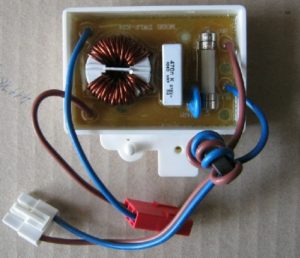 It's important to check the interference filter on your washing machine if you're having trouble turning it on. This capacitor, a semiconductor component installed on the power cord, supplies power to the machine. If the machine doesn't respond when plugged in, it's time to test the interference filter. Now it's time to figure out how to spot and fix the problem.
First, let's find the element
Most often, the machine does not turn on due to a burnt-out capacitor, but this can only be confirmed after checking the FPS. To diagnose the network filter, you need to remove it from the washing machine. Getting there is easy:
- disconnect the equipment from the power supply by removing the cord from the socket;
- we shut off the water supply to the machine;
- remove the top cover by unscrewing the corresponding bolts on the back panel;
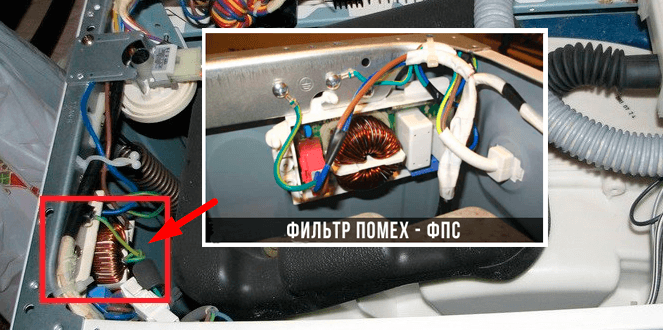
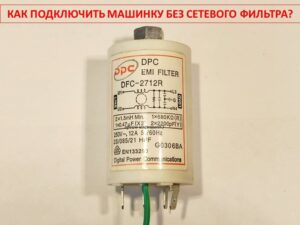
- We look under the cover and look for the interference filter (this is a small black or white round part located on the power cord).
The power filter is located under the top cover where the power cord enters.
To remove a capacitor, simply use a screwdriver to loosen the bolts holding it in place. However, visually detecting a faulty component isn't always possible—it's more reliable to check with a multimeter. We'll explain how to do this below.
Let's start testing
Filter diagnostics begin with a visual inspection of the component and its associated wires. In 98% of cases, signs of a fire are easy to spot: melted insulation, dark spots, a burning smell, and charred contacts. If the area around the filter is clean, it's time to proceed to testing.
It's easy to test a noise suppression filter yourself:
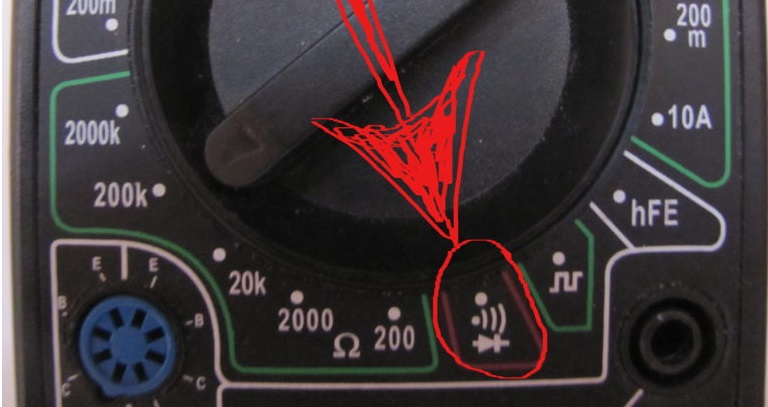
- take a multimeter and turn it on to the “Buzzer” mode;
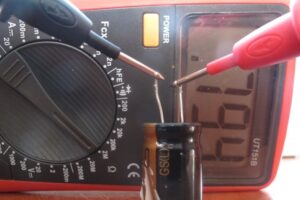
- we connect the device probes to the capacitor contacts;
- We evaluate the resistance at the input and output (if there is no voltage at the output, then the FPS has burned out).
The interference filter cannot be repaired – replacement only.
Replacing a burned-out filter with a new one is easy: just secure the "box" in place with a couple of bolts. The only difficulty arises in finding a replacement—it must be purchased separately. It's best not to try to search for a replacement part by the machine's serial number or wattage. It's much faster and more reliable to completely remove the old filter, bring it to the store, and ask them to select a similar capacitor. This way, the chance of error is close to zero.
After that, it's simple: replace the filter, secure it, replace the top cover, and connect the appliance to the power supply. Immediately assess the results and turn on the washing machine. If the control panel lights up without any problems, you've done everything correctly.
How does the element function?
Checking and replacing a noise filter is easy, but it's best to prevent it from breaking. Without fixing the problem, the new capacitor will burn out almost immediately, requiring further repairs. The best preventative measure is understanding how the FPS works and assessing the risks and likelihood of recurrence.
The filter burns out due to power surges. The fact is, no electrical grid is perfect, and in Russia and the CIS, power surges are very common. Every year, tens of thousands of electrical appliances and household equipment burn out, and washing machines are no exception. The situation with washing machines is complicated by the sensitive electronic modules that irreparably fail even with the slightest glitch.
The FPS burns out due to power surges in the electrical network.
The noise suppression filter was designed to eliminate current surges. Its purpose is to smooth out voltage spikes, absorbing the brunt of them. While the FPS can handle minor surges, it can't handle major outages. When there is a sharp rise or fall, the FPS cannot withstand it and burns out, urgently shutting down the system.
The capacitor can't be repaired—it can only be replaced with a functioning one. However, installing a new power supply won't solve the problem. If your power grid frequently experiences voltage fluctuations, consider installing a powerful stabilizer.
Interesting:


Readers' comments
Headings
Washing machine repair




For buyers




For users


Dishwasher




Add a comment