
Checking the washing machine programmer
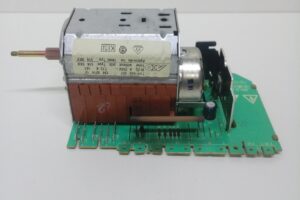
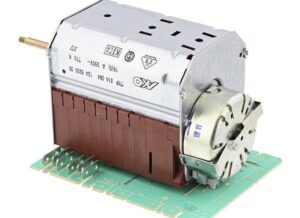 Some washing machines have mechanical rather than electronic controls. These machines are equipped with a programmer—a device consisting of a timer, a control board, and numerous contacts. This mechanism is reliable but complex: determining the cause of a malfunction without disassembling and troubleshooting is impossible. We suggest exploring the inside of the control unit and how to test a washing machine's programmer. A detailed overview of the device with step-by-step instructions is below.
Basic elements of the control apparatus
In manual washing machines, the programmer is a key component of the control unit. It contains numerous parts, each of which can become dirty or break over time. To repair the control apparatus, it will be necessary to check all the structural elements and, if necessary, patch them or replace them.
Before testing and repairing the programmer, it's necessary to examine its internal structure. A standard command unit consists of:
- synchromotor;
- gearbox;
- contacts;
- motor;
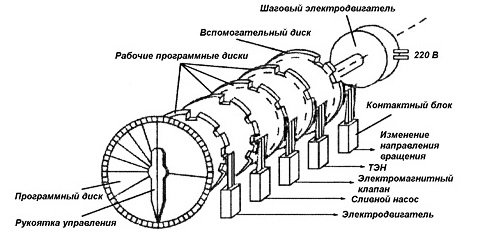
- gears and pinions;
- cams (grooves, recesses and projections).
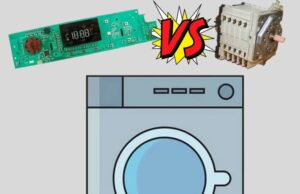
Control units on washing machines can be hybrid or electronic.
The operating principle of a programmer also depends on its type. Hybrid devices are more reliable and easier to use, but have limited functionality. Electronic controllers, on the other hand, are more convenient to use due to their fine-tuning and numerous additional options. However, electronic controllers are more prone to failure due to their sensitivity to power surges.
How does a control apparatus failure manifest itself?
It's almost impossible to miss a faulty programmer: the malfunction manifests itself with a number of telltale signs. Typically, the machine freezes, failing to respond to user commands, or fails to turn on at all. In the latter case, ensure there are no issues with the power cord or outlet. If the external electrical connections are clean, then the washing machine's control unit is faulty.
The following “symptoms” also indicate problems with the control apparatus: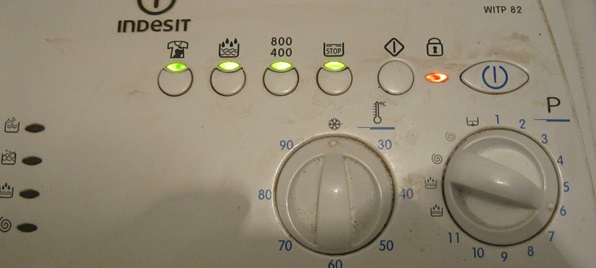
- the running program freezes;
- the set cycle time differs from the value specified in the mode;
- The LEDs on the dashboard are blinking randomly.
The programmer most often breaks down due to careless operation and sudden voltage fluctuations in the network.
Despite its robust design, the control unit can still fail after 10 years. According to service center statistics, the device most often breaks due to careless handling. It is enough to accidentally move the selector handle while the washing machine is on, for the board to become dislodged and “fly”. The programmer also displays an error after sudden power surges. A third possible cause of machine failure is moisture or dirt getting inside the control unit. A manufacturing defect in the components cannot be ruled out either.
Disassembling and checking the part
To thoroughly test a programmer, it must first be properly disassembled and disassembled. This latter step can often be challenging, as many controllers have non-standard instructions—there are dozens of different versions. However, a general principle and sequence for disassembling the component can be outlined.
Let's look at the procedure for disassembling and repairing the programmer from an Ariston washing machine. The algorithm is as follows:
- inspect the programmer and find the latches on the sides that secure the plastic cover;
- pry up the latches with a flat-head screwdriver and move them;
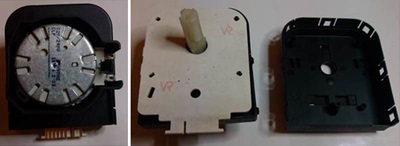
- slowly remove the top cover from the body;
- assemble the springs located under the housing;
There are several compressed springs under the programmer cover that may fly out when the case is opened – don’t lose them!
- find the control board, carefully remove it and put it aside;
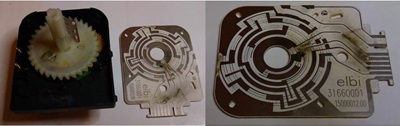
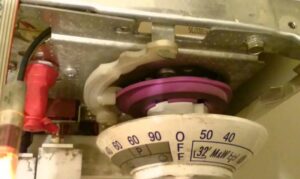
- unhook the central gear and inspect the remaining gears for contamination (any clogged debris must be removed);
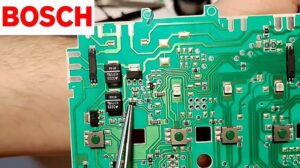
- carefully inspect the board (burnt elements and tracks are re-soldered);
- Use a multimeter to measure the resistance on the contacts (if any deviations from the norm are detected, then the programmer is faulty and will have to be completely replaced);
- remove all gears;
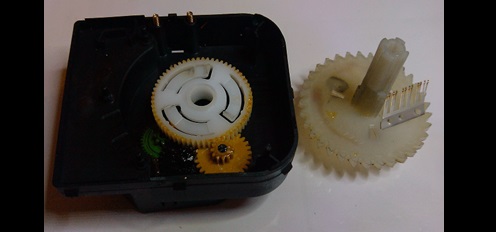
- remove the motor core;
- check each element for integrity and serviceability;
- disassemble and test the engine (be sure to inspect the winding on the motor; if it is burnt, wind a new one onto the rod);
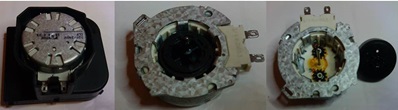
- treat the contacts with alcohol;
- Assemble the control unit by following the instructions in reverse order.
But disassembling and repairing the control unit isn't always so easy. For example, testing the electromechanics of German washing machines, such as Miele or Siemens, at home is strongly discouraged. The problem lies in the complex design, or more precisely, in the presence of several plates compressed in pairs under the casing. When the "box" is opened, the flaps fly apart, irreparably damaging the plastic holders that hold them in place. As a result, reassembling the unit is extremely difficult—the fasteners must be repaired. It's better not to take risks and entrust the diagnostics of German programmers to service professionals.
It is not recommended to check or repair programmers for Miele, Gorenie, or Siemens washing machines yourself—it is cheaper and easier to contact a service center.
Home repairs are also not suitable for Gorenie electromechanical circuit breakers. This manufacturer's programmers use soldered-in control boards. Testing such modules requires desoldering and resoldering numerous components and tracks. The difficulty lies in the need to use a special thin-tip soldering iron, not a standard "thick" one. Incidentally, not all professional technicians possess this skill. It's best to avoid wasting time and effort, avoid disassembling the control unit, and simply replace it with a new one.
It's important to understand that attempting to repair a controller yourself is risky. Some devices have a simple design and can be easily disassembled and reassembled at home. Other programmers are so complex that one careless move will result in irreparable damage. It's best not to experiment with these latter devices; instead, contact a service center immediately.
Interesting:

Readers' comments
Headings
Washing machine repair




For buyers




For users


Dishwasher




Add a comment