
How to check a washing machine lock
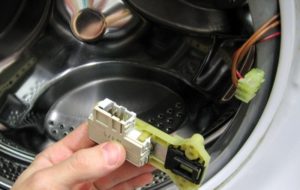 A washing machine's door lock is far from the most complex device used in it, but it can still cause your "home helper" to stall. A door lock is nothing more than a door lock, designed to lock the door during the wash, rinse, and spin cycles. The lock operates automatically, and if it breaks, it blocks the door or refuses to close it at all. In this article, we'll explain how to test your washing machine's door lock using various methods to determine whether the door lock is broken or something else.
Lock designs
Before deciding how to check the door lock on an automatic washing machine, you need to have at least a rough idea of how such a lock works, and what kind of locks are generally used to lock the door of your "home helper" during washing. Over the past 30 years, automatic washing machines produced by various manufacturers have used only two types of locks to lock the door: bimetallic and electromagnetic.
Electromagnetic locks have proven unreliable and ineffective, as they can only securely hold the door when power is available. Therefore, modern washing machines are equipped with bimetallic locking devices. Why is this type of locking device more popular, and how does it work?
It's quite simple. The operating principle of a washing machine's locking system with a bimetallic plate is based on the interaction of three main components:
- thermoelement;
- bimetallic plate;
- retainer.
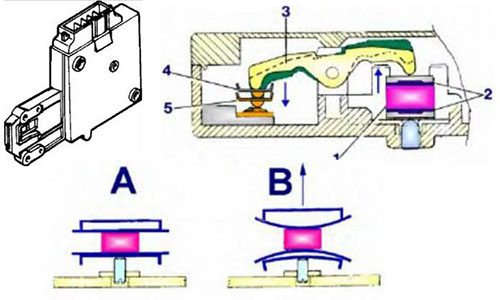
When the washing machine's control module commands the door lock, voltage is applied to the heating element, which heats up within seconds, in turn warming the bimetallic plate. The thin, long plate expands from the heat, becoming even longer. This causes pressure on the latch, which immediately engages and closes the lock, securely locking the door. As long as voltage is applied, the plate will remain hot, and the door will remain locked.
If the contact of the UBL heating element breaks, this heating element will stop heating, the plate will remain cold and the latch will not work – the hatch will remain open.
If the UBL is working properly, then when the power is turned off, the heating element will stop heating, the plate will cool down, decrease in size and pull the latch, unlocking the hatch. If the door lock is faulty or the corresponding control module triac is faulty, power will flow continuously to the lock, and it will remain closed until you unplug the washing machine. That's how this device works; now let's talk about testing it.
We check with a tester
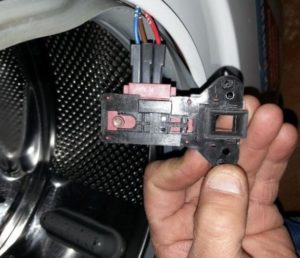
The operation of the lock can be more or less reliably checked with a tester. It's best to use a working electronic multimeter with a wide range. Before testing the door lock of an automatic washing machine with a multimeter, you'll have to remove it. We won't cover how to remove it again. hatch locking deviceIf you need this information, please read the relevant publication on our website.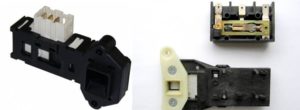
After removing the hatch lock, you need to look at its diagram. Many companies produce hatch locks with bimetallic plates, and each arranges the contacts differently. We need to know in advance which contact is responsible for what—in other words, which is the live, neutral, and common. You can find such a diagram online. Without a diagram, we will not be able to carry out a high-quality test of the hatch lock using a multimeter.
Once we know the purpose of each of the contacts of a specific washing machine lock, all that remains is to carry out the test.
- We switch the device switch to the resistance test mode.
- We install one probe on the neutral contact of the lock, and the other on the phase contact.
- If the device shows a three-digit number, everything is normal.
- We install the probes on two contacts of the lock: neutral and common.
- If the device shows zero or one, the washing machine lock is faulty.
If the lock's electrical system is working properly, but it still doesn't work, it doesn't necessarily mean the problem lies elsewhere. You should also check the mechanics of the device, in case there's a manufacturing defect.
Diagnosis by external signs
In some cases, it's possible to determine with a low degree of certainty that a washing machine's locking system is faulty even without disassembling the appliance. You can diagnose the problem based on the washing machine's behavior, provided you're familiar with its design and understand how all its modules operate. How might a washing machine behave if the locking system is faulty?
- The UBL mechanics are definitely faulty in the following case: if the washing machine door remains locked even several hours after the power to the “home helper” has been cut off.
- If you start a washing program and an error code appears on the machine display, indicating a malfunction of the door locking system.
- You're trying to start a wash cycle, but the door lock won't lock. In this case, there are two possibilities: either the lock or the control module. Replacing the door lock with a new one or testing the old one with a multimeter, as described above, will help determine the exact cause.
There are other ways to check the lock, but they require access to equipment that is not available at home, so it is not worth discussing.
To summarize, checking the door lock on a washing machine isn't as easy as it might seem at first glance. However, with basic multimeter skills and the appropriate door lock diagram, the task is quite manageable. Good luck!
Interesting:

5 reader comments
Add a comment
Headings
Washing machine repair




For buyers




For users


Dishwasher




Good day, I want to say a huge thank you. Your article helped me solve the problem with my Atlant washing machine and save the $20 the repairman asked for!
Thanks! The machine at the hostel is old. We were allowed to use it, but as luck would have it, it broke. I fixed everything. The heating element went bad. I shorted the outer wire to the central one and everything is fine.
I connected the multimeter. In the first case, the number is four-digit, not three-digit. In the second case, the article doesn't even say what it should be (if it says 1 or 0, it's not working). Where are the specifics?
I agree with Andrey. N + L is a three-digit number, N + C is 1, that's what it shows. In the first case, it's fine, in the second, it's broken. So which should we take as the truth?
Ha-ha-ha! My reason isn't worth a damn. I took the door lock apart and put it back together, and everything worked.