
How much water does a Bosch dishwasher use?
 The most important thing any dishwasher offers us is saving time and effort. But that's not all: even a Bosch dishwasher uses significantly less water than washing dishes by hand. This is especially important in the current situation, when utility rates are rising twice a year. Let's take a closer look at water consumption and other dishwasher parameters that can help you save money.
What is the fluid consumption and what does it depend on?
To understand how much water your dishwasher uses, you need to know its capacity. The type of appliance has the greatest impact on consumption.
- Slimline and full-size mid-range dishwashers are designed for cleaning up to 9 and 14 place settings, respectively. On average, these "home helpers" use approximately 9-14 liters of water per cycle. Since dishwashers are most often connected to a cold water supply, this helps them use resources even more efficiently. Therefore, to clean 9 place settings, the dishwasher requires only 9 liters of water on average—an incredibly economical result.
During the entire cycle, water goes through several stages: first, it is collected and purified through a special filter, then it is used for washing, then it rinses the dishes, and at the very end of the cycle, it rinses the utensils again before being sent to the drain.
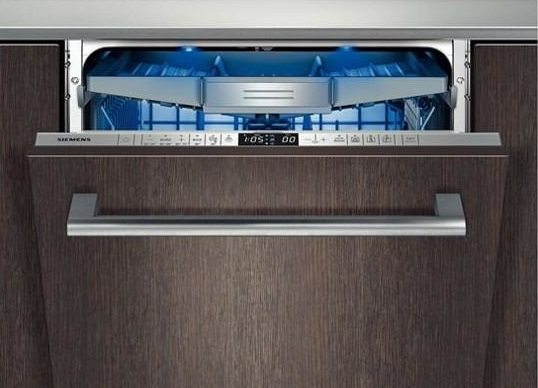
- Energy-efficient dishwashers use just 7 liters of water per wash or even less. These are either compact dishwashers or premium appliances. Therefore, low water consumption doesn't necessarily mean a small capacity. For example, the Siemens SN 236100 ME uses just 6.5 liters of water, but can wash 13 place settings in one go, and it boasts a high energy efficiency rating of A++. Energy-efficient dishwashers often require 40% less water than conventional dishwashers.
While inexpensive washing machines can also be considered economical, they pay for this with a small capacity—only 6-8 place settings. They use approximately 6.5-9 liters of water per wash, which is slightly lower than or equal to that of larger machines, but negatively impacts the efficiency of the wash cycle.
How is the efficiency of a dishwasher determined?
Let's move on to the overall efficiency of dishwashers. Water consumption levels divide household appliances into three classes:
- highly economical;
- medium-efficiency;
- uneconomical.
For user convenience, they are all marked with a separate letter, from "A" to "G." Bosch equipment is manufactured exclusively with high efficiency ratings, from "A" to "C." Equipment with worse efficiencyC" is now practically not produced or imported, so it is almost impossible to come across such low-quality equipment.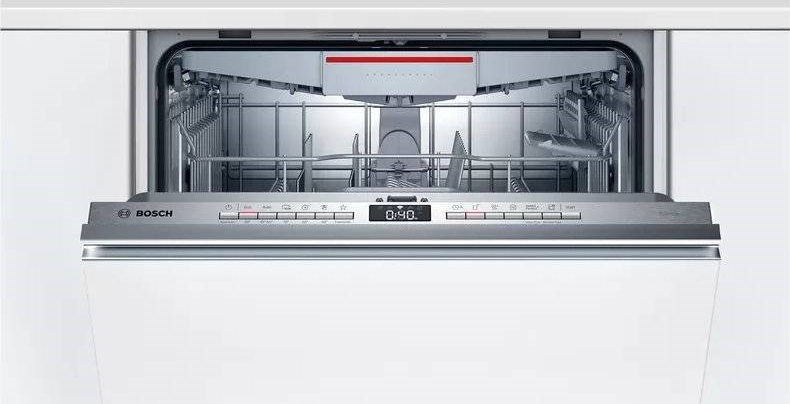
There's no single standard for how much water and electricity a dishwasher requires. Consumption depends on two factors:
- equipment features;
- availability of additional functions.
There's also a separate classification based on capacity. According to this classification, equipment is also divided into just three classes.
- Household, which can be either narrow or full-size, consuming 9-14 liters of water per working cycle.
- Compact ones that consume 6.5-10 liters.
- Professional, usually installed in restaurants, cafes and other high-traffic food service establishments, capable of using 20-25 liters of water at a time.
The figures may vary depending on the model, as some machines have a half-load mode, which helps reduce liquid consumption by approximately 30%.
We also note the intelligent water estimation feature, which is typically found in expensive household appliances. This feature allows the equipment to estimate the required amount of water for the dishes loaded into the wash chamber.
How much water is used when washing dishes by hand?
Typically, hand-washing the amount of dishes a dishwasher can handle at one time requires about 70-100 liters of water. It's important to keep in mind that hand-washing uses not only cold but also hot water, which requires resources to heat. Thus, a dishwasher with a consumption rate of 7-14 liters can wash the same amount of dishes using 10 times less water. Let's make an approximate calculation with maximum data for a dishwasher and minimum data for manual work.
- PMM. 14 liters of water per day x 365 days per year = 5110 liters of cold water.
- Hand wash. 70 liters of water per day x 365 days a year, 25,550 liters of hot and cold water.
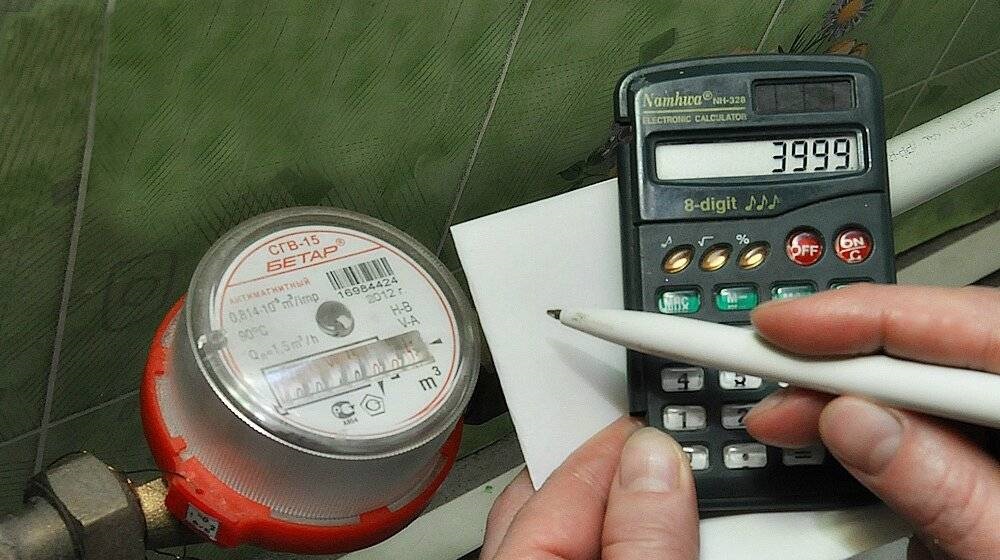
The price per cubic meter of water varies by region, so let's take $0.50 per cubic meter of cold water and $1 per cubic meter of hot water as an average. It's logical that the average user will use slightly more hot water for washing dishes, so for a rough estimate, let's divide 25,550 liters of water by 12,000 liters of cold water and 13,550 liters of hot water.
- PMM. 5.11 x $0.50 = $2,555.
- Hand wash. 12 x $0.50 + 13.55 x $1 = $19.55.
Therefore, if you take into account only water consumption, then with a dishwasher it will be almost 8 times more economical than without it.
Dishwasher energy consumption
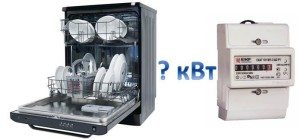
But water consumption isn't the only thing a dishwasher uses. It's also important to consider the electricity it uses to run the appliance. The water heating element, circulation pump and pump consume the most electricity. The element for drying dishes is also considered to be very energy-intensive.
Drying costs may be negligible if the dishwasher model doesn't have a drying function. Some machines have convection drying and no second heating element or fan—these machines use up to 40% less energy. It's also important to consider the capacity of the water tank, which stores water during operation. The smaller the tank, the less water needs to be heated, and the less energy required for this process.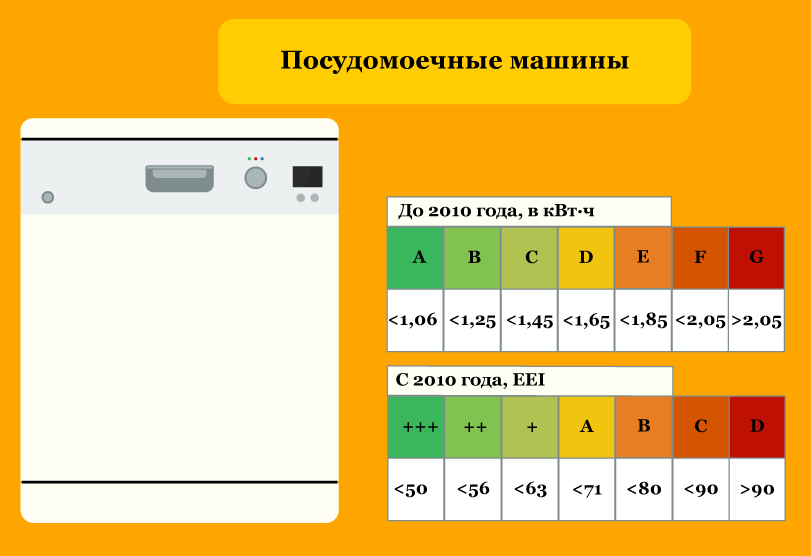
Before purchasing, be sure to check the dishwasher's energy efficiency. This process is now much easier, as you can look at the energy efficiency class, expressed as a single letter:
- A – 0.71 kW or less.
- B – less than 0.8 kW.
- C – less than 0.9 kW.
- D, E – more than 0.9 kW.
- F, G – 2-2.7 kW.
Models with a class "D" or lower are very rare these days. However, it's very easy to find models with a class "A++" or better—meaning the appliance consumes even less than 0.6 kW.
Interesting:

Readers' comments
Headings
Washing machine repair




For buyers




For users


Dishwasher




Add a comment